Reference: Our Choice–Changing the Game

About the Idea, Collaboration Zones, Communities of Practice, Ethics, IO Sense-Making, Officers Call, Policies, Real Time, Threats, Topics (All Other)

Today, with permission, I present Tom Atlee's newest vision, “Are We Ready to Change the Game Yet?,” and at the end, a link to his 2000 audio interview with Jim Rough, pioneer of Citizen Wisdom Councils and author of Society's Breakthrough.

ARE WE READY TO CHANGE THE GAME YET?

by Tom Atlee

2010-11-15-atlee.jpg

Some people say Gandhi was about nonviolence. And he was.

But he is significant for something else that I believe is far more important:

He changed the game.

With no one's permission, he reconfigured the playing field of colonialism to a higher Game in which everything the British did in their smaller, narrower game backfired on them. Prisons, guns, threats and bureaucracies of control not only ceased to work like they used to, but actually generated more power for Gandhi's world-changing Game.

Gandhi's Game involved, in his words, “experiments in Truth” — a search for Truth, a bigger Truth, a common inclusive Truth, a win-win Truth in every situation. The British — and even many of Gandhi's compatriots — were not aligned to that Truth. They wanted victory, control, and righteousness. These things trapped them in their smaller game until, one by one, and sometimes wholesale, Gandhi's commitment to Truth won their hearts and minds — and Shift happened.

Unfortunately he failed to create adequate social institutions that embodied, sustained, and empowered the Search for Truth by the whole of society. He depended on individuals seeing the light and being transformed. The miracle of his work is that so many people did transform — and continue to transform even to this day — inspired by his words, his life, his work. But in the end, what he left was an inspiring possibility, not an India or a world that was united, peaceful, just and sustainable.

Today's world calls us, with increasing intensity, not just to carry on Gandhi's work, but to carry it further. It isn't a matter of doing nonviolence as he and Martin Luther King, Jr., did it. It is a matter of changing the game.

Which brings me to the current state of U.S. politics and governance. These games are desperately in need of changing. Several recent innovations offer us the possibility to actually accomplish that and the timing is ripe.

Continue reading “Reference: Our Choice–Changing the Game”

Journal: US Keeps Spending in AF

07 Other Atrocities, 11 Society, Budgets & Funding, Cultural Intelligence, Government, Military, Officers Call, Power Behind-the-Scenes/Special Interests

Tom EngelhardtTom Engelhardt
Editor of TomDispatch.com

Posted: November 15, 2010 03:23 PM

The Stimulus Package in Kabul (I Was Delusional — I Thought One Monster ‘Embassy' Was the End of It)

You must have had a moment when you thought to yourself: It really isn’t going to end, is it?  Not ever.  Rationally, you know perfectly well that whatever your “it” might be will indeed end, because everything does, but your gut tells you something different.

Read rest of long, deep, important articulation….

Phi Beta Iota: Please take the time to link to the entire article at Huffington Post.  Tom Englehardt has produced one of the most gripping, detailed, insightful, and provactive snapshots of how three monstrous billion dollar “embassies” in Baghdad, Kabul, and now Islamabad, are the last clarion of the Empire.  His piece is a “must read,” both an epitaph on the Empire, and sadly, a preface to the next 20 years of death and debt as we wind down all that has been set in motion.

Reference: Earth System Science for Global Sustainability–Grand Challenges

Analysis, Augmented Reality, Budgets & Funding, Communities of Practice, Earth Intelligence, Ethics, Geospatial, History, info-graphics/data-visualization, InfoOps (IO), Intelligence (government), International Aid, IO Sense-Making, Key Players, Maps, Methods & Process, microfinancing, Mobile, Open Government, Policies, Politics of Science & Science of Politics, Power Behind-the-Scenes/Special Interests, Real Time, Secrecy & Politics of Secrecy, Standards, Strategy, Technologies, Threats, Tools, Waste (materials, food, etc)
Main Document (24 Page PDF)

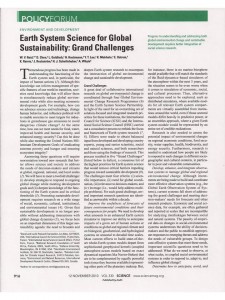
The International Council for Science (ICSU) is spearheading a consultative Visioning Process, in cooperation with the International Social Science Council (ISSC), to explore options and propose implementation steps for a holistic strategy on Earth system research. Five Grand Challenges were identified during step 1 of the process. If addressed in the next decade, these Grand Challenges will deliver knowledge to enable sustainable development, poverty eradication, and environmental protection in the face of global change.

The details of the Grand Challenges are contained in the document ‘Earth System Science for Global Sustainability: The Grand Challenges’, representing input from many individuals and institutions.

Science Article (2 Page PDF)

INTERNATIONAL COUNCIL FOR SCIENCE – PRESS RELEASE

Thursday 11 November 2010

Scientific Grand Challenges identified to address global sustainability

Paris, France—The international scientific community has identified five Grand Challenges that, if addressed in the next decade, will deliver knowledge to enable sustainable development, poverty eradication, and environmental protection in the face of global change. The Grand Challenges for Earth system science, published today, are the result of broad consultation as part of a visioning process spearheaded by the International Council for Science (ICSU) in cooperation with the International Social Science Council (ISSC).

The consultation highlighted the need for research that integrates our understanding of the functioning of the Earth system—and its critical thresholds—with global environmental change and socio-economic development.

The five Grand Challenges are:

  1. Forecasting—Improve the usefulness of forecasts of future environmental conditions and their consequences for people.
  2. Observing—Develop, enhance and integrate the observation systems needed to manage global and regional environmental change.
  3. Confining—Determine how to anticipate, recognize, avoid and manage disruptive global environmental change.
  4. Responding—Determine what institutional, economic and behavioural changes can enable effective steps toward global sustainability.
  5. Innovating—Encourage innovation (coupled with sound mechanisms for evaluation) in developing technological, policy and social responses to achieve global sustainability.

Continue reading “Reference: Earth System Science for Global Sustainability–Grand Challenges”

Journal: Arrogance, Rankism, & Incapacity

Corruption, Cultural Intelligence, IO Sense-Making, Officers Call, Power Behind-the-Scenes/Special Interests

Seth Godin Home

Arrogance is a bug in signal processing

We care a lot about finding people who are brilliant, who get things done, who make a difference. We care a lot about finding a playwright with talent, a surgeon who can cure us, a programmer who can get the thing to work.

Along the way, many of the linchpins who are able to do work like this develop affectations, quirks and even obnoxious qualities. They might demand an over-equipped dressing room or a private jet or merely be a jerk in meetings (or show up late, which is almost as bad).

We often put up with this, because, after all, they're superstars, right?

Somewhere along the way, we confused the signals with the work. Now there are people who start with the bad behavior and the affectations, hoping that it will be seen as a sign of insight and talent. And they often get away with it. “Who's that?” we wonder… “I don't know, but they must be good at what they do, because why else would we put up with them?” It's a great plan when it works, but I don't think it's a strategy to be counted on.

The key to getting a reputation for being brilliant is actually being brilliant, not just acting like you are.

Phi Beta Iota: The literature on organizational pathologies also refers to this as “rankism,” an affliction suffered by most who rise to the top ranks and allow themselves to be cut off from reality.  Daniel Elsberg's quote from Secrets: A Memoir of Vietnam and the Pentagon Papers, is still the best:

The danger is, you’ll become like a moron. You’ll become incapable of learning from most people in the world, no matter how much experience they have in their particular areas that may be much greater than yours” [because of your blind faith in the value of your narrow and often incorrect secret information].

Journal: The Future of the Internet

03 Economy, Analysis, Audio, Augmented Reality, Collective Intelligence, Collective Intelligence, Commercial Intelligence, Computer/online security, info-graphics/data-visualization, InfoOps (IO), IO Technologies, Journalism/Free-Press/Censorship, Maps, Methods & Process, Mobile, Open Government, Real Time, Standards, Strategy, Technologies, Tools
Jon Lebkowsky Home

Tim Wu and the future of the Internet

Tim Wu explains the rise and fall of information monopolies in a conversation with New York Times blogger Nick Bilton. Author of The Master Switch: The Rise and Fall of Information Empires (Borzoi Books), Wu is known for the concept of “net neutrality.” He’s been thinking about this stuff for several years, and has as much clarity as anyone (which is still not much) about the future of the Internet.



I think the natural tendency would be for the system to move toward a monopoly control, but everything that’s natural isn’t necessarily inevitable. For years everyone thought that every republic would eventually turn into a dictatorship. So I think if people want to, we can maintain a greater openness, but it’s unclear if Americans really want that…. The question is whether there is something about the Internet that is fundamentally different, or about these times that is intrinsically more dynamic, that we don’t repeat the past. I know the Internet was designed to resist integration, designed to resist centralized control, and that design defeated firms like AOL and Time Warner. But firms today, like Apple, make it unclear if the Internet is something lasting or just another cycle.

Reference: Changing the Game II

11 Society, Collective Intelligence

Tom Atlee

Speaking of Tom's work … This morning I stumbled across a podcast, which includes the audio from a TV interview I did with Tom in the year 2000. The podcast is from Jarrett Sanchez' NEXT STEP, a podcast partially inspired by Tom's work. Tom was at least fifteen years ahead of the times in 2000 so his perspective is becoming more commonsensical today.

Jim (Rough), author of Society's Breakthrough

Phi Beta Iota: The audio tape is 30 minutes long.  Tom Atlee is in many ways “ground zero” for deliberative democracy, a hub to whom all of the “modalities” from Open Space Technology to Collective Intelligence to Conscious Evolution to Appreciative Inquiry to Participatory Budgeting to Citizen Wisdom Councils to World Cafe all connect.

See Also:

Reference: Changing the Game

Journal: Cyber-Heist 2nd Generation

03 Economy, 04 Education, 10 Security, Civil Society, Collective Intelligence, Computer/online security, Cultural Intelligence, Cyberscams, malware, spam, InfoOps (IO), IO Mapping, Law Enforcement, Mobile, Standards
Marcus Aurelius Recommends

The Great Cyber-Heist

New York Times

By JAMES VERINI

November 10, 2010

Full Story Online

Mid-1990s: Gonzalez, 14, is visited by F.B.I. agents at his high school for hacking into NASA.

Gonzalez,  law-enforcement officials would discover, was more than just a casher. He was a moderator and rising star on Shadowcrew.com, an archetypal criminal cyberbazaar that sprang up during the Internet-commerce boom in the early 2000s. Its users trafficked in databases of stolen card accounts and devices like magnetic strip-encoders and card-embossers; they posted tips on vulnerable banks and stores and effective e-mail scams. Created by a part-time student in Arizona and a former mortgage broker in New Jersey, Shadowcrew had hundreds of members across the United States, Europe and Asia. It was, as one federal prosecutor put it to me, “an eBay, Monster.com and MySpace for cybercrime.”

Read rest of article….

Phi Beta Iota: We opened Hackers on Planet Earth (HOPE) in 1994, making the observation that when the Israeli's captured a hacker they gave him a job, while the US simply kicked them in the teeth and sent them to jail.  We tried to keep Phiber Optic out of jail, and we have for decades been on record comparing hackers to astronauts–full of the right stuff and pushing the edge of the envelope.  No one, including Marty Harris then in charge of the National Information Infrastructure (NII) wanted to listen.  Today the US Government is again ignoring the warnings on the urgency of getting a grip on all information in all languages all the time, and roughly 20 years behind in creating “root” cyber-security.  This article by James Verini is a phenomenal update on what we all knew in the mid-1990's that the US Government is still oblivious to–this is not a problem technology or wanton spending can solve–this is a problem that demands discipline, integrity, intelligence, and sharing.  It is neither possible nor desireable to secure government or military computers in isolation–this is an “all in” smart safe nation challenge.

See Also:

1994 Sounding the Alarm on Cyber-Security

Search: smart nation intelligence reform electoral reform national security reform

Continue reading “Journal: Cyber-Heist 2nd Generation”