
Howard Rheingold: 30 Sep to 11 Nov Online & Live Course on Literacy of Cooperation

04 Education, 11 Society, Academia, Advanced Cyber/IO, Blog Wisdom, Civil Society, Collective Intelligence, Cultural Intelligence, Earth Intelligence, Ethics, Gift Intelligence, Hacking, InfoOps (IO), Methods & Process, Non-Governmental, Offbeat Fun, Peace Intelligence
Howard Rheingold

Announcing a new Rheingold U course: Toward a New Literacy of Cooperation

For the past ten years, I've worked with Institute for the Future to track the emergence of a new story about how humans get things done together. The old story of survival of the fittest, competition, rational self-interest is changing as new knowledge comes to light about cooperative arrangements and complex interdependencies in cells, ecosystems, economies, and humans. In 2005, I delivered a TED talk about this subject; the video has been viewed more than 182,000 times. In the same year, I co-taught a seminar at Stanford with Andrea Saveri of Institute for the Future, “Toward a Literacy of Cooperation.” This six week Rheingold U course builds on the texts, videos, and other materials developed over the past ten years. Under my direction, co-learners will inquire, collaborate, discuss, co-construct knowledge about the building blocks and conceptual frames of a new literacy of cooperation. The course will run September 30 – November 11
The syllabus
The schedule of live meetings

Continue reading “Howard Rheingold: 30 Sep to 11 Nov Online & Live Course on Literacy of Cooperation”

Patrick Meier: Crowdsourcing Satellite Imagery Analysis II

Advanced Cyber/IO, Civil Society, Collective Intelligence, Hacking, Non-Governmental
Patrick Meier

Crowdsourcing Satellite Imagery Analysis for Somalia: Results of Trial Run

We’ve just completed our very first trial run of the Standby Task Volunteer Force (SBTF) Satellite Team. As mentioned in this blog post last week, the UN approached us a couple weeks ago to explore whether basic satellite imagery analysis for Somalia could be crowdsourced using a distributed mechanical turk approach. I had actually floated the idea in this blog post during the floods in Pakistan a year earlier. In any case, a colleague at Digital Globe (DG) read my post on Somalia and said: “Lets do it.”

Read full posting…

UN + Start-Up Seek to Get Poor Online with Cell Numbers

01 Poverty, 03 Economy, 04 Education, 06 Family, 07 Health, 09 Justice, 11 Society, Advanced Cyber/IO, Civil Society, Collective Intelligence, Ethics, Gift Intelligence, Hacking, Key Players, Mobile, Non-Governmental, Real Time

Startup Aims to Get the Poor Online With Phone Numbers

By Stephen Lawson, IDG News

U.K. startup Movirtu plans to help 3 million or more people in poor countries use mobile services by giving them personal phone numbers, not phones.

Working with a U.N.-affiliated initiative called Business Call to Action (BCtA), Movirtu will offer the numbers, which it calls mobile identities, through commercial carriers in developing countries in Africa and South Asia. People in those countries who typically borrow phones from others will be able to log into the carrier's network and use their own prepaid minutes and bits of data.

The service is called Cloud Phone, though it operates within a carrier's own infrastructure rather than on the Internet as a classic cloud service would. Having a personal mobile identity can save users money in two ways, according to Ramona Liberoff, executive vice president of marketing, strategy and planning at Movirtu. First, they can use mobile services without buying a phone, which is a luxury even at US$15 or $20 for people making $1 or $2 per day.

Second, the cost of prepaid service from a carrier typically is less than what consumers in those countries pay someone to borrow a phone, she said. Though it's customary in many of these countries to lend a phone to someone in need, the borrower is also expected to pay the lender for the usage. The average savings from using regular prepaid service instead is estimated at about $60 per year, Liberoff said.

The service will help people to use mobile banking, insurance and farming assistance services as well as make phone calls, Liberoff said. Some of these services currently can only be delivered to individuals and not to someone sharing a phone. Personal mobile identities could be a boon to NGOs (non-governmental organizations) that want to use mobile technology.

Read more….

See Also:

Continue reading “UN + Start-Up Seek to Get Poor Online with Cell Numbers”

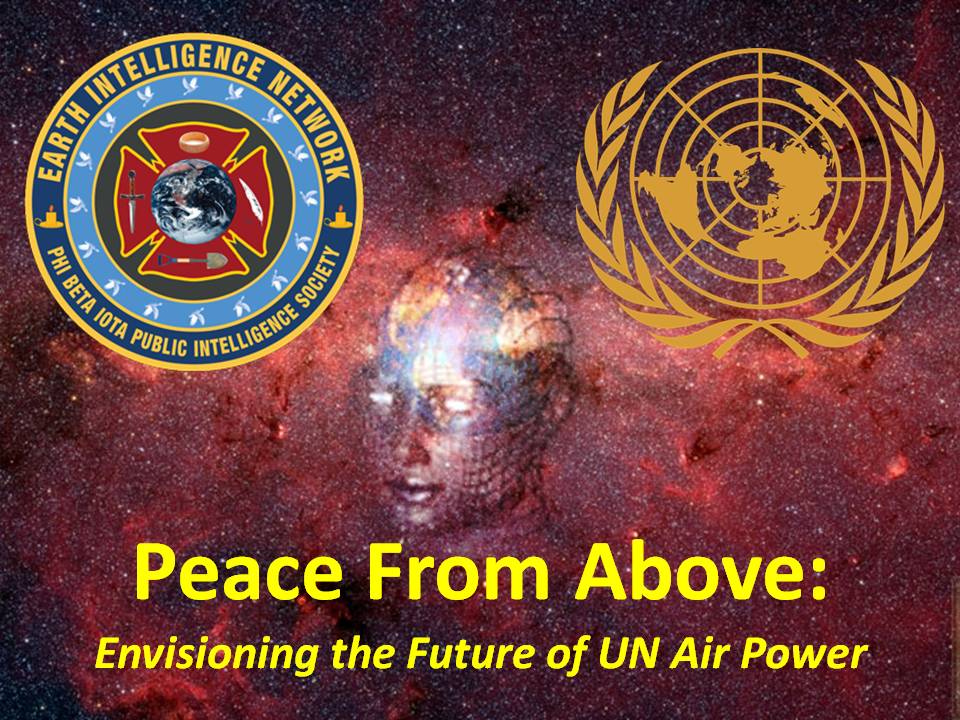
2014 Peace from Above: Envisioning the Future of UN Air Power

Advanced Cyber/IO, Analysis, Articles & Chapters, Augmented Reality, Autonomous Internet, Briefings & Lectures, Budgets & Funding, Collective Intelligence, Computer/online security, Counter-Oppression/Counter-Dictatorship Practices, Ethics, Geospatial, History, info-graphics/data-visualization, InfoOps (IO), International Aid, Journalism/Free-Press/Censorship, Key Players, Maps, Methods & Process, microfinancing, Mobile, Non-Governmental, Peace Intelligence, Policies, Policy, Real Time, Reform, Serious Games, Strategy, Technologies, Threats, Tools
Click on Image to Enlarge

Short URL: http://tinyurl.com/UNODIN

Steele in Dorn Peace from Above As Published

Finally published in 2014 (Article) originally presented in 2011 (Briefing).

The chapter more fully integrates the DNI spiral between modern mature intelligence (M4IS2) and modern mature Air Power.

Abstract 3.1

Briefing 3.3 (29 Slides With Notes As Presented 40 KB pptx)

Event: 15-17 June Ontario UN Aerospace Power

See Also:

2012 Robert Steele: Practical Reflections on UN Intelligence + UN RECAP

UN Intelligence @ Phi Beta Iota

Worth a Look: Wings for Peace – First Book on Air Power in UN Operations

John Robb: When Governments Fail, Criminal Tribes Grow

03 Economy, 09 Justice, 10 Transnational Crime, 11 Society, Blog Wisdom, Corruption, Cultural Intelligence, Government, IO Impotency, Non-Governmental
John Robb

Monday, 25 July 2011

JOURNAL: Knights Templar Norway/Mexico

Two recent attempts at revivals of the Knights Templar.

One:  Norway.  In this video posted by Anders (the Oslo bomber) before his attack.  He makes a plea for a revival of the Knights Templar at the end of the video (the first part is an attack on liberalism/multiculturalism and islamic immigration).  His bloody attack was an attempt to jump start a revival through what's called “a plausible promise.”

Two:  Mexico.  A splinter group from the Michoacan La Familia cartel (which is unravelling) has named themselves the Knights Templar.  They have published a code of conduct, eschew drug use, etc.  This group is active in the drug business, growing quickly (the simple rules of conduct required to join it are very viral), and killing every rival in their way (the Zetas, what's left of La Familia, and the Mexican government troops/police).

Why?  The Knights Templar is an historical model that is a ready made formula for manufacturing fictive kinship.  Fictive kinship is the “glue” or “cement” that holds together tribes.  Manufacturing fictive kinship enables the formation of a tribe/gang/cult that is able to defend itself and its interests.

In the case of religiously grounded historical examples like this, it allows the group and its members to believe they are special.  So special they can transcend the laws, customs, and morality of the outside world without remorse/pause.  The result is a group that will often kill in a far more aggressive way than what is seen with groups that are glued together only through economic ties (al Qaeda used this approach).

IMF: Cyber-Militia Flexing Its Muscles?

07 Other Atrocities, 08 Wild Cards, Advanced Cyber/IO, Civil Society, Computer/online security, Corruption, Government, IO Technologies, Law Enforcement, Non-Governmental, Policies

IMF attack goal said to be network ‘insider presence'

‘It was a targeted attack,' says expert who once worked for organization

Reuters, 11  June 2011

Phi Beta Iota: This is interesting on two levels.  First, all instruments of Empire can expect to be attacked; without any central impetus, we anticipate a global cyber-intelligence and penetration network to develop, similar to what has matured for Free/Open Source Software, but with penetration, understanding, and neutralization of as the objective.  A Cyber-Militia, if you will.  Second, no government, no corporation, no international organization, can muster the global intelligence capability needed to be effective in today's reality–the US Government least of all.  An opportunity is emerging for a multinational decision-support centre and network co-sponsored by a mix of stakeholders who are willing to commit to absolute integrity.  That is all it takes: integrity and a commitment to “The Virgin Truth.”

See Also:

1994 Sounding the Alarm on Cyber-Security

Cyber-Virus Proliferation: USG as “Main Enemy”

2011 Cyber-Command or IO 21 + IO Roots

Journal: Army Industrial-Era Network Security + Cyber-Security RECAP (Links to Past Posts)

Search: Steele USMC C4I 1990′s

Multinational, Multiagency, Multidisciplinary, Multidomain Information-Sharing and Sense-Making (M4IS2)


How Charities Cheat Everyone: The Bono Example

Corruption, Gift Intelligence, Non-Governmental

Bono's ONE foundation under fire for giving little over 1% of funds to charity By Daily Mail Reporter Daily Mail UK, 23rd September 2010 Bono's anti-poverty foundation ONE is under pressure to explain its finances after it was revealed that only a small percentage of money it raises reaches the needy. The non-profit organisation set up by the U2 frontman received almost £9.6million in donations in 2008 but handed out only £118,000 to good causes (1.2 per cent). The figures published by the New York Post also show that £5.1million went towards paying salaries.

Read rest of story….

Tip of the Hat to Justice Seeker at Facebook.

Phi Beta Iota: This fraudulent attribute afflicts almost all “charities” and most especially the Clinton and Bush “foundations” as well as the Red Cross.  Katrina and Haiti are classic examples of the fraud that is common.