Patrick Meier: Renaissance Crowd Sourcing — and Who Won

11 Society, Advanced Cyber/IO, Blog Wisdom, Civil Society, Collective Intelligence, Cultural Intelligence, Hacking
Patrick Meier

Crowdsourcing Solutions and Crisis Information during the Renaissance

Clearly, crowdsourcing is not new, only the word is. After all, crowdsourcing is a methodology, not a technology nor an industry. Perhaps one of my favorite examples of crowdsourcing during the Renaissance surrounds the invention of the marine chronometer, which completely revolutionized long distance sea travel. Thousands of lives were being lost in shipwrecks because longitude coordinates were virtually impossible to determine in the open seas. Finding a solution this problem became critical as the Age of Sail dawned on many European empires.

So the Spanish King, Dutch Merchants and others turned to crowdsourcing by offering major prize money for a solution. The British government even launched the “Longitude Prize” which was established through an Act of Parliament in 1714 and administered by the “Board of Longitude.” This board brought together the greatest scientific minds of the time to work on the problem, including Sir Isaac Newton. Galileo was also said to have taken up the challenge.

. . . . . . .

Interestingly, the person who provided the most breakthroughs—and thus received the most prize money—was the son of a carpenter, the self-educated British clockmaker John Harrison.  And so, as noted by Peter LaMotte, “by allowing anyone to participate in solving the problem, a solution was found for a puzzle that had baffled some of the brightest minds in history (even Galileo!). In the end, it was found by someone who would never have been tapped to solve it to begin with.”


Read full article…

John Robb: When Governments Fail, Criminal Tribes Grow

03 Economy, 09 Justice, 10 Transnational Crime, 11 Society, Blog Wisdom, Corruption, Cultural Intelligence, Government, IO Impotency, Non-Governmental
John Robb

Monday, 25 July 2011

JOURNAL: Knights Templar Norway/Mexico

Two recent attempts at revivals of the Knights Templar.

One:  Norway.  In this video posted by Anders (the Oslo bomber) before his attack.  He makes a plea for a revival of the Knights Templar at the end of the video (the first part is an attack on liberalism/multiculturalism and islamic immigration).  His bloody attack was an attempt to jump start a revival through what's called “a plausible promise.”

Two:  Mexico.  A splinter group from the Michoacan La Familia cartel (which is unravelling) has named themselves the Knights Templar.  They have published a code of conduct, eschew drug use, etc.  This group is active in the drug business, growing quickly (the simple rules of conduct required to join it are very viral), and killing every rival in their way (the Zetas, what's left of La Familia, and the Mexican government troops/police).

Why?  The Knights Templar is an historical model that is a ready made formula for manufacturing fictive kinship.  Fictive kinship is the “glue” or “cement” that holds together tribes.  Manufacturing fictive kinship enables the formation of a tribe/gang/cult that is able to defend itself and its interests.

In the case of religiously grounded historical examples like this, it allows the group and its members to believe they are special.  So special they can transcend the laws, customs, and morality of the outside world without remorse/pause.  The result is a group that will often kill in a far more aggressive way than what is seen with groups that are glued together only through economic ties (al Qaeda used this approach).

Winslow Wheeler: Analysis of US Bases Abroad

03 Economy, 04 Inter-State Conflict, 10 Security, Budgets & Funding, DoD, IO Deeds of War, Military, Peace Intelligence, Strategy, Waste (materials, food, etc)
Winslow Wheeler
Carlton Meyer, a former Marine Corps officer and editor of G2mil has produced an insightful analysis of US foreign bases to close.  The defenders of the status quo on the bases question like to paint those who want to close foreign bases as “isolationist.”  That sort of guttersnipe-baiting is rendered ignorant by Meyer's analysis.  You can easily see that from his introduction and from his analysis throughout.  In fact, some might become a little nervous that Meyer has an awful lot of American intervention in mind in with the reduced base structure he would advocate for the future.  On the other hand, Meyer is also not a sucker for the dysfunctional war advocacy from the interventionists in Congress and elsewhere.
Contact him directly at editor@G2mil.com.

Steve Denning: Changing Organizational Culture

Blog Wisdom, Commercial Intelligence, Communities of Practice, Cultural Intelligence
Steve Denning

How Do You Change An Organizational Culture?

EXTRACT

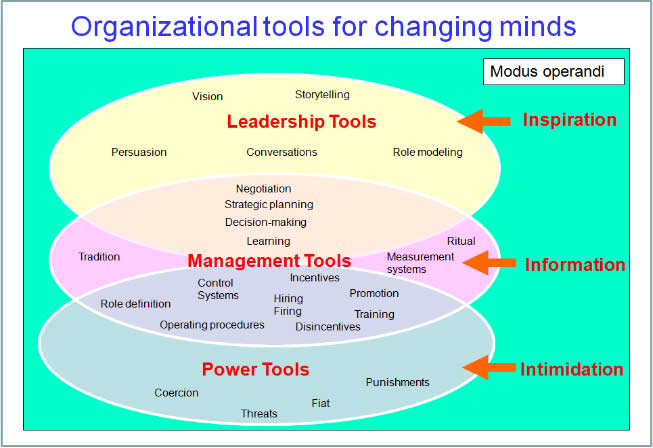
Changing a culture is a large-scale undertaking, and eventually all of the organizational tools for changing minds will need to be put in play. However the order in which they deployed has a critical impact on the likelihood of success.

Click on Image to Enlarge

In general, the most fruitful success strategy is to begin with leadership tools, including a vision or story of the future, cement the change in place with management tools, such as role definitions, measurement and control systems, and use the pure power tools of coercion and punishments as a last resort, when all else fails.

Phi Beta Iota:  Missing from this depiction is education, and the 21st Century role of leaders in eliciting and facilitating bottom-up co-creation.

Michael Dowd: “God is What Happens When Humanity is Connected”

Advanced Cyber/IO, Blog Wisdom, Collective Intelligence, Communities of Practice, Cultural Intelligence, Ethics, InfoOps (IO), Mobile, Movies, Peace Intelligence, Real Time, Strategy

“God is What Happens When Humanity is Connected”

Jim Gilliam: Why the Internet is my religion.

Yes! 19 July 2011

Video as presented at Personal Democracy Forum.

Phi Beta Iota:  Anyone educated in the 1960's and 1970's will remember Pervcival and Paul Goodman's Communitas: Means of Livelihood and Ways of Life.  The strategy devised by the Earth Intelligence Network celebrates this concept.

John Robb: Resilience 101 – Close the loop…all of them

Advanced Cyber/IO, Blog Wisdom, Communities of Practice, Earth Intelligence, Ethics, Key Players, Policies, Threats
John Robb

RESILIENT PRODUCTION: Close The Loop!

Reslient, local production can reach amazing levels of capacity and efficiency by obsessively closing loops.  How do you close loops?  Simply:

  1. Turn the waste of one production process into the fuel/input required to operate another.
  2. Do that again and again and again until there is nothing left to reuse.
  3. All along the way, find ways to take the good parts out of each process.  It could be food in one.  Heating/cooling in another.  Fresh water in a third.

For example.  Let's say you want to produce vegitables and fish.  If you did it in a disconnected way, you would be hit with expenses (both monetary and time) at each step in the process.  You would need to fertilize the plants.  Feed the fish.  Clean the water.  It gets expensive early.

If you connected the production systems together, by closing the loops, you would have an aquaponics system.  In an aquaponics system, the fish waste feeds bacteria which in turn produces fertilizer for the plants and fresh water for the fish.  The food the plants produce generate excess that feeds the fish.  With a tiny bit of automation and design, the entire thing operates seemlessly.  Loop closed!  The biggest chore is collecting the bounty.

Closing loops can turn problems into opportunties.  Waste into bounty.

noble gold