Mini-Me: From Arab Spring to Death of the US Empire

02 China, 02 Diplomacy, 03 Economy, 04 Inter-State Conflict, 05 Civil War, 06 Russia, 07 Other Atrocities, 08 Wild Cards, 10 Security, 11 Society, Analysis, Commerce, Commercial Intelligence, Corruption, Cultural Intelligence, Government, IO Deeds of War, Military, Money, Banks & Concentrated Wealth, Movies, Policy, Power Behind-the-Scenes/Special Interests, Strategy
Who? Mini-Me?

‘Arab Spring is about controlling Eurasia'

Includes Video (12:04)

The ultimate goal of the US is to take the resources of Africa and Middle East under military control to block economic growth in China and Russia, thus taking the whole of Eurasia under control, author and historian William F. Engdahl reveals.

­The crisis with the US economy and the dollar system, the conduct of the US foreign policy is all a part of breakdown of the entire superpower structure that was built up after the end of WWII, claims Engdahl.

“Nobody in Washington wants to admit, just as nobody in Britain a hundred years ago wanted to admit that the British Empire was in terminal decline,” claims the author, noting that “All of this is related to the attempt to keep this sole superpower not only intact, but to spread its influence over the rest of the planet.”

William F. Engdahl believes the uprisings in the Middle East and North Africa is a plan first announced by George W. Bush at a G8 meeting in 2003 and it was called “The Greater Middle East Project”.

Continue reading “Mini-Me: From Arab Spring to Death of the US Empire”

Tom Atlee: Occupy to Self-Manage by Michael Albert

Blog Wisdom, Cultural Intelligence
Tom Atlee

Recommended. Long and thoughtful.

Occupy to Self Manage

By Michael Albert

I have yet to see my nearest large occupation, Boston, or the precursor of all U.S. occupations, Wall Street. Instead, I have been on the road for the past six weeks in Thesselonika and Athens Greece; Istanbul and Diyarbikar Turkey; Lexington, Kentucky; London, England; Dublin, Ireland; and in Barcelona, Madrid, and Valencia Spain.

In all these places, I talked with diverse individuals at many meetings and popular assemblies. I met people involved in occupations, as well as audiences assembled by my hosts to hear about participatory economics. Beyond addressing assigned topics, my own priority was to learn about local movements. I repeatedly asked what folks struggling for many months wished to say to other folks first embarking on similar paths.

EXTRACT:

Another factor that was initially exciting but later became tedious, was seeking consensus. At first it was novel. It implied trust, which felt good. It implied shared intentions, which felt inspiring. But after awhile, seeking consensus became tortured, a time waster, and its reason for being the only decision making approach became steadily less compelling.

Read full analysis and reflections.

Tom Atlee: #Occupy Weekly Sparks = We Can Do It All

Advanced Cyber/IO, Analysis, Augmented Reality, Blog Wisdom, Civil Society, Collective Intelligence, Counter-Oppression/Counter-Dictatorship Practices, Cultural Intelligence, Ethics, Hacking, InfoOps (IO), IO Deeds of Peace, Methods & Process, Policies, Policy, Reform, Strategy, Threats
Tom Atlee

Random Communications from an Evolutionary Edge


#Occupy Weekly Sparks = We Can Do It All

Much has been said about the Occupy movement's lack of demands and vision. Some say it will have no impact unless it makes demands and organizes to make sure those demands are met.

Others respond that the People should just take charge of their democracy rather than petitioning official powers-that-be to do this and that. Still others say that any list of demands – any effort to focus OWS more narrowly and explicitly – could weaken the movement because Occupy Together is a broadly inclusive initiative that's about (a) changing whole systems and/or (b) creating microcosms of a better society in the occupation zones and/or (c) stimulating transformational conversations out in society at large and/or (d) passionately building and forcefully demonstrating the Power of the People to resist illegitimate, corrupt authority.

Others note that the disturbing lack of demands spreads OWS' surprising impact through a “blank slate effect” – OWS becomes a mystery or a mirror into which diverse individuals and groups project their various desires, hopes, frustrations, and agendas. Furthermore, that mystery helps by enhancing the movement's uncommon anarchic power that makes it so hard for authorities and others to figure out how to control, undermine or use it. Others insist that a shared vision – articulating what the 99% actually want – would be much more powerful than focusing on a laundry list of demands that many 99%ers might well disagree with. Simultaneously, many Occupiers are chronically frustrated with all this talk and want Action!! Their more thoughtful colleagues reply that pulling so many diverse people together in consensus requires taking the time to hear each other and generate collective wisdom.

Read balance of very deep and provocative commentary.

Patrick Meier: Net Impact Conference Report

Advanced Cyber/IO, Blog Wisdom, Geospatial
Patrick Meier

Democratizing ICT for Development with DIY Innovation and Open Data

The recent Net Impact conference in Portland proved to be an ideal space to take a few steps back and reflect on the bigger picture. There was much talk of new and alternative approaches to traditional development. The word “participatory” in particular was a trending topic among both presenters and participants. But exactly how “participatory” are these “participatory” approaches to develop-ment? Do they fundamentally democratize the development process? And do these “novel” participatory approaches really let go of control? Should they? The following thoughts and ideas were co-developed in follow-up conversations with my colleague Chrissy Martin who also attended Net Impact. She blogs at Innovate.Inclusively.

I haven’t had the space recently to think through some of these questions or reflect about how the work I’ve been doing with Ushahidi fits (or doesn’t) within the traditional development paradigm—a paradigm which many at the confer-ence characterized as #fail. Some think that perhaps technology can help change this paradigm, hence the burst of energy around the ICT for Development (ICT4D) field. That said, it is worth remembering that the motivations driving this shift are more important than any one technology. For example, recall the principles behind the genesis of the Ushahidi platform: Democratizing information flows and access; promoting Open Data and Do it Yourself (DIY) Innovation with free, highly hackable (i.e., open source) technology; letting go of control.

Read long report, more links.

Marcus Aurelius: OWS – Crapping on the Flag

07 Other Atrocities, Blog Wisdom, Citizen-Centered, Civil Society, Counter-Oppression/Counter-Dictatorship Practices, Cultural Intelligence, InfoOps (IO), IO Impotency, Misinformation & Propaganda, Political, Threats
Marcus Aurelius

This is circulating in retired Special Operations Forces (SOF) email.

Source:  AngryWhiteDude

EXTRACT:

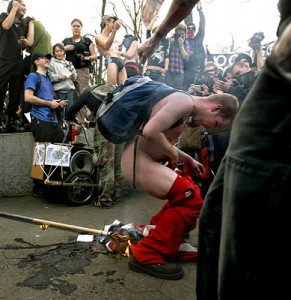
What a stark difference from the Tea Party movement. Patriots holding American flags have orderly events with poignant messages about liberty and freedom and then leave in an orderly fashion. Contrast that with the Occupy Wall Street miscreants! Arrests, rapes, flag burnings, pro-communist chanting, garbage, incessant drumming, filth, profanity and lots and lots of losers who still don’t really know why they’re there!

Phi Beta Iota:  We find this upsetting and disgusting.  Mindful of the protection of free speech, and mindful of the deep legitimate grievances that most (99%) of US citizens and even global citizens have against what the US Government has done in our name, the flag does not represent the US Government, it represents We the People.  Occupy Wall Street (OWS) is a mix of four parts: anarchists and undercover provocateurs; local only; alternative direct democracy; and electoral reform act and other tangible change agents seeking a national unity approach.  OWS is already facing twin challenges from police departments over-funded by the Department of Homeland Security (using borrowed money), and a massive corporately-funded disinformation campaign seeking to cast them as irresponsible and even dangerous.  As a movement, we find OWS to be as responsible as it is possible to get–they have the intelligence and the integrity that the US Government lacks.  However, they have not learned the art of counter-intelligence and internal security, and will continue to suffer from this kind of gratuitous and totally uncalled for stomach-turning crap (pun intended).

Chuck Spinney: Manufacturing Dissent – The Rise of the Tea Party as an Elite Front – Opposite of OWS

03 Economy, 07 Other Atrocities, 09 Justice, 11 Society, Analysis, Articles & Chapters, Blog Wisdom, Budgets & Funding, Civil Society, Commerce, Corporations, Corruption, Counter-Oppression/Counter-Dictatorship Practices, Cultural Intelligence, Government, IO Impotency, Misinformation & Propaganda, Money, Banks & Concentrated Wealth, Power Behind-the-Scenes/Special Interests
Chuck Spinney

Below is an excellent interview with Anthony DiMaggio in Counterpunch.  DiMaggio author of The Rise of the Tea Party, due out in November 2011. He uses the “propaganda model” developed by Noam Chomsky and Edward Herman in their book Manufacturing Consent to document and explain the Tea Party’s organizational dynamics for manufacturing dissent, and he compares these dynamics to those of the Occupy Wall Street movement.

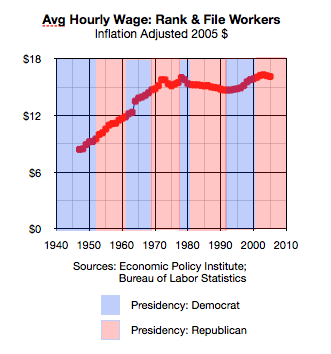
Before reading the interview, consider please the following: The forces powering the rage of the Tea Party — the stagnation of incomes and the increasingly unequal distribution of income — were around long before the Tea Party erupted on the national scene.

Click on Image to Enlarge

That the distribution of income had shifted in a very fundamental way toward the wealthy and especially the super-wealthy at the expense of the bottom 80% of the working population was clearly demonstrated in a classic study by Emanuel Saez and Thomas Piketty (Quarterly Journal of Economics, February 2003, updated in 2009), and subsequently confirmed by many other others, including just last week, on 25 October 2011, by the Congressional Budget Office.

It has also clear for years that inflation-adjusted wage growth that underpinned the improved living standards of great American dream machine sputtered out during the 1970s (see chart below).

So, it is simply beyond dispute that a fundamental change in the income distribution has taken place since the late late 1970s.  That change is also correlated with the wave of deregulation, tax cutting, defense spending increases (with a slight interregnum following the Soviet Union’s collapse), and deindustrialization/globalization that took off after 1980 during the Reagan Administration and accelerated during the Clinton and Bush II Administrations.  

Continue reading “Chuck Spinney: Manufacturing Dissent – The Rise of the Tea Party as an Elite Front – Opposite of OWS”

noble gold