Journal: Dennis Kucinich Introduces Monetary Reform

03 Economy, 07 Other Atrocities, 11 Society, Budgets & Funding, Civil Society, Collective Intelligence, Commerce, Commercial Intelligence, Corporations, Counter-Oppression/Counter-Dictatorship Practices, Cultural Intelligence, Government, InfoOps (IO), Methods & Process, Money, Banks & Concentrated Wealth, Power Behind-the-Scenes/Special Interests, Strategy
Dennis Kucinich

Dear Friends of the American Monetary Institute,

IMPORTANT MONETARY NEWS ALERT:   MAJOR, HISTORIC PROGRESS BEING MADE

On Friday December 17th Congressman Dennis Kucinich (D,Ohio, 10th District) took a crucial and heroic step to resolve our growing financial crisis and achieve a just and sustainable money system for our nation by introducing the National Emergency Employment Defense Act of 2010, abbreviated NEED. The bill number is  HR6550.

While the bill focuses on our unemployment crisis, the remedy proposed contains all the essential monetary measures being proposed by the American Monetary Institute in the American Monetary Act. These are what decades of research and centuries of experience have shown to be necessary to end the economic crisis in a just and sustainable way, and place the U.S. money system under our constitutional checks and balances. Yes it can be done!

We expect this bill will also be re-introduced next year in the 112th Congress. By putting it in now Congressman Kucinich accomplishes these important things:

* First, the seriousness of intent is underscored;

* Second, it gives our nation the opportunity to view, discuss and understand the necessary provisions, giving the chance to make improvements for re-introduction;

* Third it serves as a beacon to our beleaguered people, cutting through the error, vested interest and disinformation that has blocked monetary reform understanding and action in the past.

The American Monetary Institute has activated its blog to discuss and review any questions about this act. Just click on the blog link at our homepage.

To participate in this process, please sign up at the bottom of our home page at . Then, after reading the proposed legislation feel free to make comments or put questions on the blog, including thoughtful suggestions on how it might be improved.

You can read a copy of the legislation here.

Warm regards to all,
Stephen Zarlenga
AMI

See Also:

Dennis Kucinich on the Proposed Monetary Reform

New Economy Network

Dennis Kucinich, Vice President for the Commonwealth–and Some Details

Journal: Wind Power Boondoggle–and the Information Operations (IO) Challenge of Energy and Time in Relation to Policy, Acquisition, and Operations

Advanced Cyber/IO, Analysis, Budgets & Funding, Collective Intelligence, Communities of Practice, Counter-Oppression/Counter-Dictatorship Practices, Earth Intelligence, Ethics, History, InfoOps (IO), Intelligence (government), IO Multinational, IO Sense-Making, Key Players, Methods & Process, Officers Call, Open Government, Peace Intelligence, Policies, Strategy, Threats
Chuck Spinney Recommends...

My good friend Robert Bryce, author of the must-read Power Hungry: The Myths of ‘Green' Energy and the Real Fuels of the Future just launched this little torpedo.

A Wind Power Boonedoggle

T. Boone Pickens badly misjudged the supply and price of natural gas.

By ROBERT BRYCE, Wall Street Journal, 22 December 2010

After 30 months, countless TV appearances, and $80 million spent on an extravagant PR campaign, T.

Boone Pickens has finally admitted the obvious: The wind energy business isn't a very good one.

Read full article….

Click to Enlarge

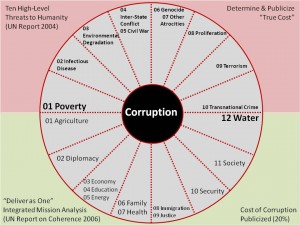
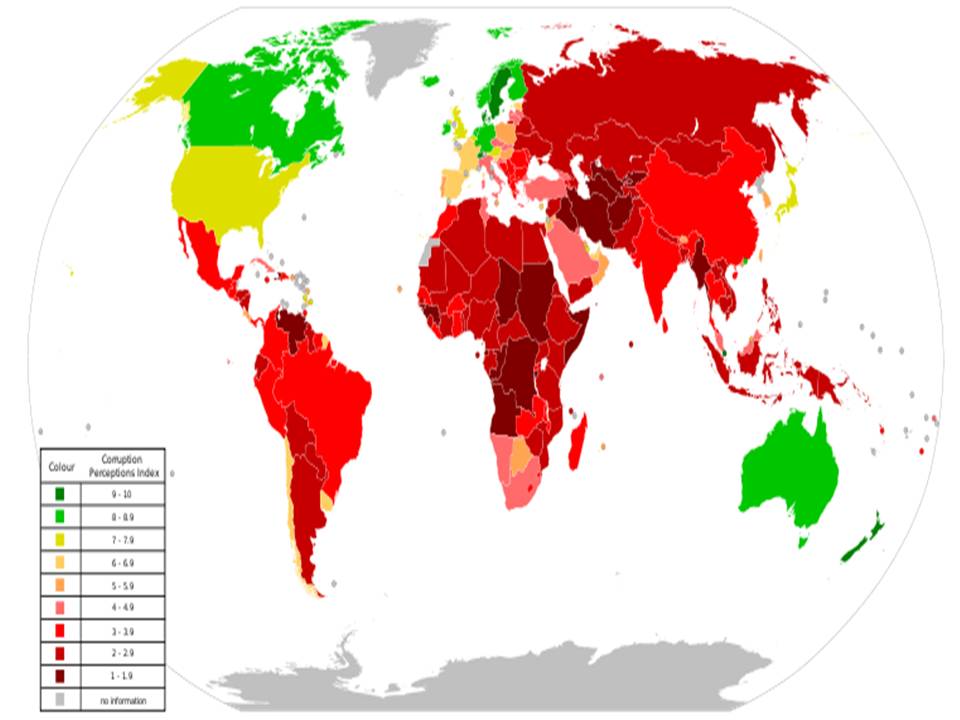
Phi Beta Iota: Buckminster Fuller and Russell Ackoff nailed it–everything has to be evaluated in relation to energy source and cost and time cost, and you have to focus on doing the right things, not doing the wrong things righter.  Where Mr. Pickens went wrong was in sticking with the centralized ownership concept.  Wind power and solar power are best for localized applications.  The central grid–the Industrial Era top down control grid, is DEAD.  Similarly, water and sewage should not be centralized grids demanding massive investments in collection and processing.  The graphic to the right shows corruption in the center–when analytics and decision-making lose their holistic integrity, they inevitably fail to achieve the desired outcome while creating cascading costs everywhere else.  Military spending in the USA is at the beginning of a nose dive–our military leaders would be wise to get a grip sooner than later, and “beat the dive” by making evidence-based decisions (Advanced IO) sooner than later.  Now a really advanced thought: 21st Century national security is about eradicating corruption at home and abroad–this makes possible the creation of a prosperous world at peace.  The breadth of that challenge is in the graphic below.  That is an IO challenge, not a kinetic challenge.  IO must be co-equal to kinetics beginning immediately.  In our humble opinion.

Click to Enlarge

See Also:

Journal: ‘Systemic Corruption’–Daunting Challenge in Globalized Era

Reference: Frog 6 Guidance 2010-2020

Reference: Transparency Killer App Plus “Open Everything” RECAP (Back to 01/2007)

Reference: Cultures of Resistance–A Look at Global Militarization

Reference: Truth & Nuance as an Information Operations (IO) Mission

Analysis, Articles & Chapters, Collaboration Zones, Communities of Practice, Corruption, Counter-Oppression/Counter-Dictatorship Practices, Ethics, InfoOps (IO), Intelligence (government), IO Sense-Making, Journalism/Free-Press/Censorship, Methods & Process, Misinformation & Propaganda, Money, Banks & Concentrated Wealth, Officers Call, Open Government, Policies, Power Behind-the-Scenes/Special Interests, Real Time, Secrecy & Politics of Secrecy, Strategy, Threats
Kelley Vlahos

Aldous Huxley Would Be Proud

by Kelley B. Vlahos, December 14, 2010

EXTRACT:  British novelist Aldous Huxley was a social critic and futurist, who is best known for penning Brave New World, which, aside from being a nearly 80-year-old science fiction masterpiece, is both an allegory and prophecy for 21st Century western society.

Huxley’s finger was on the pulse of human freedom, and he warned us over 50 years ago that it was fading fast. In 1958, he predicted that when concentrated in the hands of the “Power Elite,” rapidly evolving “mass communication” like television would be a critical tool of social and political conformity. Technology is only the medium, and it is “neither good nor bad,” Huxley wrote, but when in the wrong hands it can be “among the most powerful weapons in the dictator’s armory.” Propaganda, the suppression of the truth, particularly in democratic societies, Huxley argued, would bring upon an age of human enslavement, where instead of yokes and chains, people in celebrated “free” societies like America would be bound by the soft restraints of ignorance, incuriousness, distraction and irrationality.

. . . . . . .

EXTRACT:  In his 1958 interview with Mike Wallace, Huxley explained his concept of velvet totalitarianism:

“’If you want to preserve your power indefinitely, you must get the consent of the ruled,’ he said. Those in power will do this primarily through ‘techniques of propaganda,’ by ‘bypassing the rational side of man and appealing to his subconscious and deeper emotions’ and ‘making him love his slavery.’”

I would submit that Mr. David Brooks loves his slavery, and furthermore, is the perfect “alpha caste” prototype from Brave New World – he uses the good brains God (Ford) gave him to reflexively sustain the status quo, barking and nipping like a loyal lapdog when something or someone threatens it. The same goes for the rest of the so-called journalistic elite who have taken to the Net and on the television to discredit Assange in recent days, either through bald ad hominem or discrediting his work as “not journalism,” or “criminal.” Proto-elite scrambling among the herd of pundits across the mediascape are the worst, feeling they have to be more red-faced and extravagant in their commentary in order to stand out.

. . . . . . .

EXTRACT:  They aren’t even necessarily things we shouldn’t be reading or have some level of access to. Officials and journalists of every ilk spent the better part of this decade bemoaning the “over classification” of government information before, and especially after, 9/11. When pouring over the reams of information for the 9/11 Commission, former New Jersey Gov. Thomas Kean, who was chairing the commission said, “Three-quarters of what I read that was classified shouldn’t have been.”

Read this entire brilliant piece being categorized as a Historic Contribution.

Phi Beta Iota: Since starting this fight in 1988, the single most valuable body of knowledge we have acquired over those 22 years has been our little black book of great minds that speak the truth across all functional domains.  Kelley Vlahos is married to Michael Vlahos, and they are two of the most nuanced thinkers we know.  The era of secrecy and top-down micro-management for the benefit of the few is over.  It will not be replaced by communism or anarchy, it will be replaced by moral communitarian capitalism and panarchy.  It will focus–as we should have been focused since the end of World War II–on the needs and gifts of the five billion poor who can create infinite wealth, especially when we achieve infinite free energy by turning away from the corruption associated with the scarcity of fossil fuels, and instead tap into the free cosmic energy that Buckminster Fuller addressed so ably.  INTEGRITY IS BACK IN VOGUE.  That's a good thing.

Reference: Logistics Oversight as an Information Operations (IO) Mission

Articles & Chapters, Computer/online security, Cultural Intelligence, InfoOps (IO), Intelligence (government), IO Multinational, IO Sense-Making, Methods & Process, Military, Officers Call, Peace Intelligence, Power Behind-the-Scenes/Special Interests, Secrecy & Politics of Secrecy, Strategy, Threats

David IsenbergDavid Isenberg

Posted: December 21, 2010 11:59 PM

Huffington Post

Can't Anyone at DoD Do Oversight? Anyone at All?

The perennial issue regarding private military security contractors is the degree to which they are subject to effective oversight. In that regard there is only one item in today's news worth looking at. That is the report issued by the House Subcommittee on National Security and Foreign Affairs, chaired by John F. Tierney (D-MA). The Majority staff report is titled, Mystery at Manas: Strategic Blind Spots in the Department of Defense's Fuel Contracts in Kyrgyzstan. The report culminates an eight-month investigation into the Department of Defense's multi-billion dollar aviation fuel contracts at the Manas Transit Center in Kyrgyzstan.

Reminding one of the famous line by 1st Lieutenant Milo Minderbinder in Joseph Heller's famous Catch-22 novel, “We're gonna come out of this war rich!” the report found that to keep U.S. warplanes flying over Afghanistan, the Pentagon allowed a “secrecy obsessed” business group to supply jet fuel to a U.S. air base in Kyrgyzstan, turning a blind eye to an elaborate fraud involving fuel deliveries from Russia.

. . . . . . .

But the fuel was being bought by the Pentagon for shipment to the American airbase in Manas, Kyrgyzstan, and from there on to Afghanistan, the report said. Once Russian officials discovered the true identity of the recipient, they cut off supplies, creating a major logistical headache for United States military commanders.

That breakdown forced a major redrawing of supply routes into Afghanistan for jet fuel, which is in chronically short supply in landlocked Afghanistan. It also touched off a major behind-the-scenes diplomatic effort by the Obama administration to rebuild the fuel lines.

Read the complete very well-presented and documented article….

Phi Beta Iota: David Isenberg, author of Shadow Force: Private Security Contractors in Iraq, has become a valuable oversight contributor with respect to the out-of-control acquisition system on top of the out-of-control Private Military Contractor (PMC) system.  When reliability and redundancy matter, any military force that does not understand its supply chain timelines, costs, and geospatial realities down to the RFID level, as well as the vulnerabilities to disruption, is begging for a major hit.  The Information Operations (IO) domain appears poised for a major advance, integrating intelligence, logistics, operations, and civil affairs information in a manner never before attempted–with the supplemental value of placing Human Intelligence (HUMINT) in proper relationship to Cyber-Security, i.e. 70-30 or thereabouts (some would say 80-20).  Make this multinational, and it will be a game changer.  This is one reason the Office of the Inspector-General is one of the fifteen slices of HUMINT that must be managed by IO.

See Also:

Continue reading “Reference: Logistics Oversight as an Information Operations (IO) Mission”

2011 Top 10 Cyber Predictions (and Then Some)

Collaboration Zones, Communities of Practice, Computer/online security, Cyberscams, malware, spam, InfoOps (IO), IO Multinational, IO Sense-Making, IO Technologies, Key Players, Methods & Process, Mobile, Officers Call, Policies, Real Time, Secrecy & Politics of Secrecy, Standards, Strategy, Technologies, Threats

2011 Top 10 Cyber Predictions

Posted by Anup Ghosh on December 16, 2010

Everybody is putting out their Top 10 lists of predictions for 2011. Not to be left out of the party, below is a list of what we expect to see in 2011 in Cyber Security.

1.  Malware.

2.  Blame the User.

3.  Reactive approaches to security will continue to fail.

4.  Major Breaches in Sectors with Intellectual Property.

5.  Hacktivists will bask in their new-found glory.

6.  Critical Infrastructure Attacks.

7.  Hello Android.

8.  Windows Kernel Exploits.

9.  Organized Crime rises.

10.  Congress will rear its head.

Read full paragraph that goes with each of the above….

Phi Beta Iota: Nothing wrong with any of the above, except that they are out of context.  As the still-valid cyber-threat slide created by Mitch Kabay in the 1990's shows, 70% of our losses have nothing to do with disgruntled or dishonest insiders, or external attacks including viruses.  Cyber has not been defined, in part because the Human Intelligence crowd does not compute circuits, and the circuit crowd do not computer human intelligence.  We are at the very beginning of a startling renaissance in cyber/Information Operations (IO) in which–we predict–existing and near-term hardware and software vulnerabilities will be less than 30% of the problem.  Getting analog Cold War leaders into new mind-sets, and educating all hands toward sharing rather than hoarding, toward multinational rather than unilateral, will be key aspects of our progress.  Cyber is life, life is cyber–it's all connected.  Stove-piped “solutions” make it worse.

See Also:

Graphic: OODA Loop (Observe, Orient, Decide, Act)

Journal: 1 in 4 Fail US Army Extrance Exam

Journal: Development at Gunpoint? Wasteful & Wrong

Undersea Cables: The Achilles Heel of our Economies

Journal: NSA Assumes It Has Been Compromised…Correct!

Reference: Frog 6 Guidance 2010-2020

Journal: NSA Assumes It Has Been Compromised…Correct!

Computer/online security, InfoOps (IO), Intelligence (government), Methods & Process, Open Government, Reform, Secrecy & Politics of Secrecy, Standards, Strategy, Technologies, Waste (materials, food, etc)

U.S. Code-Cracking Agency Works As If Compromised. The U.S. government's main code-making and code-cracking agency now works on the assumption that foes may have pierced even the most sensitive national security computer networks under its guard.

“There's no such thing as ‘secure' any more,” Debora Plunkett of the National Security Agency said on Thursday amid U.S. anger and embarrassment over disclosure of sensitive diplomatic cables by the website WikiLeaks.

“The most sophisticated adversaries are going to go unnoticed on our networks,” she said.

Plunkett heads the NSA's Information Assurance Directorate, which is responsible for protecting national security information and networks from the foxhole to the White House.

“We have to build our systems on the assumption that adversaries will get in,” she told a cyber security forum sponsored by the Atlantic and Government Executive media organizations.

The United States can't put its trust “in different components of the system that might have already been violated,” Plunkett added in a rare public airing of NSA's view on the issue. “We have to, again, assume that all the components of our system are not safe, and make sure we're adjusting accordingly.”

The NSA must constantly fine tune its approach, she said, adding that there was no such thing as a “static state of security.”

More than 100 foreign intelligence organizations are trying to break into U.S. networks, Deputy Defense Secretary William Lynn wrote in the September/October issue of the journal Foreign Affairs. Some already have the capacity to disrupt U.S. information infrastructure, he said. Plunkett declined to comment on WikiLeaks, which has started releasing a cache of 250,000 diplomatic cables, including details of overseas installations that officials regard as vital to U.S. security.

Official have focused publicly on Army Private Bradley Manning, who is being detained at a Marine Corps base in Quantico, Virginia, as the source of the leak.

NSA, a secretive Defense Department arm that also intercepts foreign communications, conceives of the problem as maintaining the availability and assuring the integrity of the systems it guards, rather than their “security,” she said.

NSA – which insiders jokingly used to say referred to “No Such Agency” – also focuses on standardization and auditing to hunt for any intrusions, Plunkett said. She referred to the development of sensors for eventual deployment “in appropriate places within our infrastructure” to detect threats and take action against them.

Mike McConnell, a retired Navy vice admiral who headed the NSA from 1992 to 1996, told the forum he believed no U.S. government network was safe from penetration.

A third-party inspection of major computer systems found there was none of consequence “that is not penetrated by some adversary that allows the adversary, the outsider, to bleed all the information at will,” said McConnell, director of national intelligence from 2007 to 2009 and now leader of the intelligence business for the Booz Allen Hamilton consultancy.[Wolf/Reuters/18December2010]

Phi Beta Iota: In 1992 NSA knew that shrink-wrapped hardware and software coming across its loading dock was pre-compromised with both hardware and software viruses, Trojan Horse backdoors, and so on.  In 1994 the National Information Infrastructure “leadership” refused to address the need for a $1 billion a year national cyber-security program.  Since then it has simply gotten worse, with the latest (in the last four years) being the ability of the Chinese to ride the electrical circuits into any computer (think of your Best Buy ethernet extender that uses the wiring as a pass through).  The good news is that 90% of what we have behind the green and black doors is not really secret or in such obscure minutia as to be immaterial to national security.  What we should be doing, in our view as the proponent for public intelligence, is this:

1.  Default both Whole of Government and Multinational Engagement to unclassified.  Civil Affairs can lead the way with the Joint Civil Affairs Information Management Sytem that feeds the high side everything, but keeps the open system open.

2.  Set a notional limit of 10% of what can be classified secret within any Embassy, roughly 8% for the spies and 2% for everyone else.

3.  Take the most sensitive stuff completely off the electrical grid (the real reason NSA wants its own power station at Fort Meade and in Utah).

4.  Invest one third of the cyber-war budget, whatever it ends up being (probably half), in education & research relevant to all stakeholders, not just the national security community.  It is not possible to have smart safe spies within a dumb unsafe nation.  It's all connected.

Turning away from secrecy is the single best thing we can do as a government, as a military, as a nation.  It will yield productivity and innovation and foreign relations dividends beyond our dreams.

Everybody who's a real practitioner, and I'm sure you're not all naïve in this regard, realizes that there are two uses to which security classification is put: the legitimate desire to protect secrets, and the protection of bureaucratic turf. As a practitioner of the real world, it's about 90 bureaucratic turf; 10 legitimate protection of secrets as far as I am concerned.

Rodney McDaniel, then Executive Secretary of the National Security Council, to a Harvard University seminar, as cited in Thomas P. Croakley (ed), C3I: Issues of Command and Control (National Defense University, 1991). Page 68.

Reference: Frog 6 Guidance 2010-2020

About the Idea, Collaboration Zones, Communities of Practice, Ethics, IO Multinational, IO Sense-Making, Key Players, Methods & Process, Officers Call, Policies, Strategy, Threats

2010-12-21-FrogTransparent.JPG

From Virtual Secretary of Defense

Purpose

The purpose of this memorandum is to establish priorities for my strategic objectives through 2012 and pending the concurrence of a new president with a proper staff, 2020. There is no such thing as strategic guidance for one year. This document informs without directing anyone.

Intent

My intent is to establish a baseline of truth–the truth at any cost reduces all other costs–so as to return our Armed Forces to a condition of readiness, responsiveness, and effectiveness in the face of all threats to the Republic, both domestic and foreign. At a minimum this means an Air Force capable of long-haul lift; a Navy capable of distributed littoral operations; an Army able to fight uncomfortable wars while also reinforcing legitimate governments and where appropriate helping insurgents holding the moral high ground to displace despotic regimes. It also means a Marine Corps able to put air-land-sea forces on any spot in 24 hours (platoon landing team), 48 hours (company landing team) and 72 hours (battalion landing team), along with a Coast Guard able to fulfill all of its homeland safety and security missions. Underlying my intent for the Armed Forces is a strategic intent to demand clarity, integrity, and sensibility from the Whole of Government–sustainable legal orders consonant with our public's culture.

Our blood must only be shed when our brains are engaged and all other means–cultural, diplomatic, economic, educational, and political–cannot achieve the objectives that are open, legal, ethical, moral, and validated by both Congress and the public. My intent therefore consists of creating the conditions for getting a grip on reality and being able to deal with reality, with a particular emphasis on assuring that all information necessary to inter-agency effectiveness and multinational engagement is both known to us, and shareable with others.

Continue reading “Reference: Frog 6 Guidance 2010-2020”

noble gold