Basic Reference on Next Generation IT–Order Out of Print!,
May 29, 2000
Harry R. Collier
Harry is the founder and sponsor of the very interesting Association for Global Strategic Information. His book is as good a review as one could ask for, of “whither electronic publishing.” He defines the pieces as consisting of data originators, information providers, online vendors, information integrators, delivery channels, and customers. Overall Harry is quite firm on pointing out that the Internet is not revolutionary and will not transform most medium and small businesses in the near future. He goes over the Internet in relation to established publishers, covers pricing and copyright issues in relation to the Internet, and ends with a discussion of next generation applications and technologies and forecasts.
Enduring Classic on the Hard Truth about Changing Minds,
May 29, 2000
Thomas S. Kuhn
Two points are worthy of emphasis: 1) the paradigm shift is always forced and 2) until the paradigm shift occurs, always suddenly, the incumbents can comfortably explain everything with their existing paradigm. There will be many from the current “laissez faire” academics without accountability environment who would be critical of this book, but the fact is that it's fundamentals are on target; as the sociology of knowledge has shown time and time again, “thinkers” are nepotistic, incestuous, and generally lazy, as well as mono-lingual and culturally-constrained, and it takes a major shock-wave to push any given intellectual domain up to the next plateau.
First published in 1938, a modern edition is vastly improved by the addition of a critical introduction by Alan Mayne. Very much focused on how a world-brain might alter national policy-making, how Public Opinion or an “Open Conspiracy” might restore common sense and popular control to arenas previously reserved for an elite. The information functionality of the World Brain easily anticipated the world wide web as it might evolve over the next 20-30 years: comprehensive, up to date, distributed, classification scheme, dynamic, indexes, summaries and surveys, freely available and easily accessible. We have a long way to go, but the framework is there. The communication functions of the world brain would include a highly effective information retrieval system, selective dissemination of information, efficient communication facilities, effective presentation, popular education, public and individual awareness for all issues, and facilitate social networking between organizations, groups, and individuals. The world brain is the “virtual intelligence community” qua noosphere. This is one of the fundamental references for anyone thinking about the future of politics, economics, or social systems.
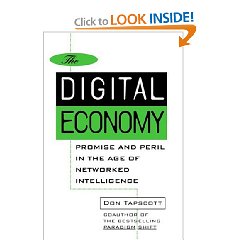
After demolishing Business Process Reengineering (BPR) as a necessary element of but insufficient substitute for corporate strategy, organizational learning, or reinvention, the author goes on to address twelve themes central to success in an economic environment characterized by networked intelligence: knowledge, digitization, virtualization, molecularization, integration/internetworking, disintermediation, convergence (a big one), innovation, prosumption, immediacy, globalization, and discordance (another big one). He stressed the need for “busting loose from the technology legacy”, the need to dramatically transform both the information management and human resource management concepts and also a turning on its head of how government works-from centralized after the fact “leveling” and gross national security to decentralized, proactive nurturing of individual opportunity before the fact, providing individual security through individual opportunity and prosperity within the network.
Kevin has produced what I regard as one of the top five books of this decade. A very tough read but worth the effort. I had not understood the entire theory of co-evolution developed by Stewart Brand and represented in the Co-Evolution Quarterly and The Whole Earth until I read this book. Kevin introduces the concept of the “hive mind”, addresses how biological systems handle complexity, moves over into industrial ecology and network economics, and concludes with many inspiring reflections on the convergence of biological and technical systems. He was easily a decade if not two ahead of his time.
Persico has done a wonderful job of capturing Casey's magnificent complexity and intellectual voraciousness. Oddly enough the best quote in there, part of a really excellent over-all description of why the DO does not succeed, comes from Herb Meyer when he was a special assistant to Casey: “These guys have built a system that shuts them off from any intelligence except what you can steal. These people needed to be reconnected to reality.”
Dick is a genius, and he and Bradford Ashton have pulled together a number of very fine contributions in this book. Still, they sum it up nicely in the concluding chapter: “The formal practice of developing technical intelligence in American business is only in its infancy.” They have a nice appendix of sources on scientific and technical intelligence that is missing a few big obvious sources like the Canadian Institute for Scientific and Technical Information (CISTI) and the Defense Technical Information Center (DTIC) as well as the Institute of Scientific Information (ISI) and several smaller sources. On balance, this technical intelligence community is, as Bradford notes, in its infancy. It is U.S. centric, does not yet understand operational security and counterintelligence, is weak of cost intelligence, relies too heavily on registered patents, and has too few practical successes stories. Especially troubling is the recent trend within DIA and the Air Force of cutting off all funding for open source exploitation of Chinese and other foreign S&T sources, combined with a dismantling by many corporations of their libraries and most basic market research functions. This book is an essential reference and I admire its authors greatly-sadly, they are part of a small minority that has not yet found its full voice.