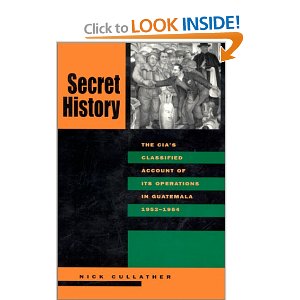
Review: Secret History–The CIA’s Classified Account of Its Operations in Guatemala, 1952-1954

5 Star, Atrocities & Genocide, Corruption, Country/Regional, Crime (Corporate), Crime (Government), Crime (Organized, Transnational), Empire, Sorrows, Hubris, Blowback, History, Intelligence (Government/Secret), Justice (Failure, Reform), Misinformation & Propaganda, Voices Lost (Indigenous, Gender, Poor, Marginalized)
Amazon Page
5.0 out of 5 stars Phenomenal “Primary” Source Relevant Today
July 26, 2010

Nick Cullather

This is the original, Stanford has also just produced a new version, Secret History: The CIA's Classified Account of Its Operations in Guatemala 1952-1954. I bought this used and not only loved the speed of delivery, but the notes from the previous owner.

My next review will cover The CIA in Iran: The 1953 Coup and the Origins of the US-Iran Trade. The two “successes” would both be condemned by history, but more pointedly, led to the CIA misadventures in Cuba, Chile, the Philippines, Viet-Nam, and so on.

There is a great deal in this book that I was not aware of, and that is with 294 reviews tagged Intelligence (Government/Secret)at Phi Beta Iota the Public Intelligence Blog, all leading back to their Amazon page.

In a nutshell, PBSUCCESS was a stunningly inept widely known endeavor penetrated across multiple points by the Guatemalan government, which succeeded only because the Army lost its nerve and deposed their own elected President. Especially new to me were the US Navy blockage of the Guatemalan ports (one on each coast), and the failure of CIA-trained “saboteurs” to derail the shipment of arms from the port to the capital city that the President was able to procure despite a global US embargo on arms for Guatemala.

Continue reading “Review: Secret History–The CIA's Classified Account of Its Operations in Guatemala, 1952-1954”

Review: Hack the Planet–Science’s Best Hope–or Worst Nightmare–For Averting Climate Catastrophe

5 Star, Complexity & Catastrophe, Complexity & Resilience, Culture, Research, Environment (Problems), Environment (Solutions), Nature, Diet, Memetics, Design, Science & Politics of Science, Threats (Emerging & Perennial)
Amazon Page

5.0 out of 5 stars Tour of the Horizon, the Smartest of Skeptics

July 25, 2010

Eli Kintisch

I bristled when I saw the title, but bought the book in association with my own talk to Hackers on Planet Earth (HOPE) on “Hacking Humanity.” I've put the book down glad I did not give up in the early pages, and thoroughly impressed by the author, clearly among the smartest of skeptics.

Although I was suprised to find no mention of HAARP (High Frequency Active Auroral Research Program) which is striving for openness but still appears to have an unnerving patina of weather change and earthquake triggering potential–in my uninformed view. I'd love the author's informed opinion on HAARP.

What the author does provide in this book is a totally superb overview with multiple drill-downs of what is now called “geoengineering.” Geo-systems are not in this book, and that is the greatest flaw with any contemplation of geo-engineering–you cannot engineer what you cannot understand.

The arrogance of those proposing “methods” to “hack” the Earth is truly outstanding, an arrogance I am glad to see that the author does not share. Among the long list of ideas:
Continue reading “Review: Hack the Planet–Science's Best Hope–or Worst Nightmare–For Averting Climate Catastrophe”

Review (Guest): The Vanishing Face of Gaia: A Final Warning

4 Star, Atlases & State of the World, Environment (Problems), Environment (Solutions), Nature, Diet, Memetics, Design
Amazon Page

4.0 out of 5 stars An important book on our planet's future

April 13, 2009

Review by Future Watch Rider

Book by James Loveluck

Lovelock merits our attention because he has been proven right in predicting grim events. Indeed, Lovelock's grim views have in some ways been too optimistic in light of the speed with which the global environmental situation has been declining.

I think his views in this book are too pessimistic but Lovelock is a creative original thinker about science who does not fit into neat categories. He has infuriated a lot of his fellow environmentalists with his advocacy of nuclear power. He does so because he sees the huge size of the gap between what is needed and what exists. For example, President Obama has promised to “double” the percentage of renewable energy America uses in a few years. It sounds great….. until you realize renewable energy is less than one percent of America's energy now. (Meanwhile, renewable energy is being very badly hurt by the global economic crisis.) Optimistic predictions about a “boom” in renewable energy over the past 20 years by various environmental advocates have turned out to be pie in the sky. It hasn't happened. Hopefully, it will happen now. However, according to predictions of the International Energy Agency, the share of the world's energy coming from coal, the worst form of energy, is going to go up, not down by 2020. This is why Lovelock also supports research on making coal less disastrous although it's never going to be “clean” as claimed by the coal industry and its millions of dollars in advertising. (Some environmental purists have also attacked him for this.)

Continue reading “Review (Guest): The Vanishing Face of Gaia: A Final Warning”

Review (Guest): Whole Earth Discipline

5 Star, Culture, Research, Environment (Solutions), Science & Politics of Science, Stabilization & Reconstruction, Survival & Sustainment, Technology (Bio-Mimicry, Clean), Values, Ethics, Sustainable Evolution, Water, Energy, Oil, Scarcity
Amazon Page

5.0 out of 5 stars Perhaps the most important — certainly the most thought-provoking — book in years

October 22, 2009

Review by Jesse Kornbluth

Book by Stewart Brand

I was interviewing George Soros as the Dow rapidly shed 300 points and crashed through the 10,000 level.

“Is this it?” I asked.

Soros shrugged — a very calm reaction from an investor who might have seen his portfolio shrink by hundreds of millions of dollars in a matter of minutes.

I lost much less that day, but I had a different reaction — panic. The thing to do, I concluded, was to trade my beloved Classic 6 in Manhattan for a self-sustaining house in the country. Ten acres would suffice, as long as they had decent water, land suitable for a large garden and enough sunlight for the solar panels.

I bought a URL for the web site I planned to launch: […]. This was no back-to-the-land hippie retreat. I would be stepping into the smart future: small town/rural purity (Woodsmoke) with the 21st century benefits of a fast Internet (Broadband) and Amazon.com's free shipping.

Given all that, you will understand that I was quite stunned to read “Whole Earth Discipline: An Ecopragmatist Manifesto” — by Stewart Brand, creator of the 1960s and 1970s classic, the “Whole Earth Catalog” — and discover that the last place its author would have me go is back to the land.

Continue reading “Review (Guest): Whole Earth Discipline”

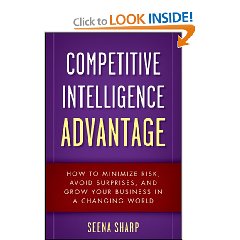
Review: Competitive Intelligence Advantage: How to Minimize Risk, Avoid Surprises, and Grow Your Business in a Changing World

5 Star, Intelligence (Commercial)
Amazon Page

REPOSTED to end Russian spammer constant hitting on former URL.

5.0 out of 5 starsBest Possible Starting Point for Executives & Students

October 20, 2009

Seena Sharp

This book is a gem. It is a rare book that I would recommend equally to senior executives and students thinking about a career path, but this is such a book. I agreed to review this book for the publisher and received a free copy. I've known the author since the early 1990's when the U.S. Government first tried to learn how to do commercial intelligence, calling it Open Source Intelligence (OSINT). They still don't get it, for the same reason most executives don't get it: arrogance, ignorance, and a complacency that comes from having too much money and not enough accountability.Before laying down my notes, let me first place this book squarely in the top twelve books in English. This is the one I would recommend to anyone as a starter, followed by:

Continue reading “Review: Competitive Intelligence Advantage: How to Minimize Risk, Avoid Surprises, and Grow Your Business in a Changing World”

Review: International Peace Observations

5 Star, Civil Affairs, Complexity & Resilience, Country/Regional, Culture, Research, Force Structure (Military), Information Operations, Insurgency & Revolution, Intelligence (Public), Misinformation & Propaganda, Peace, Poverty, & Middle Class, Politics, Power (Pathologies & Utilization), Public Administration, Religion & Politics of Religion, Secrecy & Politics of Secrecy, Security (Including Immigration), Stabilization & Reconstruction, Survival & Sustainment, Threats (Emerging & Perennial), Truth & Reconciliation, United Nations & NGOs, Voices Lost (Indigenous, Gender, Poor, Marginalized), War & Face of Battle

Amazon Page

5.0 out of 5 stars Seminal Work Cited by Dr. Walter Dorn
July 23, 2010
David Wainhouse

EDIT of 6 Sep 2010 to add comments on books once received.

I bought this book, a real bargain, at the suggestion of Dr. Walter Dorn, the “dean” of the peace intelligence scholars, who cites the book with great favor in his own forthcoming book, KEEPING WATCH: Monitoring and Technology in UN Peace Operations, which I am going through now in galley form.

Now that I am holding it in my hands, here are some comments.

1)Ā  Published in 1966, it is a phenomenal, an utterly superb, historical review of League of Nations, Latin American Union, and UN peace observation missions from 1920 to 1965.Ā  The book concludes with a major section on “Strengthening Peace Observations.”

2)Ā  Right away I decide to donate this book to the George Mason University library without marking it up, nor am I reading it, having seen enough to understand why Professor Dorn recommends it so highly as a historical reference work.

3)Ā  The book clearly needs a sequel, from 1966 to date, over 40 years of new conflicts and new peace missions, and I make mention of this hoping that someone reading this review will be inspired to take on the project with many collaborators.

Other related books I have reviewed:
Peacekeeping Intelligence: Emerging Concepts for the Future
Intelligence and the War in Bosnia: 1992-1995 (Perspectives on Intelligence History)
U.S. Commercial Remote Sensing Satellite Industry: An Analysis of Risks
Peacekeeping and Public Information: Caught in the Crossfire (Cass Series on Peacekeeping, 5)
Public Information Campaigns in Peacekeeping : The UN Experience in Haiti

Continue reading “Review: International Peace Observations”

noble gold