4.0 out of 5 starsOverkill — 50 pages fluffed to 342, October 20, 2013
If you ever wanted to get to know a Russian Kettlebell intimately, as well as its family going back 1000 years and every possible nuanced aspect of it, this is the book for you. For me it is total overkill and would more usefully be replaced by a 50 page illustrated guide and a single wall chart — or two, one for warm-up with jumprope and stick, the other a series of exercises. I watched Powerbody: Advanced Russian Kettlebell Workout with Phil Ross before going through this book,and now I am leaning toward reversing my conclusion that the Ross DVD was too advanced and one should start with this book. Given a choice between the two, I would dump this book and use the DVD as a complete package.
Bottom line: too much of everything. This is a doctoral thesis on pulling carrots out of the ground. This is a formula book on steroids. It certainly earns four stars — some might give it five (I mistrust most of the reviews, them seem to be very short and empty reviews from people doing the author a favor) — and the substance is worthy, but the overall “door stop” nature of the book is very off-putting. I could have distilled this book into 50 pages with two wall charts, and been happier with that at the same price.
5.0 out of 5 starsSIX Stars — A National Enema with Champagne, October 17, 2013
Ten percent of the books I have reviewed here at Amazon make it into my six star group. This is such a book. I have been a fan of Lee Camp's outrageously spirited, funny, and profane social commentaries for years, through his videos. This book was given to me as a gift, and I have been laughing all morning with occasional tears of sadness for society.
Amazon's Look Inside the Book provides the Table of Contents, look at that if you have any doubt.
HUGE PLUS: Each short chapter has the YouTube URL at the top. Amazon also sells two audios for Lee, great for the car, but personally I value the combination of Lee's face and live delivery with his words, for now found only on YouTube.
The subtitle says it all: Lee is a stark raving sane man. Others have compared him to Carlin, I would go a step further, Lee is Carlin with class (smile). He's like a giant-sized Irish elf armed with an intelligence flame thrower capable of skewering any lie, any pretense, any crime against humanity — his book covers most of them.
I would certainly like to see a Lee Camp: The Movie but until that comes available, this book is a sane person's salvation. We who are sane are labeled crazy by the 1% and the sheep that listen to the 1%, this book is life-affirming, mind-altering, soul-strengthening righteous good stuff.
God Bless Lee, God Bless America, and as Winston Churchill once said, NEVER GIVE UP.
Radical idea: buy as many of these books as you can, and either put the books in toilets where the willing might still be saved, or cut the spine off and sprinkle Lee's individual stories around. This book is pixie dust for humanity.
Ten books, none funny, that reinforce Lee's sanity parade:
5.0 out of 5 starsExtraordinary Effort, Surprise Turn, One Gap, October 16, 2013
FINAL REVIEW
The original review and its links remain valid. The book is misrepresented as a history of military strategy – despite flyleaf comments about the book also covering business strategy, the fullness of the book is not properly presented to the public.
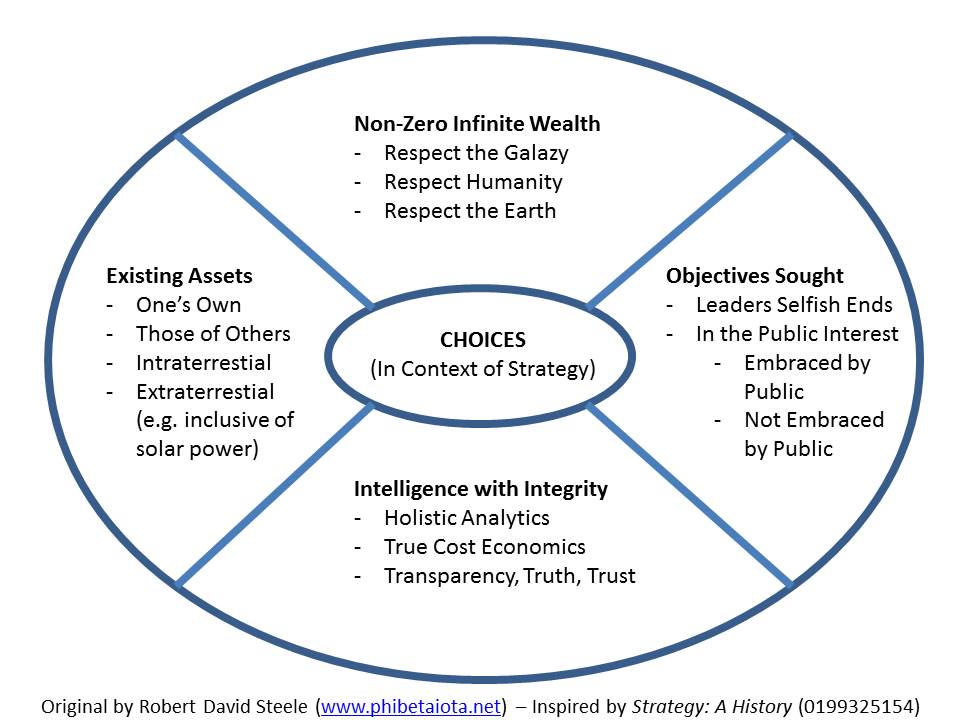
Had this book included Herman Daly and the entire underlying foundation of true cost economics, perhaps augmented by holistic analytics, and had the book focused on win-win and non-zero strategies in its conclusion, it would easily have moved into my six-star (top ten percent) category. As it is the book is assuredly at the top of the five star group.
Click on Image to Enlarge
The author touches briefly on a core point where we converge: he states in passing that “victory” is a military concept while “peace” is a political concept. Across the book he addresses persistent conflicts as those whose underlying disputes are never fully resolved, with peace and prosperity made ever less likely by the persistence of rulers striving to optimize their self-interest rather than the public interest. Exactly! Strategy without integrity is not strategy, it is systemic looting.
REF A — 12 Years of Lessons Learned in Time for 2014, October 13, 2013
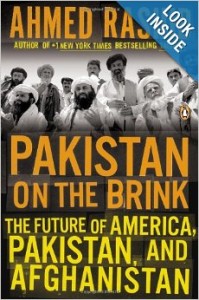
This is an extraordinary book that required a great deal of time, not in the reading, but in the reflection. This will be a longer review than usual, even for me, because this book contains all of the insights that the US and the Coalition have refused to embrace for the past twelve years. It is never too late to learn.
The author opens with a well-known quote on the dangers of drawing a line between fighting men and thinking men, lest one end up with the fighting being done by fools and the thinking by cowards. To this I would add another group, the “deciders,” who in the absence of any familiarity with fighting or access to intelligence with integrity, end up making decisions whose true cost in blood, treasure, and spirit crosses the line dividing legitimate actions “in the national interest” from “crimes against humanity.
Positive up front: US under Obama has given more of everything and progress has been made across both military (stronger Afghan army, degraded Taliban) and socio-economic (education, health, media) domains. To that I would add elections. Afghanistan is about to experience the most extraordinary election cycle it has ever been my privilege to observe.
In contrast, the author finds that Pakistan has worsened in every possible manner, in large part because the US has not understood Pakistan, has lacked a strategy (or the intelligence with which to devise a coherent sustainable strategy), and in failing, the US has allowed Pakistan to drag itself down and Afghanistan to be a regional albatross – a cancer on all others.
The author is quite blunt in describing an incoherent even infantile US decision-making environment characterized by “contradictory policies, intense political infighting, and uncertainty.” In being inept, the US opened the way for regional players to manipulate, exploit, and exacerbate.
Chapter 1 on the Bin Laden raid is utter nonsense, this may be the price the author pays to maintain access and avoid being assassinated. See instead The Bin Laden Story 00-90 at Phi Beta Iota.
The author points out that by 2014 the Coalition engagement in Afghanistan will have been longer than WWI and WWII. In my own mind this highlights the fact that the US in particular, but the Western nations in general, have lost their integrity. They are incapable of collecting and analyzing the truth, thinking holistically, evaluating true costs over time, or devising a sustainable strategy that ultimately achieves the desired end-state: peace and prosperity. A churlish skeptic would point out that no, the West has achieved precisely what it wants, public theater at home, a massive transfer of wealth from the individual taxpayer to the military-industrial complex, and personal enrichment of most policymakers, at least in the USA. Either way, the larger publics lose at home and abroad.
Pakistan and Afghanistan matter not only to Central Asia, where other countries such as Uzbekistan are beginning to implode, but to the Middle East and India. At the very end of the book the author ponders how Afghanistan might follow the Turkish example of Islamic/secular regeneration, and I cannot help but wish that 12 years ago the Coalition had had the brain to leave the British home and make Afghanistan a collaborative effort among Muslim nations led by Turkey.
QUOTE (19) “After a decade, NATO has achieved none of its strategic aims – rebuilding the Afghan state, defeating the Taliban, stabilizing the region – so what assurances can it now plausibly give that it will do so by 2014?
The author defines Afghanistan today (2012) as a corrupt and incompetent government, a dysfunctional bureaucracy and inoperable justice system, high on drugs and illiteracy, with a police force that has the highest desertion rate in the world.
The sucking chest wound: no indigenous economy. Bush specifically refused to invest in roads, dams, water, and power. Karzai has been a complete failure [the author gives Karzai credit and cause across the book, outlining the many ways in which the US failed to develop a relationship of trust with him.]
Pakistani military is out of control and the deal breaker. Nothing the US or other can do will overcome an arrogant ignorant Pakistani military continuing to support extremists and their violence within Afghanistan.
QUOTE (22): “If the west is to depart Afghanistan by 2014 and leave behind relatively stable regimes in Kabul and Islamabad, it will need a multidimensional political, diplomatic, economic, and military strategy.”
Answering this challenge is the purpose of the book.
My nine page detailed summary for professionals coping with Afghanistan and not having the time to read this excellent work, is posted at Phi Beta Iota the Public Intelligence Blog.
7 Stars, Life Transformational, So Fundamental as to be Priceless, October 10, 2013
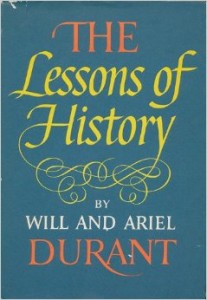
When I donated my 2500 volume library to George Mason University (down from 5000 in earlier years), this is one of a tiny handful of books I held back, along with Buckminster Fuller's Ideas and Integrities: A Spontaneous Autobiographical Disclosure.
This edition is the FIRST edition. The reprinted currently in stock version The Lessons of History is more readily available, but if you can get the first edition, it is priceless at multiple levels.
This is the first book that I discuss in my national security lecture on the literature relevant to strategy & force structure. It is a once-in-a-lifetime gem of a book that sums up their much larger ten volume collection which itself is brilliant but time consuming. This is the “executive briefing.”
Geography matters. Inequality is natural. Famine, pestilence, and war are Nature's way of balancing the population.
Birth control (or not) has *strategic* implications (e.g. see Catholic strategy versus US and Russian neglect of its replenishment among the higher social and economic classes).
History is color-blind. Morality is strength. Worth saying again: morality is strength.
They end with “the only lasting revolution is in the mind of man.” In other words, technology is not a substitute for thinking by humans.
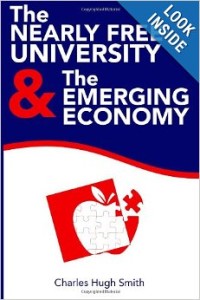
Publisher's Overview: With the soaring cost of higher education, has the value a college degree been turned upside down. College tuition and fees are up 1000% since 1980. Half of all recent college graduates are jobless or underemployed, revealing a deep disconnect between higher education and the job market. It is no surprise everyone is asking: Where is the return on investment? Is the assumption that higher education returns greater prosperity no longer true? And if this is the case, how does this impact you, your children and grandchildren? We must thoroughly understand the twin revolutions now fundamentally changing our world: The true cost of higher education and an economy that seems to re-shape itself minute to minute. The Nearly Free University and the Emerging Economy clearly describes the underlying dynamics at work – and, more importantly, lays out a new low-cost model for higher education: how digital technology is enabling a revolution in higher education that dramatically lowers costs while expanding the opportunities for students of all ages. The Nearly Free University and the Emerging Economy provides clarity and optimism in a period of the greatest change our educational systems and society have seen. The Nearly Free University and the Emerging Economy offers everyone the tools needed to prosper in the Emerging Economy.
Smith has the genius to find the words to distill observations which become clear to all when he reduces them to the succinct text that others seem not to have managed.
Smith opens with the observation that education is a dinosaur of an industry. It is delivered the same way it was in Aristotle's day, by assembling the students in the physical presence of a teacher. That was necessary when there were no books, and when books were too expensive for individuals to own. The reason that the situation perpetuates itself has more to do with the rich benefits which accrue to teachers and administrators in the University itself rather than any benefits to the students.
Education is a protected cartel. The right to accreditation is controlled by the state, and it is doled out to institutions which conform to the traditional mold. All participants in the industry have an interest in and its perpetuation, except students. Students are powerless and not very well informed, so the system continues as it is.
4.0 out of 5 starsFundamentals Most Ignore A Bit Too Generic, October 6, 2013
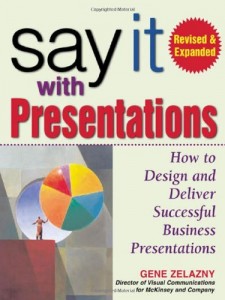
I was lent this book by a colleague. Here is some context for my appreciation of the book:
01 The Chairman of the Joint Chiefs of Staff (C/JCS) once BANNED all powerpoint presentations, for two reasons. First, because they had become “death by powerpoint” monstrocities in which intellectually limited people tried to substitute technology for thinking and color for precision of thought; and second, because more often than not, something would go wrong with the computer and the briefing officer would be found to be empty-headed. Too often (and I include myself) powerpoint presentations have been an aid for the BRIEFER, rather than a visual map for the DECISION-MAKER.
02 Presentations as most understand them are didactic tools (I talk you listen) instead of socractic tools (I spark, you engage, we create new understanding). Yes, one good visual can equal 10,000 words, but every visual past one radically loses value in a downward spiral. Less is more.
Put as simply as I can, a presentation is a tool for thinking — one third of the value is in the thinking and doodling and exploration of alternative paths leading to the presentation; one third of the value is in the final product that can inspire others on its own and as a tool, and the last third of the value, almost never achieved, is in the reaction, engagement, inspiration, and collective intelligence that the presentation might elicit.