If you want to get elected in the US, you need media.
When TV was king, the secret to media was money. If you have money, you can reach the masses. The best way to get money is to make powerful interests happy, so they'll give you money you can use to reach the masses and get re-elected.
Now, though…When attention is scarce and there are many choices, media costs something other than money. It costs interesting. If you are angry or remarkable or an outlier, you're interesting, and your idea can spread. People who are dull and merely aligned with powerful interests have a harder time earning attention, because money isn't sufficient.
Thus, as media moves from TV-driven to attention-driven, we're going to see more outliers, more renegades and more angry people driving agendas and getting elected. I figure this will continue until other voices earn enough permission from the electorate to coordinate getting out the vote, communicating through private channels like email and creating tribes of people to spread the word. (And they need to learn not to waste this permission hassling their supporters for money).
Mass media is dying, and it appears that mass politicians are endangered as well.
Phi Beta Iota: For the first time, Seth Godin has caused us to realize that the Koch Brothers funding the Tea Party might be a good thing….it is lighting the path that eventually could be lit by hundreds of millions whose 1-2 dollar contributions will outweight the “loose change” that the super rich are willing to spend on political chicanery. Joe Trippi was there first, but this is a new spin that we find salutory.
On October 20, I caught Steven Johnson’s talk at Book People in Austin. I’ve known Steven since the 90s – we met when he was operating Feed Magazine, one of the early web content sites. After Feed, Steven created a second content site, actually more of a web forum, called Plastic.com.
Daniel Pink has a smart article on flip thinking, a trend in innovation. It’s a matter of rethinking sequence logic: for instance, a math instructor finds that it makes more sense to work on problems in class, and follow with the lecture (uploaded to YouTube, where students watch as homework). You experience the tension of the problem first, and get hands-on guidance from the instructor. Having learned your way around the problem, you see the lecture that contextualizes that learning.
While the idea is great, and Pink offers excellent examples where turning sequences around might work, the more compelling lesson is about creativity: we should rethink our habits and routines, and consider re-engineering our processes, as a matter of course. It’s too easy for ruts to form. We avoid disruptive innovation because it can be painful, but it’s productive pain.
Mexico: For the record. Suspected members of the Sinaloa drug trafficking cartel warned that they would kill 135 people after security forces seized 134 tons of marijuana last week in Tijuana, Baja California state, Milenio reported today, 25 October. The warning was made over a police radio frequency late on 24 October reportedly minutes after gunmen killed 13 patients at a drug rehabilitation center in Tijuana.
Phi Beta Iota: This kind of indiscriminate mass murder in retaliation for what are relatively minor interdictions suggests that on the one hand, both the US and Mexican government have not only lost all control of the territory for which they are responsible for providing good order and public safety and security; but also that neither government has an effective intelligence capability to guide operations in detail. We are reminded of how long it took to hunt down one man in Colombia, Pablo Escobar. A MAJOR obstacle is the recalcitrance of the US secret intelligence community with $75 billion or more being applied to produce “at best” 4% of what is needed, to reinvent itself and engage in M4IS2: multinational, multiagency, multidisciplinary, multidomain information-sharing and sense-making. The El Paso Intelligence Center (EPIC) is a massive failure precisely because it embodies all of the handicaps of the past and none of the advantages of the present.
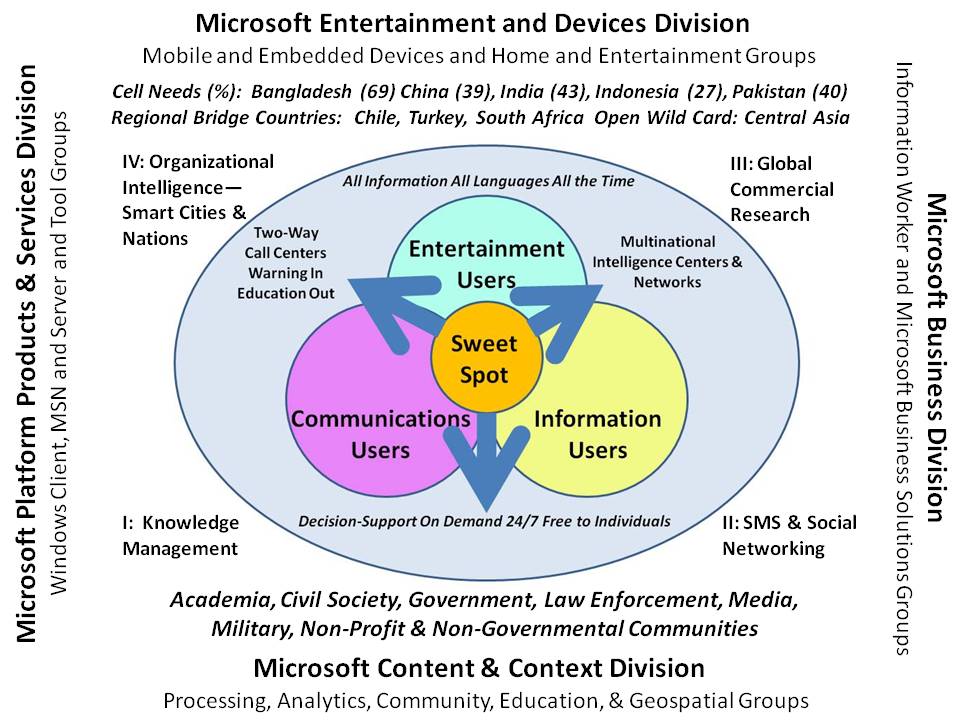
In a memo, Microsoft executive Ray Ozzie warned that the industry is moving to a post-PC world, and warned Microsoft employees that they must either lead or be pushed aside.
Ozzie said that memo had helped Microsoft on to success in the cloud, with products like Microsoft Azure, Microsoft Windows Live, and a socially-connected Xbox.
“Our products are now more relevant than ever,” Ozzie wrote. “Bing has blossomed and its advertising, social, metadata & real-time analytics capabilities are growing to power every one of our myriad services offerings. Over the years the Windows client expanded its relevance even with the rise of low-cost netbooks. Office expanded its relevance even with a shift toward open data formats & web-based productivity. Our server assets have had greater relevance even with a marked shift toward virtualization & cloud computing.”
Ozzie's latest memo, however, may have much less impact than his previous missive, however. That's because Ozzie said he would step down from his post as chief software architect after an undisclosed amount of of time. Ozzie apparently has no plans after that.
Ozzie's memo acknowledged the reality of “always-on” services like Facebook or Twitter, or Web mail services like Gmail or Hotmail, combined with connected devices like the Boxee Box or Apple TV.
The service offered by Batchelor is to get to what he regards as the core of Buddhist practice, free of “accretions” imposed by various Asian traditions. Of course, some westerners are attracted to Buddhism in part by the rich Baroque trappings of the Tibetans, the subtle Theravada traditions of southeast Asia or the spare paradoxes in Zen cultures. But other westerners want a practice they feel is more suitable for a scientific and democratic society.
Having been a monk in two of three Asian traditions (Tibetan and Korean), Batchelor sought what he regards as Buddha's basic realization. In his writing, he even set aside such crucial elements of traditional Buddhism as rebirth and karma, not denying that the founder taught these doctrines, but attributing them to the Hindu world in which he'd grown up and arguing that they aren't necessary to Buddha's genius as expressed in the “four noble truths.”
Within Buddhism, Bachelor's heresy is not to do without the concept of divinity (the founder was agnostic about metaphysics), but rather to set aside any realm other than our life on earth and to accept the possibility of death as oblivion. This is a delicate point because the prestige of Tibetan religious leaders, starting with the Dalai Lama, depends in part on the claim to be reincarnations and because the finality of death is almost unimaginable to most of us.
What a waste to obtain the necessities of life, guard against danger, form attachments to other humans and accumulate knowledge, and then poof, it's all gone like photo albums when a house burns down. This would be almost as unthinkable as a process of evolution. What human would design so slow, wasteful and unfair a process? Batchelor's point here would be that the gist of Buddhist dharma practice is being aware of what's here, now, rather than placing hope, without evidence, in a happier life after death.
“In all probability,” British Economist William Stanley Jevons wrote in 1874, “the errors of the great mind exceed in number those of the less vigorous one.” Making mistakes turns out to be a strangely generative process: it sends you down a new path, allows an interesting new connection to form in your mind. The history of being spectacularly right has a shadow history lurking behind it: a much longer history of being spectacularly wrong, again and again. (For a rich philosophical take on this subject, I recommend Kathryn Schulz's book, “Being Wrong.”) And not just wrong, but messy. A shockingly large number of transformative ideas in the annals of science can be attributed to contaminated laboratory environments. Great scientists and inventors seem to have an openness to the serendipitous discoveries that happen when you accidentally knock over the tissue sample, or misinterpret the data from the last experiment. As one great inventor, Ben Franklin, put it: “Truth is uniform and narrow; it constantly exists, and does not seem to require so much an active energy, as a passive aptitude of soul in order to encounter it. But error is endlessly diversified.” In that spirit, a short tour of some of history's most brilliant and world-changing mistakes:
Livestock today consume 5 times as much grain as the entire American population, the average meal travels 1,500 miles from farm to fork, and seven football fields' worth of land is bulldozed every minute to create more room for farmed animals and the crops that feed them.
But it doesn't have to be all doom-and-gloom. We as consumers still have options, which, over time, can change our economy. It's this idea that drives INFORM — the educational and advocacy nonprofit that raises environmental consciousness for the general public through visual media. Its “Secret Life” film series, seen by over 2 million viewers in 80 countries, examines the lifecycle environmental impact of everyday objects we all consume.



 On October 20, I caught Steven Johnson’s talk at Book People in Austin. I’ve known Steven since the 90s – we met when he was operating
 Craig K. Comstock
 Chris Elam
