Secrecy News Headlines: Iraq + Lies Leading to Iraq

04 Inter-State Conflict, 08 Wild Cards, Corruption, Government, Media, Military, Officers Call, Power Behind-the-Scenes/Special Interests
0Shares

**      DOD SEES NO INTEL COMPROMISE FROM WIKILEAKS DOCS
**      REVISITING THE DECISION TO GO TO WAR IN IRAQ

It is to be expected that national intelligence services will sometimes fail to identify and discover a threat to the nation in a timely fashion.  But when intelligence warns of a threat that isn’t really there, and then nations go to war to meet the phantom threat — that is a serious, confounding and deeply disturbing problem.

But in a nutshell, that is the story of the war in Iraq, in which the U.S. and its allies attacked Saddam Hussein’s Iraq because of the supposedly imminent threat posed by Saddam’s stockpile of weapons of mass destruction — a threat that proved illusory.

A new book published in the United Kingdom called “Failing Intelligence” provides a remarkable account of the British experience of how intelligence on the Iraqi WMD program was shaped and packaged to support the decision to go to war in Iraq.  The book’s author, Brian Jones, was the chief specialist in weapons of mass destruction on the UK Defence Intelligence Staff.  He was also a skeptic of the stronger claims made about the existence of Iraqi WMD stockpiles.  The book documents his mostly unsuccessful attempts to register that skepticism, to moderate the extreme claims made by government officials, and later to hold those officials accountable for their actions.

He provides a detailed first-hand account of how his efforts were consistently deflected in the rush to war, and how intelligence declined into propaganda.  It’s a grim but instructive case study in the overlapping failure of intelligence gathering, intelligence production, and intelligence oversight.

The National Security Archive has recently published three richly informative collections of declassified U.S. and British government documents on the lead-up to the Iraq war (including several key documents cited or relied upon by Brian Jones).

“The more deeply the processes of creating the government reports on the alleged Iraqi threat are reconstructed — on both sides of the Atlantic — the more their products are revealed as explicitly aimed at building a basis for war,” wrote John Prados of the National Security Archive and journalist Christopher Ames in an analysis of the documents.

“In the light of a decision process in which no serious consideration was given to any course other than war, the question of whether American and British leaders set out to wage aggressive war has to be squarely faced,” they wrote.

See Also:

Review: Weapons of Mass Deception–The Uses of Propaganda in Bush’s War on Iraq

Review: Web of Deceit: The History of Western Complicity in Iraq, from Churchill to Kennedy to George W. Bush

Review: VICE–Dick Cheney and the Hijacking of the American Presidency

Review: Empire of Illusion: The End of Literacy and the Triumph of Spectacle

Review: Shooting the Truth–The Rise of American Political Documentaries

Review: Grand Theft Pentagon–Tales of Corruption and Profiteering in the War on Terror

Journal: Seth Godin on the Customer as a Celebrity

Commercial Intelligence, Cultural Intelligence
0Shares

You're famous

What makes a celebrity special? She was just an ordinary person a month or a year ago, but now, suddenly, your heart goes flitter-flutter when you meet her, or you want an autograph.

One way to consider fame is that it increases the options for the person at the same time the number of demands go up. In other words, celebrity makes the celebrity's attention more valuable.

It's exciting to shake hands or get an autograph from a famous person, then, because the celebrity has something others want, you're getting a slice of attention from someone who has other options. But she didn't exercise those options–she chose you.

By this definition, you're famous. Compared to just a few years ago, more people know you, you have more options and your attention is far more precious than it ever was.

Not just you, of course. Your customers too. They're famous now.

Time to start treating them that way.

Phi Beta Iota: This is a play on both diversity and co-creation as well as business ecologies.  We are One.

Review (Guest) (DVD): The Social Network

5 Star, Biography & Memoirs, Capitalism (Good & Bad), Change & Innovation, Consciousness & Social IQ, Culture, DVD - Light, Information Society, Reviews (DVD Only)
0Shares
Amazon Page

Jesse Eisenberg (Actor), Andrew Garfield (Actor), David Fincher (Director)

Review by Jon Lebkowsky

The David Fincher/Aaron Sorkin film collaboration called “The Social Network” is not about technology, though there are scenes that suggest how code is produced through focused work (which actually looks boring when you’re watching it “IRL” (in real life), without Fincher’s hyperactive perspective – but is so engaging you can lose yourself totally in the process when you’re the one actually producing the code).  The film is more about the entrepreneurial spirit, what it takes to have a vision and see it through. The real visionary in the film, Mark Zuckerberg, appears far less intense IRL than Jesse Eisenberg’s interpretation would suggest, but his drive and work ethic are undeniable. It’s not an accident that a guy in his twenties produced a billion-dollar platform; he could have been derailed if he’d lacked the persistence of vision and intent that the film shows so clearly. And, of course, he was kind of a jerk, probably without meaning to be. That kind of focus and drive tends to override comfortable social graces, kind of ironic when you’re building a social platform.

Continue reading “Review (Guest) (DVD): The Social Network”

Reference: Humanizing “The Man”

04 Inter-State Conflict, 05 Civil War, 07 Other Atrocities, 08 Wild Cards, Articles & Chapters, Blog Wisdom, Officers Call, Strategy
0Shares

Humanizing “The Man:” Strengthening Psychological and Information Operations in Afghanistan
by A. Lawrence Chickering

In this paper, I will argue there are three great challenges the coalition forces need to overcome in their search for narratives that resonate with Afghans and that ultimately will promote support for the coalition and for the government. First is the traditional and tribal Afghan antagonism to outsiders. Second is the lack of a stake that ordinary Afghans have in the larger system. And the third involves a conflict in impact of major activities in the country, a conflict between programs that empower Afghans and programs that disempower them.

Download the Full Article: Humanizing the “Man”

Phi Beta Iota: The four levels of war and peace were best explained by Edward N. Luttwak, see Review: Strategy–The Logic of War and Peace, Revised and Enlarged Edition.  We raise this point, as we raised it while teaching at a Civil Affairs course at Fort Bragg, because no amount of good intentions at the operational and tactical levels of war can overcome flagrant irresponsibility and immorality at the strategic level, or the lack of anything other than killing tools at the tactical level.  War and Peace are a whole.  If you cannot start with morality and a just cause, and if you cannot implement a Whole of Government strategy that leads to an outcome of peace and prosperity for those you wish to win over, then everything in the middle is waste–wasted blood, wasted treasure, wasted spirit.  And if everything you do on the battlefield and in your supply line is rife with corruption–e.g US funding the Taliban, never mind–then you are thrice cursed and unlikely to prevail.

See Also:

Review: Surrender to Kindness (One Man’s Epic Journey for Love and Peace)

Review: Modern Strategy

Search: Strategic Analytic Model

Search: four levels intelligence analysis

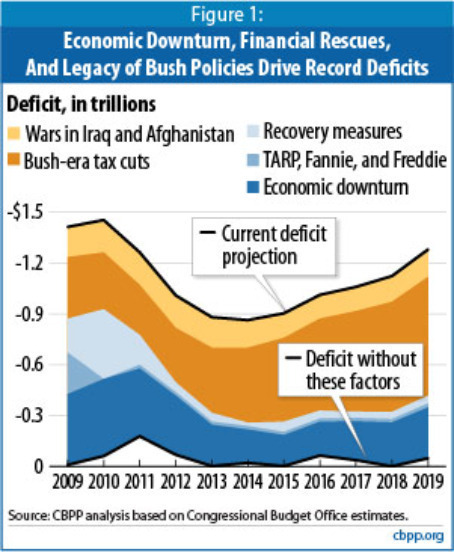
Reference: Cool Chart on US Deficit Sources

Blog Wisdom
0Shares
Source Story

Phi Beta Iota: Surprisingly, the future cost of Medicare is not included here, which is both considerable, and reducible by 90% by buying drugs wholesale, generically, and overseas, something Congress has been paid to forbid.

Review (Guest): Film Review–“2012: Time for Change”

5 Star, Atlases & State of the World, Capitalism (Good & Bad), Complexity & Catastrophe, Complexity & Resilience, Cosmos & Destiny, Culture, Research, Economics, Education (General), Environment (Problems), Environment (Solutions), Future, Nature, Diet, Memetics, Design, Peace, Poverty, & Middle Class, Politics, Power (Pathologies & Utilization), Priorities, Stabilization & Reconstruction, Survival & Sustainment, Values, Ethics, Sustainable Evolution, Voices Lost (Indigenous, Gender, Poor, Marginalized), Water, Energy, Oil, Scarcity
0Shares
Home Page

Film Review: “2012: Time for Change”

Opening This Weekend in NYC, Playing in LA again this week as well, it’s:

A Film that Will Change the World

by Sander Hicks

If I told you I just saw a great movie named “2012: Time for Change” you may think I’m talking about the 2009 Roland Emmerich disaster movie. That flashy flick was wildly successful at the box office, but it’s described as “cinematic waterboarding,” and worse, by most critics. So how did it make $567 million? Maybe it tapped into that nagging little voice we all have, which says that if we do not change how we live, we face planetary catastrophe, a global environmental meltdown, in full-color HD.

“2012: Time for Change” is different. It’s a lively, smart documentary that weaves a more hopeful vision from over 200 voices and visionaries. The film works as a kind of collaborative brainstorm: Yes, we are destroying the planet, with our patterns of consumption, competition, war and blindness. The Asian Tsunami,  Hurricane Katrina, and even now tornados in Brooklyn show that the Earth has just about run out of patience with us human beings.

Continue reading “Review (Guest): Film Review–“2012: Time for Change””

Review (Guest): Innovation–The Five Disciplines for Creating What Customers Want

2 Star, Change & Innovation
0Shares
Amazon Page

Curtis R. Carlson (Author), William W. Wilmot (Author)

2.0 out of 5 stars This is a BAD book on innovation

September 30, 2006

By ARMAN KIRIM, PhD (Istanbul, Turkey) – See all my reviews

This is a BAD book on innovation

As a matter of fact it is a bad book in the most general meaning of the word. First of all, it does not deliver what it promises to deliver and thus misleads the buyer. It claims that it is going to provide a `framework' for an innovative organization, but instead turns out to be a most general blah blah on every subject in the area of `management'. Apart from an abundant use of the word `innovation', there is hardly anything related to the core of innovation process in this book.

If you like, let me summarise what they say:

1. The book starts with an expose of the CHANGES in the world economy, globalization etc. The usual stuff you would expect to find in any `wake-up call' book these days. But is there anyone left who is not aware of the big changes going on around us? Do we need another book warning us that business is no longer usual?

2. The book then goes on outlining their `framework' for innovation. This is called the `five disciplines'. Disciplines indeed! And such `novel' ones. Let's look at them, if you like.

Continue reading “Review (Guest): Innovation–The Five Disciplines for Creating What Customers Want”