Journal: Taking a WikiLeak

Civil Society, Cultural Intelligence, Government, IO Sense-Making, Law Enforcement, Military, Peace Intelligence
Jon Lebkowsky Home

Taking a Wikileak

In my obligatory post about Wikileaks as the story du jour, I point to the great set of questions Dan Gillmor has posted in his column at Salon. These are especially lucid. I like especially Dan’s point about the character of the communications that were leaked, that many of the messages are gossip. Journalists are dutifully reporting “facts” gleaned from the leaked material without necessarily digging deeper, verifying and analyzing. Of course, they don’t have time – the information environment moves too quickly, he who hesitates is lost, accuracy be damned.

Then again, journalism is so often about facts, not truth.  Facts are always suspect, personal interpretations are often incorrect, memories are often wildly inaccurate. History is, no doubt, filled with wrong facts and bad interpretations that, regardless, are accepted as somehow “true.”

The high-minded interpretation of this and other leaks, that people need to know what is being said and done by their representatives in government, especially in a “democratic society,” is worth examining. We’re not really a democracy; government by rule or consensus of a majority of the people doesn’t scale, and it would be difficult for the average citizen to commit the time required to be conversant in depth with all the issues that a complex government must consider.

Do we benefit by sharing more facts with more people? (Dan notes that 3 million or so in government have the clearance to read most of the documents leaked – this seems like a lot of people to be keeping secrets… is the “secret” designation really all that meaningful, in this case?) But to my question – I think there’s a benefit in knowing more about government operations, but I’m less clear that this sort of leak increases knowledge vs. noise.

I’m certain about one thing: we shouldn’t assume that the leaked documents alone reveal secrets that are accurate and true. They’re just more pieces of a very complex puzzle.

See Also:
Graphic: Information Pathologies

Journal: AlterNet on “Beyond Madness”–Patraeus in Pakistan

Methods & Process, Military, Peace Intelligence

‘Beyond Madness': Obama's War on Terror Setting Nuclear-Armed Pakistan on Fire

Rather than seeking to stabilize Pakistan, General David Petraeus has been irresponsibly lighting matches with his shortsighted use of Special Forces and drone strikes

by Fred Branfman

EXCERPT 1:  But rather than seeking to stabilize Pakistan, General David Petraeus has, incredibly, been irresponsibly lighting matches through his shortsighted and relentless effort to secure Afghanistan by using U.S. forces and drone strikes, and pressuring the Pakistani Army to attack Taliban “sanctuaries” in Pakistan’s northwest provinces. Wajid Shamsul Hasan, Pakistan's High Commissioner to London for the past 16 years and a pillar of the Establishment, has recently stated that U.S. drone and gunship attacks in Pakistan have “set the country on fire” and threatened that such acts could eventually lead to attacks on U.S. personnel in Pakistan.  Petraeus has disastrously miscalculated. The more “progress” he tries to show in Afghanistan, the more he weakens the U.S. position in far more important Pakistan.

EXCERPT 2:  The single most important — yet surprisingly ignored — revelation of Bob Woodward's new book, Obama's Wars, is that Petraeus and the Obama team never discussed how their strategy for attacking Taliban sanctuaries in Pakistan was weakening the Pakistani state. Woodward also makes clear that it is Petraeus, not Obama, who is driving U.S. policy in “Af-Pak.” CIA Director Leon Panetta declared that “no Democratic president can go against military advice, especially if he asked for it. So just do it. Do what they say,” according to the book. Petraeus’ power derives from America’s unconscious need for a military hero and his perceived and overblown success in Iraq. But this perception has blinded normally sensible observers to his disastrous performance in Pakistan since becoming Centcom commander in October 2008.

Tip of the Hat to John Steiner via E-Mail.

Phi Beta Iota: the author has pulled together a number of linked references and this is a useful article narrowly focused.  He missed the larger picture, the fact that Obama has no strategy and no brain trust (the emphasis being on brains in touch with reality).  Obama will get his Wall Street reward on his present course, but he is neither leading nor serving the nation with his ideologically passive-aggressive incoherence across the board–nothing serious on all ten threats to humanity, nothing serious on all twelve core policies, an intelligence community that is pathologically expensive and ineffective, and a Pentagon that is so out of control as to be a cancer on the public blood, treasure, and spirit.  these are all good people trapped in a bad system–they desperately need a “wake-up call” and we are not sure that is achievable at this point.

Reference: WikiLeaks and Al Qaeda as Open Source Insurgencies

10 Security, 11 Society, Blog Wisdom, Civil Society, Counter-Oppression/Counter-Dictatorship Practices, Cultural Intelligence, Ethics, Money, Banks & Concentrated Wealth, Officers Call, Peace Intelligence, Power Behind-the-Scenes/Special Interests, Reform, Strategy, Threats

Journal: The Security and Secrecy “Tax” – Global Guerrillas

By John Robb at Global Guerrillas (Networked tribes, systems disruption, and the emerging bazaar of violence. Resilient Communities, decentralized platforms, and self-organizing futures)

Wikileaks and Al Qaeda's Open Source Jihad are both open source insurgencies. While there are obvious differences between the two, what's more interesting is how they are similar. Namely: as open source insurgencies both groups use systems disruption (the ability…

Tip of the Hat to Mario Profaca at Facebook.

Phi Beta Iota: The deeper interpretation of the similarity of Al Qaeda and WikiLeaks is that they are both finding huge audiences for what they are offering, and they are both playing off of a massive public distaste for Open Veins of Latin America, Killing HopeRule by Secrecy, Sorrows of Empire, Web of Deceit, The Fifty Year Wound, etc.  The USA has created its enemies because of its hubris and the corruption inherent in how it has supported dictators and predatory immoral capitalism, imposing virtual colonialism and unilateral militarism, all without regard to either the rights of the indigenous parties treated as “collateral damage” or the interests of the American citizen-voter-taxpayer whose blood, treasure, and spirit have been consumed by an elite class that comprises an “Other Atrocity” on a global scale.  It troubles us that there is no one in the Administration with the intellectual breadth of mind and the intestinal fortitude to point out to President Barack Obama that he has a game-changing choice in front of him.  We (the 800 contributors, 80 active, 8 frequent) of Phi Beta Iota have always been open, honest, and loyal–these insurgencies are occurring because the US Government failed to heed the early warnings that began in the 1970's and reached a crecsendo in the 1990's.  There is still time for Barack Obama to Change the Game!

See Also:

Legitimate Grievances Part I (Domestic versus US Government)

Legitimate Grievances Part II (Global versus US Government)

Reference: No Labels “Non-Party” = “Four More Years” for Wall Street

Reference: Crash Course on Reality

Journal: Taliban Laughing–the Clowns Dance On…

Journal: Debt, Defense, and the Diem Moment in AF

Worth a Look: Book Reviews on Elite Rule

Worth a Look: Book Reviews on Empire as Cancer Including Betrayal & Deceit

Reference: The Modern Big Picture–Two Minds

Analysis, Articles & Chapters, Collective Intelligence, Collective Intelligence, Communities of Practice, Counter-Oppression/Counter-Dictatorship Practices, Earth Intelligence, Ethics, Geospatial, History, InfoOps (IO), IO Sense-Making, Key Players, Methods & Process, Officers Call, Open Government, Peace Intelligence, Policies, Politics of Science & Science of Politics, Real Time, Reform, Secrecy & Politics of Secrecy, Strategy, Technologies, Threats, Tools, Waste (materials, food, etc)

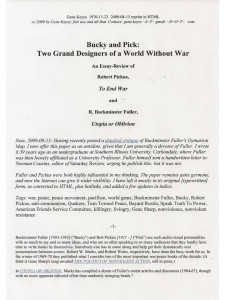
Extract from Conclusion in the Above:  I have observed the World Game as a student-participant, and wish it well. I have also observed Bob Pickus's work, as a student-participant in Turn Toward Peace, and wish him well. There are still other alternatives, but whichever road leads us faster into a world without war, what I gain most from Pickus and Fuller is their sense of the Big Picture. No one else can match their indefatigable and comprehensive efforts to see the problem whole, and to steer the world's energy into a grand design of peace.

See Also:

Who's Who in Collective Intelligence

Who's Who in Peace Intelligence

BigPictureSmallWorld

BigPicture Consulting

Design Science Lab

Global Education Lab

EarthGame

Worth a Look: Backpacks Full of Hope–The UN Mission in Haiti

5 Star, Disaster Relief, Humanitarian Assistance, Intelligence (Government/Secret), Intelligence (Public), Peace Intelligence, United Nations & NGOs, Worth A Look
Amazon Page

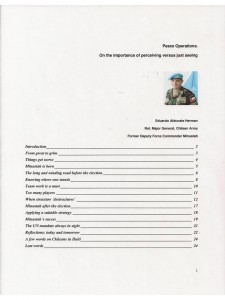
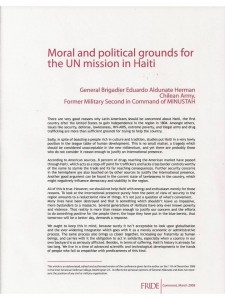
Backpacks Full of Hope: The UN Mission in Haiti describes the experience of a Chilean general as Deputy Force Commander of the United Nations Stabilization Mission in Haiti (MINUSTAH) during the particularly turbulent year September 2005 to September 2006. It details the realities of commanding more than 7,000 men from eleven countries while working to fulfill the mandate of the United Nations in Haiti—to ensure a secure and stable environment, to support the transitional government in a democratic political process, and to promote and protect the human rights of the Haitian people.

Despite the enormous challenges of a complex scenario that included local violence and extreme poverty, the UN command succeeded in its mission, stabilizing the local situation and paving the way for Haiti to hold a presidential election.

Originally published as Mision en Haiti, con la mochila cargada de esperanzas, this work provides a new audience with insight on the peace operation and sheds light on the long-term endeavour of civilians, military, and local and international agencies to support Haiti’s path to prosperity.

Co-published with the Centre for International Governance Innovation.

See Free by the Same Author:

Reference (2): United Nations Intelligence in Haiti

Reference (2): United Nations Intelligence in Haiti

05 Civil War, 07 Other Atrocities, 08 Wild Cards, 10 Security, 10 Transnational Crime, 11 Society, Analysis, Augmented Reality, Ethics, Government, Historic Contributions, InfoOps (IO), Intelligence (government), IO Multinational, IO Sense-Making, Law Enforcement, Methods & Process, Military, Officers Call, Peace Intelligence, Real Time
Peace Operations: Seeing

MajGen Eduardo ALDUNATE Herman, Chilean Army (Ret), served as the Deputy Force Commander of the United Nations Force in Haiti (MINUSTAH) in the earliest rounds, and was instrumental in both sponsoring the Joint Military Intelligence Analysis Center (JMAC) concept in its first modern field implementation, but also in evaluating most critically both the lack of useful intelligence from allies relying on secret sources and methods that did not “penetrate” to achieve gangs and neighborhoods; and the astonishing “one size fits all” propensity of the allies to treat every “threat” as one that could be addressed by force.

His contributions are helpful in understanding the more recent failure of allied relief operations in Haiti that again assumed that the use of armed bodies would address the problem, without making provision for real-world ground truth intelligence (CAB 21 Peace Jumpers Plus) or intelligence-driven harmonization of non-governmental assistance (Reverse TIPFID).

See Also:

Reference: Walter Dorn on UN Intelligence in Haiti

Reference: Civil Military Operations Center (CMOC)

2003 PEACEKEEPING INTELLIGENCE: Emerging Concepts for the Future

Books: Intelligence for Peace (PKI Book Two) Finalizing

Reference: Intelligence-Led Peacekeeping

Review: International Peace Observations

Search: UN intelligence peace intelligence

Journal: Taliban Tet a Tet + Tet Offensive

04 Inter-State Conflict, 08 Wild Cards, 10 Security, 11 Society, Government, Officers Call, Peace Intelligence
DefDog Recommends...

Analysis: Nine years on, the Taliban have a message for West

By Sayed Salahuddin

KABUL | Sat Nov 13, 2010 1:44am EST

KABUL (Reuters) – When NATO leaders gather for a summit in Lisbon next week, where Afghanistan will top the agenda, they can expect a message waiting for them from the Taliban.

That message may well be a violent demonstration of their staying power, even though Washington and U.S. and NATO commanders have been talking up recent successes in Afghanistan before the summit and a strategy review by President Barack Obama next month.

This comes as many European NATO members begin to look at how long they can keep justifying their commitments to an increasingly unpopular war, and as Obama remains committed to beginning a gradual drawdown of U.S. troops from July 2011 before the 2014 goal set by Kabul to take total security responsibility.

Rest of article….

Phi Beta Iota: Morality is a strategic force and generally favors the indigenous fighting on their own land for their own values.  It is costing us $50 million per Taliban body to fight the Taliban on their own ground.  Obama needs advisors who have integrity, intelligence, and an instinct for the future.

noble gold