Sandy Heierbacher: Deliberative Policy Engagement – Nine Principles

Advanced Cyber/IO, Collective Intelligence, Communities of Practice, Ethics, Methods & Process, Policies, White Papers
Sandy Heierbacher

Deliberative Public Engagement: Nine Principles

Posted by   |  August 18th, 2011

Deliberative is a distinctive approach to involving people in . It is different from other forms of engagement in that it is about giving participants time to consider and discuss an issue in depth before they come to a considered view. The aim of this 18-page background paper (2008) from Involve and the National Consumer Council is to encourage and support deliberative in public policy.

itself – where a range of people learn, discuss and work out solutions together – is not new. Forums, advisory groups, partnerships and some forms of consultation have done this for years and are becoming increasingly sophisticated. More recently, citizens’ juries and large-scale citizens’ summits have found favour with government and public service providers at both local and national levels.

Involve and the National Consumer Council (NCC) believe that deliberative can be valuable in helping to create better public services, promote social cohesion and foster a thriving democracy. There is already good practice throughout the UK, and the full potential contribution of to improving the quality of decisions and policy solutions, and to enhancing representative democracy is becoming clearer as experience grows.

The government and other public bodies are currently developing general guidelines on public and stakeholder engagement – making it timely for Involve and NCC to draw on the growing body of learning and evidence to contribute a set of specific principles on deliberative public engagement from outside government.

This is far from being the last word. Over the next year Involve and NCC will continue to monitor the field, listen to feedback on the value and relevance of these principles, and consider the potential need for more detailed guidance. In the mean time, we hope our work will contribute to the already-flourishing debate on the role of deliberative public engagement in Britain today.

Resource Link

Phi Beta Iota:  The 18 page document is available in English, French, and Turkish.  The nine principles of public engagement discussed in the document are:

  • The process makes a difference.
  • The process is transparent.
  • The process has integrity.
  • The process is tailored to circumstances.
  • The process involves the right number and types of people.
  • The process treats participants with respect.
  • The process gives priority to participants' discussions.
  • The process is reviewed and evaluated to improve practice.
  • Participants are kept informed.

See Also:

Tom Atlee: Citizen Deliberations – Chart and Options

Participatory Budgeting Practices, Games, Resources

Memoranda: Policy-Budget Outreach Tool
 

Patrick Meier: Crowdsourcing Imagery Analysis

Advanced Cyber/IO, Analysis, Blog Wisdom, Collective Intelligence, Geospatial, InfoOps (IO), Methods & Process, Threats
Patrick Meier

Analyzing Satellite Imagery of the Somali Crisis Using Crowdsourcing

EXTRACT:

Here’s the plan. He talks to UNOSAT and Google about acquiring high-resolution satellite imagery for those geographic areas for which they need more information on. A colleague of mine in San Diego just launched his own company to develop mechanical turk & micro tasking solutions for disaster response. He takes this satellite imagery and cuts it into say 50×50 kilometers square images for micro-tasking purposes.

We then develop a web-based interface where volunteers from the Standby Volunteer Task Force (SBTF) sign in and get one high resolution 50×50 km image displayed to them at a time. For each image, they answer the question: “Are there any human shelters discernible in this picture? [Yes/No].” If yes, what would you approximate the population of that shelter to be? [1-20; 21-50; 50-100; 100+].” Additional questions could be added. Note that we’d provide them with guidelines on how to identify human shelters and estimate population figures.

Read more….

John Robb: 147 Banks & Corporations as Global Financial Cancer, Gray Markets Fairs, Urban Foraging

01 Poverty, 03 Economy, 07 Other Atrocities, Blog Wisdom, Commerce, Commercial Intelligence, Communities of Practice, Corporations, Corruption, IO Impotency, Money, Banks & Concentrated Wealth
John Robb

JOURNAL: Global Financial Cancer

EXTRACT:  A new paper, The Network of Global Corporate Control by Vitali et. al. from ETH in Zurich.  This paper finds, through extensive network analysis, that a small group of tightly intertwined financial institutions control the bow of the global financial system.  It is in effect, the world's first super-organism.  147 trans-national companies that the global core that is owned by itself (3/4 of the ownership of firm's in this organism are owned by firms in the organism).  This organism is beyond governments.  If it is self serving (and this shouldn't be too hard to assume), it is the equivalent of a biological cancer that has metastasized.

JOURNAL: Grey Market Fairs

Maker grey market ecosystem in China. Note how the Shanzhai Rules are reminiscent of the standing orders of OSW.

Foraging on vacant lots.  The NYTimes dives in.

Phi Beta Iota:  The day will come when the executives of the 147 transnational companies find themselves kidnapped, renditioned, and tortured until they make restitution by giving up the majority of their ill-gotten gains.  We anticipate a mix of vigilante, criminal, and third world governments getting into this business.  On the other end of the spectrum, we anticipate a massive withdrawal of normal people from the fraud-ridden world of banking and government-printed money.  The two go together.

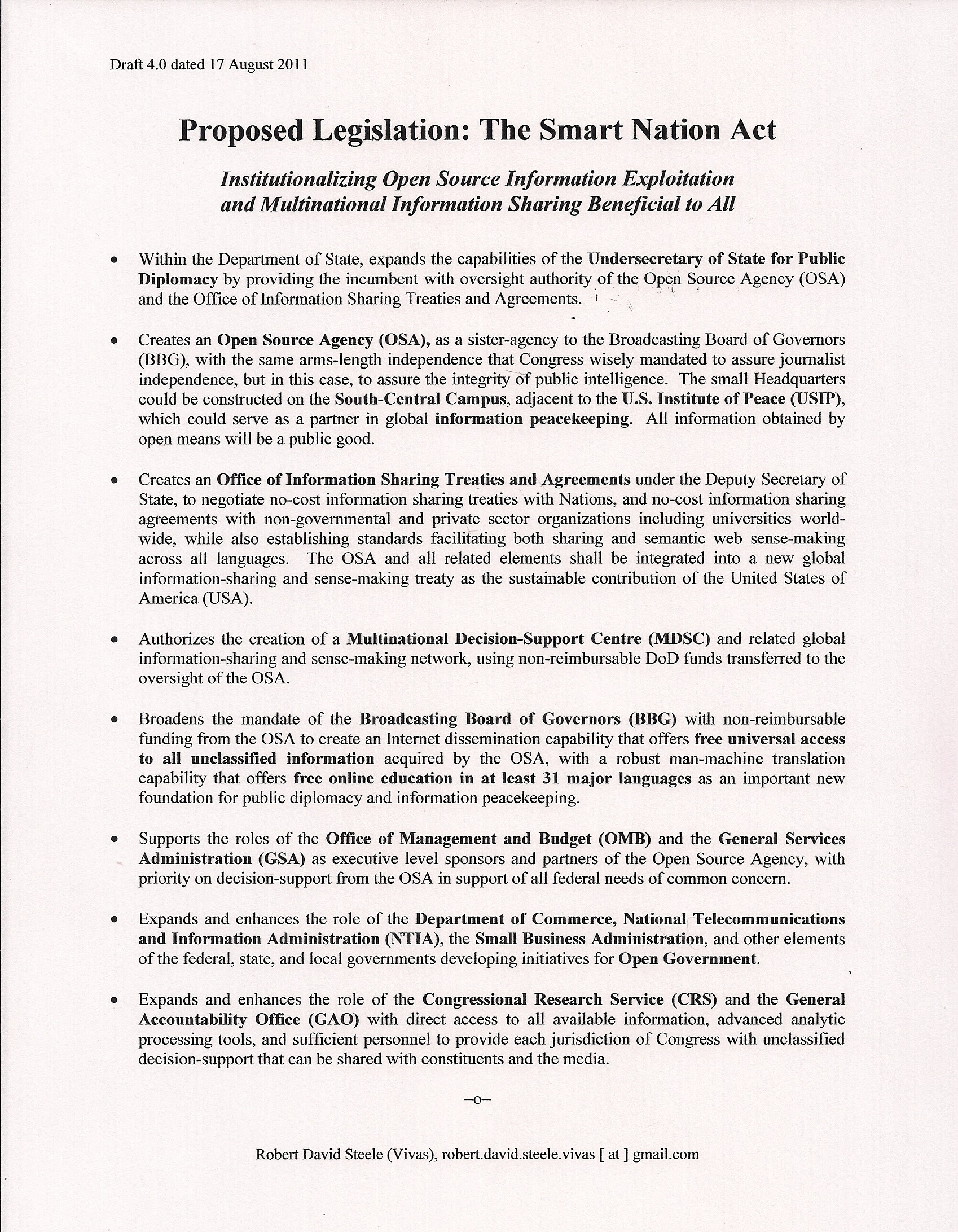
Reference: Smart Nation Act (Simplified) 2011

Advanced Cyber/IO, Analysis, Budgets & Funding, Collaboration Zones, Collective Intelligence, Communities of Practice, Congressional Research Service, Ethics, General Accountability Office, Hill Letters & Testimony, InfoOps (IO), Intelligence (government), Key Players, Legislation, Memoranda, Methods & Process, Mobile, Office of Management and Budget, Officers Call, Open Government, Policies, Policy, Politics of Science & Science of Politics, Real Time, Reform, Research resources, Resilience, Serious Games, Standards, Strategy, Technologies, Threats
Click on Image to Enlarge

Original Online (.doc 1 page)

Chuck Spinney: US versus Iran on Uranium-Lack of Integrity

05 Iran, 08 Proliferation, 10 Security, 11 Society, Corruption, Cultural Intelligence, Government, IO Deeds of War, IO Impotency, Peace Intelligence
Chuck Spinney

Spinning Iran's centrifuges

By Yousaf Butt, Asia Times, Aug 16, 2011

Yousaf Butt is a nuclear physicist and is currently serving as a scientific consultant to the Federation of American Scientists on global security issues. Previously, he was a fellow on the Committee on International Security and Arms Control at the US National Academy of Sciences, and on the Global Security Program at the Union of Concerned Scientists.

Consider yourself warned – “[I]n the next few years Iran will be in position to detonate a nuclear device,” so writes Ray Takeyh, confidently, in a recent Washington Post OpEd [1]. Why? Because the Iranian government willingly informed the International Atomic Energy Agency (IAEA) that it would begin installing additional centrifuges with higher capacity to enrich uranium. [2]

Just like fertilizer can be used to increase crop yields – or make bombs – uranium is a dual use material.

Read full article.

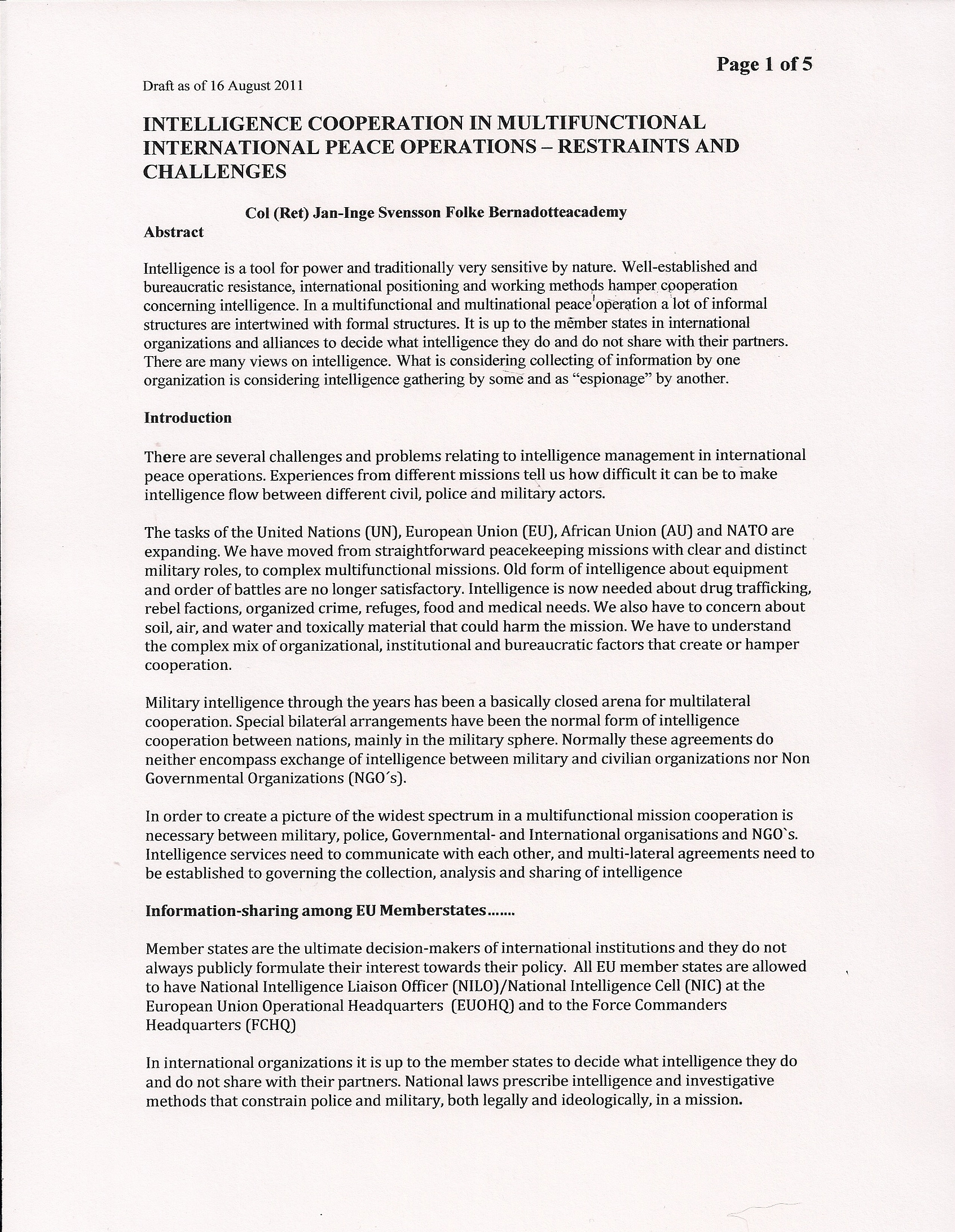
Reference: Intelligence Cooperation in Multinational International Peace Operations

Advanced Cyber/IO, Articles & Chapters, Communities of Practice, Ethics, InfoOps (IO), Intelligence (government), Key Players, Officers Call, Peace Intelligence, Policies, Real Time, Resilience, Strategy, Threats
Jan-Inge Svensson

ABSTRACT

Intelligence is a tool for power and traditionally very sensitive by nature. Well-established and bureaucratic resistance, international positioning and working methods hamper cooperation concerning intelligence. In a multifunctional and multinational peace operation a lot of informal structures are intertwined with formal structures.

EXTRACT

In order to create a picture of the widest spectrum in a multifunctional mission cooperation is necessary among military, police, Governmental- and International organisations and NGO`s.  Intelligence services need to communicate with each other, and multi-lateral agreements need to be established to governing the collection, analysis and sharing of intelligence.

Click on Image to Enlarge

DOC Online (5 Pages)

See Also:

2003 PEACEKEEPING INTELLIGENCE: Emerging Concepts for the Future

2004 4 Dec Stockholm Peacekeeping Intelligence Trip Report

Books: Intelligence for Peace (PKI Book Two) Finalizing

PKI Book I CH04 Svensson Peacekeeping and Intelligence Experiences from United Nations Protection Force 1995

Worth a Look: First Ever UN Joint Military Analysis Centre Course (October 2009)

Koko: CIA Bows to Islamic Radicals, with Strong Comment on Need for Religious Counterintelligence

07 Other Atrocities, 09 Terrorism, 10 Security, 11 Society, Blog Wisdom, Corruption, Cultural Intelligence, Government, IO Impotency, Officers Call
Koko

Below is an exact reprint from the Association For Intelligence Officers (AFIO).   HOWEVER, AFIO does not endorse the tone of the article, only the fact of its appearance.

The CIA Should be a bit more ‘CAIR'less. This week, a three-day conference hosted by the CIA on “homegrown radicalization” was supposed to have taken place at CIA headquarters. It did not. The conference was abruptly canceled – or, softening the blow, “postponed.” Question: Did pressure from what we might (and should) call a certain “homegrown radical” group – the Council on American Islamic Relations (CAIR) – make this happen?

Here is what we know.

On Monday, July 18, CAIR issued a press release headlined: “CAIR Asks CIA to Drop Islamophobic Trainer.” It revealed that CAIR national executive director Nihad Awad wrote a letter to now-former CIA Director Leon Panetta to that effect. The rest of the release is more opaque. In referencing an NPR report that slammed one counterterrorism trainer by name, former FBI agent John Guandolo, for “allegedly smearing” an “Ohio Muslim” in a presentation, CAIR noted that an entirely different trainer, unnamed, was “scheduled to hold a similar session in August for the CIA.” (Full disclosure: Guandolo and I are among 19 co-authors of Shariah: the Threat to America.) The August CIA “session” appears to be the driver of both the CAIR release and letter asking the CIA, as the headline put it, to “Drop Islamophobic Trainer.”

Continue reading “Koko: CIA Bows to Islamic Radicals, with Strong Comment on Need for Religious Counterintelligence”

noble gold