Open Source Insurgency: No More Corruption

About the Idea, Advanced Cyber/IO, Collaboration Zones, Collective Intelligence, Communities of Practice, Corruption, Counter-Oppression/Counter-Dictatorship Practices, Historic Contributions, InfoOps (IO), Key Players, Methods & Process, Mobile, Officers Call, Open Government, Policies, Real Time, Threats
Mario Profaca Recommends...

A Plausible Promise

by John Robb of Global Guerrillas

For an open source revolt (here's some background on “open source insurgency“) to be successfully formed, it needs a plausible promise.  A meta issue around which all of the different factions etc. can form (remember, most of the groups and individuals involved in an open source revolt can't agree on anything but some basic concepts).  A generic “day of revolt” doesn't accomplish that. What could?

Using the multi-million scale No Mas FARC protests as an example and the critical ingredient in the Tunisian protests (extreme corruption that generated an endless wellspring of anger/frustration), a potential “plausible promise” for an Egyptian open source revolt is:

No More Corruption

Not only is a movement opposing corruption something the government will find hard to oppose, it is something every Egyptian deals with on a daily basis.  It also has the added benefit of directly harming the entrenched ruling elite, who are likely to become poster children of the very thing the movement is against.

See Also:

Open Source Insurgency in Now Mainstream, So What's Next?

Emerging Concept of Open Stewardship

Reference: Peace versus War–Competing Visions

Reference: WikiLeaks and Al Qaeda as Open Source Insurgencies

Reference: On WikiLeaks and Government Secrecy + RECAP on Secrecy as Fraud, Waste, & Abuse
Achieving Peace in a Digital Society

Advanced Cyber/IO, Collective Intelligence, Communities of Practice, Counter-Oppression/Counter-Dictatorship Practices, Cultural Intelligence, Ethics, Mobile, Peace Intelligence, Policies, Real Time, Threats

How Do We Achieve Peace In A Digitally-Driven, Self-Assembling Society?

DK Matai, mi2g | Jan. 24, 2011, 11:58 AM

Business Insider

EXTRACT:  What we are witnessing in the 21st century is the empowerment of sovereign individuals to confront the legitimacy and authority of a sovereign nation state's government via digitally driven means. As witnessed in Tunisia, revolution has been attempted and achieved via digitally driven leaderless groups.  [ATCA: Tunisia: A Digitally Driven Leaderless Revolution, 15th January 2011]

Revolutionaries are leveraging digital technology to self-organise, to learn and to proliferate. Incumbent leaderships struggle to keep up because their thinking is generationally out-of-step and based on traditional forms of centralised hierarchical control and resource allocation.

Read complete article….

See Also:

2011: Self-Assembling Dynamic Networks And Boundary-less Tribalism

Reference: Advanced Cyber-IO (First Cut)

Advanced Cyber/IO, Computer/online security, Corruption, Cultural Intelligence, DoD, Government, Military, Monographs, Officers Call, Policies, Real Time, Threats

The below was inspired by a close look at the evolving concept of cyber-commands.  In our judgment, LtGen Keith Alexander, USA and those in charge of the various service cyber-commands are headed for spectacularly expensive failure, minor operational successes not-with-standing.  The officers concerned are well-intentioned, precisely like their predecessors who chose to ignore precisely the same insights published in 1994–they simply lack the intestinal fortitude to break with the past and get it right for a change.  What they plan is the cyber equivalent of “clear, hold, build,” and just as mis-guided.  They are out of touch with reality and will remain so.  They will all be happily retired long before the predictable recognition of their failure occurs, and the next generation of young flags will make the same mistakes again…and again…until we get an honest President with an honest Office of Management and Budget (OMB) able to demand and enforce integrity across the board.

Draft Monograph on Cyber-Command

See Also:

Continue reading “Reference: Advanced Cyber-IO (First Cut)”

Reference: Intelligence for the Spirit of Assisi

Advanced Cyber/IO, Budgets & Funding, Collective Intelligence, Collective Intelligence, Commercial Intelligence, Communities of Practice, Counter-Oppression/Counter-Dictatorship Practices, Cultural Intelligence, Earth Intelligence, Ethics, Geospatial, Gift Intelligence, History, info-graphics/data-visualization, InfoOps (IO), International Aid, Journalism/Free-Press/Censorship, Key Players, Memoranda, Methods & Process, Mobile, Open Government, Peace Intelligence, Policies, Policy, Politics of Science & Science of Politics, Power Behind-the-Scenes/Special Interests, Real Time, Reform, Research resources, Secrecy & Politics of Secrecy, Standards, Strategy, Technologies, Threats, Tools, True Cost, Waste (materials, food, etc)
Click on Image to Enlarge

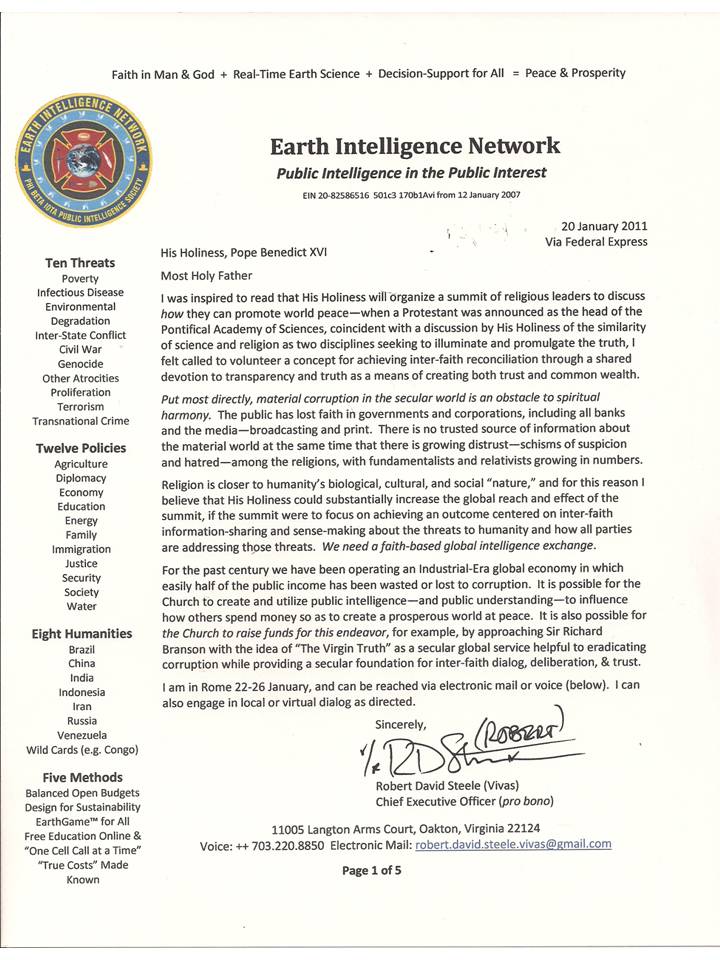
Letter to His Holiness Pope Benedict XVI

Steele Book Profile

Resume Robert David STEELE Vivas M4IS2

See Also:

28 Jan Seven Answers–Robert Steele in Rome

27 Jan Assisi-Rome 2nd Meeting

27 Jan Reference: Correspondence on Assisi Intelligence

16 Jan Event: 26 Oct 2011 Assisi Italy Pope, Peace, & Prayer — 5th Inter-Faith Event Since 1986 — Terms of Reference…

Worth a Look: Book Review Lists (Positive)

Worth a Look: Book Review Lists (Negative)

REFERENCE: IBM Advanced Information Operations

Advanced Cyber/IO, Analysis, Augmented Reality, Collaboration Zones, Collective Intelligence, Communities of Practice, Geospatial, info-graphics/data-visualization, InfoOps (IO), Key Players, Methods & Process, Mobile, Policies, Real Time, Reform, Research resources, Strategy, Threats

Posted with permission.  Provided by Dr. James Spohrer in response to a request from Phi Beta Iota for a “snap-shot” overview of the “soul” of IBM going into the 21st Century.

1. Cities: here is a short IBM video (YouTube 4:15) on cities as the nodes in the planetary system of systems

Features Mike Wing, Irving Wladawsky-Berger, Julia Grace.  Cities as planetary accupunture points of intervention.  Cities are HUMAN–computers cannot handle the unpredictable.  Dominos analogy–everything is interconnected and knowledge or information are the “energy” being exchanged among individual people, the HUMAN element. It is the mixture of people and hardware, and software that is so elegant and exciting.

2. Universities in Cities: My current job at IBM builds from the notion that universities are the knowledge batteries of city/regions… see slide #34 in this presentation on Service Science: Progress and Directions (64 Slides), connected with Handbook of Service Science (Springer, 2010).  NOTE:  Downloading presentation enables viewing of Notes for each slide.

Click on Image to Enlarge

Overview of IBM University Programs focusing on 5 R's (Research, Readiness, Recruiting, Revenue, Responsibilities); Quality of Life balance between local and global optimization; Ecology–study of all things in relation to all life forms; and Holistic Service Systems with cities and within cities, universities, and the fundamental “intelligent” building blocks.  Emphasis on information information exchanges and life-long learning.  Slide #34:

3. Connecting Universities and Cities Locally and Globally: My global team at IBM University Programs is funding connecting the universities locally with their cities, and globally with each other – networked improvement communities in Doug's language… Really connecting service systems, see Slide #16 in this presentation.

Continue reading “REFERENCE: IBM Advanced Information Operations”

BLOG WISDOM: One View of Internet & Devices

Advanced Cyber/IO, Collaboration Zones, Communities of Practice, Methods & Process, Mobile, Policies, Real Time, Threats
Seth Godin Home

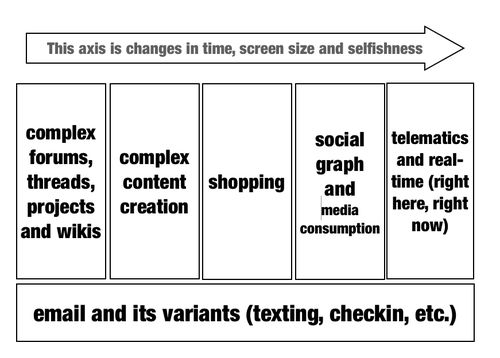
It might be about the size of the screen and whether or not you're standing up.

Start at the bottom. For the first five years of the Internet, the most used function was email. Email remains a bedrock of every device and system that's been built on top of the internet, though sometimes it looks like a text message or a mobile check in. This is the layer for asynchronous person to person connection, over time.

Moving from left to right, we see how the way we use the thing we call the internet has evolved over time. We also see how devices and technology and bandwidth have changed the uses of the net and, interestingly, how a growth in mass has led to a growth in self-motivated behavior.

Early online projects were things like Archie and Veronica and checking in changes to the Linux code base. You needed patience, a big screen and a sense of contribution.

Layer on top of this a practice that is getting ever more professional, which is creating content for others to consume. Sometimes in groups, sometimes using sophisticated software and talented cohorts.

Click on Image to Enlarge

As we move to the right (and through time) we see the birth of online shopping. Still to this day, most online shopping happens on traditional devices, often sitting down.

The sitting down part is not a silly aside. Ted Leonsis theorized twenty years ago that the giant difference between TV and the internet was how far you sat from the screen. TV was an 8 foot activity, and you were a consumer. The internet was a 16 inch activity, and you participated. I think the sitting down thing is similar. You're not going to buy an armoir while standing on the subway.

Moving over in time and device and intent, we see the idea of consuming content. While tablets get their share of shopping, this is where they really shine. I think 2011 is going to be the year of the tablet, from the Kindle to the iPad to the thing we used to call a phone.

It's in the last two categories that these other devices, things that don't involve sitting down, are superior, not just a mobile substitute. The social graph is a very low bandwidth, peripheral attention interaction, perfect for this audience and this medium. And the last category–tell me where I am, where to eat, who's near me, what's the weather, get me a cab right now–is all about me and now and here.

I don't believe this is a winner take all situation, any more than one bestselling book makes all other books obsolete. I think different pillars work for different devices, and there will continue to be winners in all of them.

MILITARY INTELLIGENCE: All Eyes No Brain

04 Inter-State Conflict, 05 Civil War, 07 Other Atrocities, 10 Security, Advanced Cyber/IO, info-graphics/data-visualization, InfoOps (IO), Intelligence (government), Methods & Process, Military, Politics of Science & Science of Politics, Power Behind-the-Scenes/Special Interests, Real Time, Secrecy & Politics of Secrecy, Strategy, Technologies
DefDog Recommends...

Interesting, but also fails to mention we do not train our analysts on the
basics, know your enemy……we are so focused on technology we forget
that the basics are still the best way to view the situation…..

When military investigators looked into an attack by American helicopters
last February that left 23 Afghan civilians dead, they found that the
operator of a Predator drone had failed to pass along crucial information
about the makeup of a gathering crowd of villagers.

In New Military, Data Overload Can Be Deadly

By THOM SHANKER and MATT RICHTEL

New York Times, Published: January 16, 2011

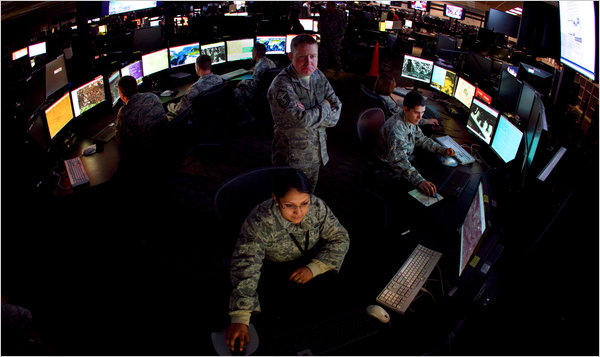
When military investigators looked into an attack by American helicopters last February that left 23 Afghan civilians dead, they found that the operator of a Predator drone had failed to pass along crucial information about the makeup of a gathering crowd of villagers.

Click on Image to Enlarge

But Air Force and Army officials now say there was also an underlying cause for that mistake: information overload.

See Also:

Gorgon Stare–USAF Goes Nuts (Again)

Gorgon Stare (All Eyes, No Brain)

noble gold