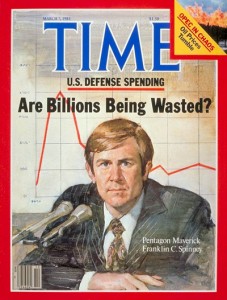
Phi Beta Iota: The author, Michael O'Hanlon, remains one of our most respected commentators on defense, and his suggestions within this document are entirely reasonable. However, he does not go far enough. A 10% reduction of a military-industrial complex budget that has nearly tripled in 30 years is not serious, nor is there innovation in this document. The military-industrial complex must be reduced by 40% if not 50%: one third direct cuts; one third reallocation to Program 150 (diplomacy & development); and one third to thinkers and actual shooters–Cyber and Advanced Information Operations, Civil Affairs, Multinational Decision Support Centres, and long over-due investment in tactical intelligence, surveillance, & reconnaissance that is Of, By, and For the Strategic Sergeant, NOT Of, By, and For Lockheed, Harris, or the U.S. Air Force.
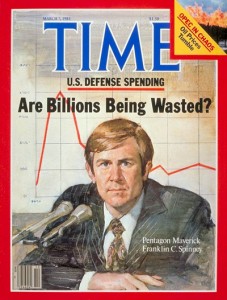
The book is a history of the largest military contractor in U.S. history, Lockheed Martin. Hartung argues that with 25 billion dollars annually in Defense Department contracts, Lockheed Martin's reach into American life is extensive and largely unknown, including creation of satellites used to spy on the phone calls of American citizens. He discusses the company's size, scope and influence with Pierre Sprey, father of the A-10 and F-16 military aircraft and a well-known thorn in the Pentagon's side. Chuck
William Hartung
Mr. Hartung is the director of the Arms and Security Initiative at the New America Foundation. He is the author of How Much are You Making on the War Daddy? and And Weapons for All. He's written for the Washington Post, the New York Times, the Los Angeles Times and The Nation magazine.
Phi Beta Iota: Our political, policy, and military leaders simply do not know what they do not know. Assuming–desiring–that they have the best of intentions–the reality is that they are not receiving the intelligence (decision-support) that they require to make intelligent decisions. In both Iraq and Afghanistan, because there was political will, trillions have been wasted on “security” instead of sustenance. Haiti, because there were no political will, was a microcosm–20,000 troops with a huge logistics tail when what was really needed were CAB 21 Peace Jumpers able to call in a Reverse TPFID…. Advanced Cyber/IO starts with imagination & intelligence.
On Need to Know, we do a lot of reporting about the world’s problems. But we’re premiering a new series about people coming up with creative solutions — it’s called “Agents of Change.”
Social entrepreneur challenging conventional wisdom
Samasource–microwork (small digital tasks that can be done on an inexpensive computers).
Building 21st Century assembly line that can break down massive tasks (e.g. updating addresses for Google maps, or translating emergency messages from Creole to English). Won contracts with Google, LinkedIn, Microsoft.
15% premium for socially-conscious companies, AND competitive on cost, quality, and turnaround time.
Small scale digital tasks did not exist before.
Transforming lives, especially women, young men, and refugees. $5 a day is very much better than local norms, and buys an active English-speaking brain with hands able to do quality work.
IMPORTANT: Developing world is out-pacing USA and West generally in extending Internet infrastructure to the poor–centers created, humans come in, also doing viewing (Gorgon Stare, take note!), creating logs of store videos on shopper buying habits, anything that can be noticed and logged by a human–$5 a day.
Phi Beta Iota: We could not, in a million years, have found a better “off-set” to the USAF Gorgon Stare program. This micro-tasking, combining human brains and hands with Internet access, is one of the most profoundly intelligent and socio-economically useful ideas we have seen in our lifetimes (there are 800 of us here). BRAVO.
The American Way of War: If You Can See Everything, Can You Know Anything?
With Air Force's new drone, ‘we can see everything,'in today's Washington Post (attached below) is a good example of how the high-cost addiction to techno war is running amok. One thing ought to be clear in Afghanistan: A tiny adversary armed with the most primitive weapons, and a command and control system made up of prayer rugs and cell phones, has brought the high tech US military to a stalemate … or even worse, the looming specter a grand-strategic defeat, because we are becoming economically and morally exhausted by the futility of this war. It does not matter whether it is President Obama presiding over a vapid strategic review or a low ranking grunt on point in Afghanistan — the central problem facing the United States in Afghanistan is the absence of what the Germans call fingerspitzengefühlor the feeling in the fingerprints needed for an intuitive feel for or connection with one's environment.
As the American strategist Colonel John Boyd (USAF Ret.) showed, fingerspitzengefühl is absolutely essential to the kind of synthetic (as opposed to analytic) thinking that is necessary for quick, relevant, and ultimately successful decision making in war, where quick decisions and sharp actions at all levels must be made and harmonized in an ever-present atmosphere of menace, uncertainty, mistrust, fear, and chaos that impedes decisive action.[1]
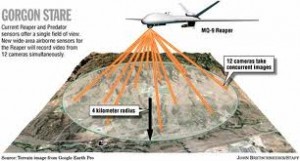
Article About Grogon Stare
To paraphrase Clausewitz, these difficulties multiply to produce a kind of friction, and therefore, even though everything in war is simple, the simplest thing is difficult. Clausewitz considered friction is the atmosphere of war. Nevertheless, according to the Post, the Air Force is about to deploy to Afghanistan a “revolutionary airborne surveillance system called Gorgon Stare, which will be able to transmit live video images of physical movement across an entire town.”
Quoting Maj. Gen. James O. Poss, the Air Force's assistant deputy chief of staff for intelligence, surveillance and reconnaissance, “Gorgon Stare will be looking at a whole city, so there will be no way for the adversary to know what we're looking at, and we can see everything.” Nirvana. While the Post dutifully reports a smattering of opposing views, it misses the ramifications of the central idea epitomized by General Poss's confident assertion: namely, how the American ideology of techno war assumes it can negate the human need for fingerspitzengefühl on a battlefield.
General Poss's confidence suggests quite clearly he believes seeing everything enables one to know everything. This a stunning theory of knowledge. It is also a classic example of the American military's unquestioned belief that complex technologies coupled to step-by-step analytical procedures can negate the friction of combat to solve any problem in war. Lifting the fog of war is, in fact, a phrase frequently used in contractor brochures touting the efficacy of these technologies. This reflects theory of knowledge — really an unquestioned ideology — that views war as fundamentally a procedural problem of methodical analytical thinking, as opposed to its messy reality of being in large part an art of synthetic thinking.
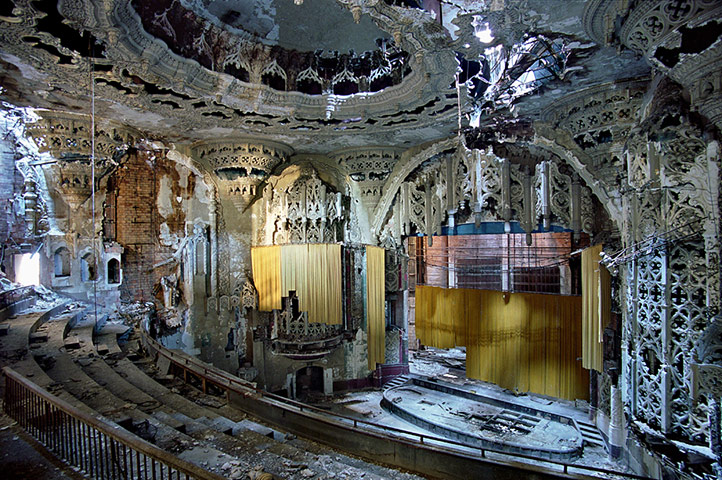
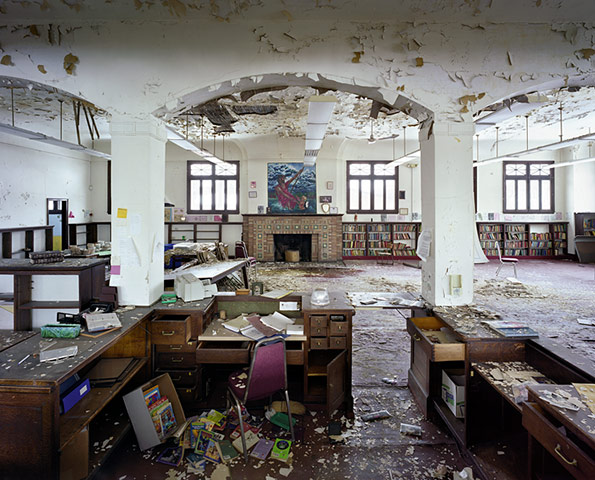
In downtown Detroit, the streets are lined with abandoned hotels and swimming pools, ruined movie houses and schools, all evidence of the motor city's painful decline. The photographs of Yves Marchand and Romain Meffre capture what remains of a once-great city – and hint at the wider story of post-industrial America
. . . . . . .
Click to Enlarge
Cumulatively, the photographs are a powerful and disturbing testament to the glory and the destructive cost of American capitalism: the centre of a once-thriving metropolis in the most powerful nation on earth has become a ghost town of decaying buildings and streets. There is a formal beauty here too, though, reminiscent of Robert Polidori's images of post-hurricane Katrina New Orleans. “It seems like Detroit has just been left to die,” says Marchand, “Many times we would enter huge art deco buildings with once-beautiful chandeliers, ornate columns and extraordinary frescoes, and everything was crumbling and covered in dust, and the sense that you had entered a lost world was almost overwhelming. In a very real way, Detroit is a lost world – or at least a lost city where the magnificence of its past is everywhere evident.”
. . . . . . .
Click to Enlarge
The Ruins of Detroit tells the city's story so far in one starkly beautiful photograph after another, all of which add up to nothing less than an end-of-empire narrative. Or as Sugrue puts it: “The abandoned factories, the eerily vacant schools, the rotting houses, and gutted skyscrapers that Yves Marchand and Romain Meffre chronicle are the artefacts of Detroit's astonishing rise as a global capital of capitalism and its even more extraordinary descent into ruin, a place where the boundaries between the American dream and the American nightmare, between prosperity and poverty, between the permanent and the ephemeral are powerfully and painfully visible. No place epitomises the creative and destructive forces of modernity more than Detroit, past and present.”





 Working for change: Samasource redefines international aid