BAD news for opening up broad access to crime data - the
number one everyday citizen demanded government information based my
direct experience with online community forums. Note some useful
links: http://pages.e-democracy.org/Minneapolis_and_St._Paul_crime_data

"CrimeReports is contending in a current federal case that public crime
data becomes CrimeReports' own proprietary product in the form
provided on CrimeReports.com."

The bill should be amended to fund an effort modeled on the
standardization of transit scheduling/routing data -
http://www.gtfs-data-exchange.com - so that all police departments can
put out real-time feeds of various crime data (heck, Seattle even does
911 calls now - http://schrier.wordpress.com/2010/08/05/citywatch/ )
for broad reuse.

Like weather data provided by the federal government, it gets to the
people through many, often competing providers.
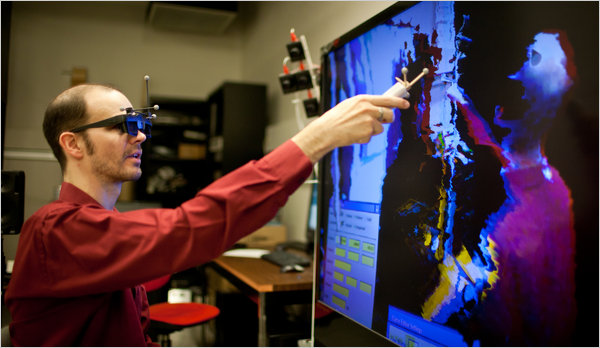
Mr. Kreylos, who specializes in virtual reality and 3-D graphics, had just learned that he could download some software and use the device with his computer instead. He was soon using it to create “holographic” video images that can be rotated on a computer screen. A video he posted on YouTube last week caused jaws to drop and has been watched 1.3 million times.
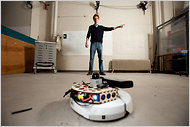
Philipp Robbel combined an iRobot device and the new Microsoft controller that can recognize gestures. He calls it the KinectBot.
Mr. Kreylos is part of a crowd of programmers, roboticists and tinkerers who are getting the Kinect to do things it was not really meant to do. The attraction of the device is that it is outfitted with cameras, sensors and software that let it detect movement, depth, and the shape and position of the human body.
Mehmet S. Akten uses the system to draw in 3-D.
Phi Beta Iota: Microsoft took a few days to “get it” but their “final answer” is exactly right: “Anytime there is engagement and excitement around our technology, we see that as a good thing,” said Craig Davidson, senior director for Xbox Live at Microsoft. “It’s naïve to think that any new technology that comes out won’t have a group that tinkers with it.” Kudos as well to the New York Times for a lovely piece of useful inspiring reporting.
I’ve found myself giving cautionary talks on the future of the Internet, or possible futures, plural – the real danger that the Internet and the World Wide Web that operates on it will become less open, perhaps become fragmented, balkanized into closed networks that no longer cooperate, filled with walled gardens with various filters and constraints, and no longer be a platform with low barriers to entry and assurance that if you connect something, anyone anywhere in the world will have access to it. The Internet would no longer be the powerful engine for innovation and communication it has been.
Tim Berners-Lee, who created the World Wide Web, writes about this in Scientific American, saying that some of the web’s “successful inhabitants have begun to chip away at its principles. Large social-networking sites are walling off information posted by their users from the rest of the Web. Wireless Internet providers are being tempted to slow traffic to sites with which they have not made deals. Governments—totalitarian and democratic alike—are monitoring people’s online habits, endangering important human rights.”
If we, the Web’s users, allow these and other trends to proceed unchecked, the Web could be broken into fragmented islands. We could lose the freedom to connect with whichever Web sites we want. The ill effects could extend to smartphones and pads, which are also portals to the extensive information that the Web provides.
My next scheduled talk about the future of the Internet is January 5 at noon, at Link Coworking [Austin, TX].
Phi Beta Iota: The paradigm is power is “rule by secrecy” and fragmentation. The web and all that suggests for human connectivity is its anti-thesis. 2012 appears to be the year of convergence, confrontation, and emergence.
If it's a new problem, perhaps it demands a new approach. If it's an old problem, it certainly does.
Phi Beta Iota: From Gandhi to Einstein to Ackoff and Fuller, and now Tom Atlee, the point is obvious to most of us–just not to those in power who see that the lack of integrity is working for them, never mind the rest…
However you want to define the American dream, there is not much of it that’s left anymore.
Wherever you choose to look — at the economy and jobs, the public schools, the budget deficits, the nonstop warfare overseas — you’ll see a country in sad shape. Standards of living are declining, and American parents increasingly believe that their children will inherit a very bad deal.
We’re in denial about the extent of the rot in the system, and the effort that would be required to turn things around. It will likely take many years, perhaps a decade or more, to get employment back to a level at which one could fairly say the economy is thriving.
With the public in the U.S and particularly in Europe losing patience with the Afghan mission, the NATO announcement seemed intended to generate headlines or at least a public perception of a plan for withdrawal.
In fact, the transition plan is more of a hope than a detailed road map. The provinces to be handed over next year by NATO and U.S. forces have yet to be selected, officials said, and the prospects for transition in parts of the country facing the fiercest fighting are murky at best. Decisions about whether to negotiate with the Taliban have yet to be made and disagreements remain about what concessions could be made.
As a published field, though, Conspiracy Theory has a surprisingly strong foundation. Consider Carroll Quigley's “The Anglo-American Establishment,” a masterpiece that completely unravels a powerful, and very real, conspiracy. It's written by an internationally respected Oxford professor, and it's content has never been disputed. Indeed, it is so meticulously and absurdly detailed that nobody has ever read it. There are lists of names and dates over 10 pages long throughout the text and I find myself skipping whole chapters every time I try and dig in. The information here is seldom referenced today, but it has been co-opted and integrated into the marketplace, too. Professor Quigley becomes Cleon Skousen becomes Glenn Beck.
In her newest book, former Alaska Governor Sarah Palin sharply criticizes the record of President Barack Obama while defending her own, in the process offering an unapologetic vision of conservative politics that strongly suggests a forthcoming presidential run.
“America by Heart,” which will be officially released on Tuesday (The Huffington Post obtained an advance copy), exhibits Palin in a variety of roles: culture warrior, presidential critic, committed mother and political provocateur. Clocking in at roughly 270 pages, it reads, at times, like an episode of Glenn Beck's Fox News show. Lengthy quotes and historical research is threaded, often, around contemporary political debates. In the mind's eye of the former governor, the founders, were they alive today, would be nothing short of Palin devotees — and they would certainly be shocked by Obama.
The president makes infrequent appearances in Palin's book, but when he does surface it is in an unflattering light.
“There is a narcissism in our leaders in Washington today,” Palin writes. “There's a quasi-religious feeling to the message coming from them. They are trying to convince us that not only are they our saviors, but that we are our saviors… as candidate Obama proclaimed on Super Tuesday 2008, ‘We are the ones we've been waiting for, we are the change that we seek.'”
Obama, as Palin posits, is neither providing the change that was sought nor fulfilling the role of savior he supposedly promised. Instead, he is cast as a wealth re-distributor, a sly practitioner, and, above all else, a politician with policies antithetical to American values. This is true, she argues, on matters large and small.

 http://www.publicinsightnetwork.org