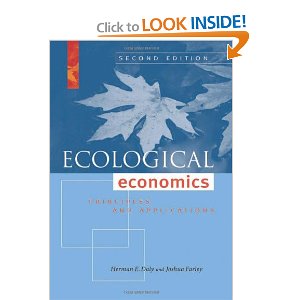
Review: Ecological Economics – Principles and Applications (Second Edition)

5 Star, Complexity & Resilience, Economics, Environment (Solutions), Nature, Diet, Memetics, Design, Science & Politics of Science, Survival & Sustainment, Technology (Bio-Mimicry, Clean), True Cost & Toxicity, Values, Ethics, Sustainable Evolution, Water, Energy, Oil, Scarcity
Amazon Page

Herman Daly

5.0 out of 5 stars Nobel Level Foundation for Resilience & Sustainability, February 1, 2012

Dr. Herman E. Daly may well be a future Nobel Prize winner …he is especially well-regarded in Norway and Sweden, where he has received prizes one step short of the Nobel. He is the author, co-author, or primary contributing editor of many books that fully integrate the disciplines of economics and ecology. I bought the three most recent for the purpose of selecting one to give out at my annual Global Information Forum. I ended up choosing For The Common Good: Redirecting the Economy toward Community, the Environment, and a Sustainable Future, in part because it is available in paperback and is not a more expensive “trade” publication; and in part because it is strong in laying out specific ecological policy areas in the context of a strong theological or ethical perspective. More on that in its own review.

Of the three books (the third one that I reviewed is Valuing the Earth: Economics, Ecology, Ethics) this, the text-book, is assuredly the most up-to-date and the most detailed. If you are buying only one book for yourself, this is the one that I recommend, because these are important issues and a detailed understanding is required with the level of detail that this book provided. It should, ideally, be read with “Valuing the Earth” first (see my separate review of that book, from the 1970s updated with 1990s material and new contributions), then “For the Common Good”, and finally the text book as a capstone. But if you buy only one, buy this one.

Continue reading “Review: Ecological Economics – Principles and Applications (Second Edition)”

Review: Ecological Intelligence – The Hidden Impacts of What We Buy

5 Star, Economics, Education (General), Environment (Solutions)
Amazon Page

Daniel Goleman

5.0 out of 5 stars Relevance, Content, Price–Solid Five,December 29, 2011
I chose this book over Ecological Intelligence: Rediscovering Ourselves in Nature and seeing the author's note about this other book “by a physician, Jungian analyst, and poet” am certain I made the right choice.

The author's “big idea” is called “Radical Transparency,” what the rest of us have been calling “Open Books” for decades. I like it, and in the context of his elegant story-telling, I buy in. This book also goes to a five because it is an Information Operations (IO) books, ably focused on data, information, and information-sharing as well as collective sense-making. He author anticipates most of us becoming “active agents” for change, armed with information as Thomas Jefferson understood so well.

CORE NUGGET: Life Cycle Assessment (LCA) is not done for most things, but when done right, it is mainly data and it tracks impacts on human health, ecosystems, climate change, and resource draw-down, for every single component and every single process including transport, packaging, etcetera. Toward the end of the book when the author talks about how an LCA commons is emerging, and quotes Andy Ruben of normally ultra-evil Wal-Mart as saying that LCA innovation “is the largest strategic opportunity companies will see for the next fifty years,” I am seriously impressed.

Continue reading “Review: Ecological Intelligence – The Hidden Impacts of What We Buy”

Review: How People Harness Their Collective Wisdom and Power to Construct the Future

5 Star, Best Practices in Management, Change & Innovation, Communications, Complexity & Resilience, Democracy, Education (Universities), Environment (Solutions), Information Operations, Intelligence (Public), Leadership, Nature, Diet, Memetics, Design, Science & Politics of Science, True Cost & Toxicity, Truth & Reconciliation, Values, Ethics, Sustainable Evolution, Voices Lost (Indigenous, Gender, Poor, Marginalized), Water, Energy, Oil, Scarcity
Amazon Page

Alexander Christakis, Kenneth Bausch

5.0 out of 5 stars 5 for Original, 4 For Density, October 25, 2011

The primary author of this book was closely associated with Dr. Jan Warfield, one of the giants of reflexive practice and cybernetic coherence, along with Dr. Russell Ackoff, and that alone makes this book a special read for me.

Warfield never got the recognition he merited, and George Mason University blew a decade long lead in this area, and today they are still failing to create the integrative and pro-active inter-disciplinary programs that reflect the the wisdom of Buckminster Fuller, Jan Warfield, and Russell Ackoff, among others. I know from personal experience that GMU refused to consider the World Brain Institute and EarthGame, both of which would have made them unique in the world, so I can appreciate to a personal degree how lonely Jan Warfield must have felt there.

Continue reading “Review: How People Harness Their Collective Wisdom and Power to Construct the Future”

Review: Whole Earth Discipline – An Ecopragmatist Manifesto

5 Star, Complexity & Catastrophe, Complexity & Resilience, Culture, Research, Economics, Environment (Problems), Environment (Solutions), Nature, Diet, Memetics, Design, Priorities, Science & Politics of Science, Survival & Sustainment, Technology (Bio-Mimicry, Clean), True Cost & Toxicity, Voices Lost (Indigenous, Gender, Poor, Marginalized)
Amazon Page

Stewart Brand

5.0 out of 5 stars Surprising, Challenges, Perhaps Wrong on Some Points,September 13, 2011

This book is an absorbing read, and several of the top reviews are very useful to anyone considering buying the book (also available in paperback, Amazon is now NOT crossing reviews over from different forms, a mistake in my view, but perhaps motivated by their trying to give the millions of new reviewers a starting point against those of us who have been reviewing books on Amazon for eleven years.

This book can read at multiple levels, and I dare to say that to reach each additional level, a second and third reading of the book is required.

Level 1: An overview of books that Stewart Brand has read and his general sense of the world.

Level 2: A deeper engagement with his thinking on climate change, urbanization, and biotechnology

Level 3: A very deep and necessarily skeptical reading of his book, mindful of many areas where he may be wrong while appreciating the extraordinary lifetime of intellectual and ethical leadership that he brings to bear–this is the man who created Co-Evolution Quarterly, Whole Earth Review, the Silicon Valley Hacker's Conference that I was elected to in 1994 and am attending this year (4-6 November), and the Clock of the Long Now, as well as Global Business Network and other initiatives. He is in brief, one of a dozen minds I consider “root” for whatever good we might muster in the USA in the near term, along with Tom Atlee and a handful of others.

Continue reading “Review: Whole Earth Discipline – An Ecopragmatist Manifesto”

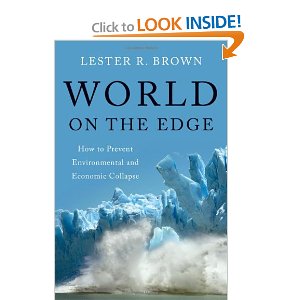
Review: World on the Edge – How to Prevent Environmental and Economic Collapse

4 Star, Environment (Problems), Environment (Solutions), Nature, Diet, Memetics, Design, Priorities, True Cost & Toxicity, Values, Ethics, Sustainable Evolution
Amazon Page

Lester Brown

4.0 out of 5 stars The One Book to Buy of Brown's–By No Means the Whole Picture, September 10, 2011

I've read and reviewed a number of books by Lester Brown and his advocacy agency, and have especially appreciated the State of the World series, and his Plan B Series that keeps getting pushed back, and now has a Plan B 4.0, but between that latter book and this one, I chose this one.

It gets four stars for reasons I outline in passing below. The author has his pet rocks, they are all here, but NOT in this book can one find corruption, disease, mercury, rare earths, a strategic analytic model that is holistic, actual true costs across the spectrum of options, or a strategic analytic model.

However, and this is strong praise, if you are going to get only one book by Lester Brown, this is the book to get. There are others I recommend, including High Noon 20 Global Problems, 20 Years to Solve Them, and A More Secure World: Our Shared Responsibility–Report of the Secretary-General's High-level Panel on Threats, Challenges and Change, the latter also free online.

Here are highlights, generally things I did not know and thought worth putting into my notes.

Continue reading “Review: World on the Edge – How to Prevent Environmental and Economic Collapse”

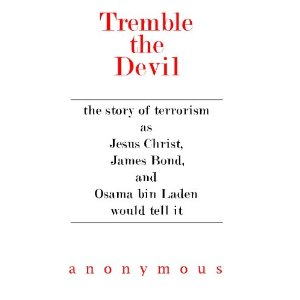
Review: Tremble the Devil (in Hard Copy Finally)

6 Star Top 10%, America (Founders, Current Situation), Asymmetric, Cyber, Hacking, Odd War, Civil Society, Complexity & Catastrophe, Congress (Failure, Reform), Culture, Research, Democracy, Diplomacy, Economics, Empire, Sorrows, Hubris, Blowback, Environment (Problems), Environment (Solutions), Executive (Partisan Failure, Reform), History, Insurgency & Revolution, Intelligence (Government/Secret), Intelligence (Public), Peace, Poverty, & Middle Class, Politics, Power (Pathologies & Utilization), Priorities, Public Administration, Religion & Politics of Religion, Terrorism & Jihad, Threats (Emerging & Perennial), Truth & Reconciliation, Values, Ethics, Sustainable Evolution, Voices Lost (Indigenous, Gender, Poor, Marginalized), War & Face of Battle
Amazon Page

Anonymous

5.0 out of 5 stars Beyond 5 Stars, Epic, Poetic, Startling, Reasoned,September 9, 2011

I am the one who urged the author to get his book into Amazon's excellent CreateSpace. As much as I personally hate electronic books, I absorbed this book in electronic form and can only say that in print it has got to become a collector's item. This is hard truth, straight up. It should certainly be translated into Arabic, Chinese, and other languages. This book goes into my top ten percent “6 Stars and Beyond.” See the others at Phi Beta Iota the Public Intelligence Blog, under Reviews (middle column).

Right up front, let me give the author and this book my highest praise: both have INTEGRITY. Integrity is not just about honor, it's about doing the right thing instead of the wrong thing righter, it's about being holistic, open-minded, appreciating diversity, respecting the “other.” There is more integrity in this book than in the last thousand top secret intelligence reports on Afghanistan, all full of lies and misrepresentations.

Continue reading “Review: Tremble the Devil (in Hard Copy Finally)”

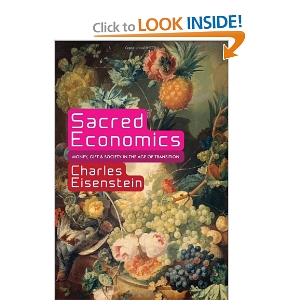
Review: Sacred Economics – Money, Gift, and Society in the Age of Transition

6 Star Top 10%, America (Founders, Current Situation), Capitalism (Good & Bad), Change & Innovation, Complexity & Resilience, Consciousness & Social IQ, Culture, Research, Democracy, Economics, Environment (Solutions), Intelligence (Collective & Quantum), Intelligence (Public), Intelligence (Wealth of Networks), Peace, Poverty, & Middle Class, Politics, Power (Pathologies & Utilization), Stabilization & Reconstruction, Survival & Sustainment, Values, Ethics, Sustainable Evolution, Voices Lost (Indigenous, Gender, Poor, Marginalized), Water, Energy, Oil, Scarcity
Amazon Page

Charles Eisenstein

5.0 out of 5 stars Beyond 5 Stars, an Integrative Pioneering Work,August 13, 2011

Sacred Economics is the second book in the new Evolver Editions imprint, following Jose Arguelles Manifesto for the Noosphere. Other books in the first season include What Comes After Money, The Secret Tradition of the Soul, The Four Global Truths, The Electric Jesus, Star Sister, and Nothing and Everything.

I read a lot, and the one word that really describes this book is “integrative.” The author describes, in three parts, what is wrong with what he calls the “economics of separation,” today's money and financial network economy that lacks soul or spirit; its alternative, the “economics of reunion” in which all forms of transaction have memories, gifts and reciprocal gifts and localized forms of exchange rule, and economics is fully integrated with society to produce social and cultural dividends. The third and last part closes the circle with a hundred-page discourse (double-spaced large print, this is not a hard book to read) on how to live within the new economy in which gifting, community, and beauty are integrated.

Throughout the book the author evolves his core point: money is “hard” and nurtures external diseconomies, including grave destruction of cultural and social intangible value-gradually the author builds up to his conclusion, that beauty is a tangible value, that relatedness is a tangible value, and that in the past century or two we have stripped so much value from what it means to be human as to have become less than human, less than we can be.
Continue reading “Review: Sacred Economics – Money, Gift, and Society in the Age of Transition”