White House meets corporate CEOs for ideas on modernizing government
Because too many government information technology systems are rooted in the 1960s and ’70s, the White House is convening a conference today of 50 corporate chief executives with the hope of generating fresh ideas to help modernize government and improve efficiency.
Chief Performance Officer Jeffrey Zients, who has spent 20 years in the private sector, said that “in my seven months as CPO it has become clear to me that one of the biggest challenges we face is the technology gap that exists between the public and private sectors.”
Phi Beta Iota: Despite the Office of Management and Budget (OMB) effort to find “common solutions,” the reality is that stove-pipe budgets and stove-pipe promotion systems produce stove-pipe minds. What OMB should be doing is creating a global skunk works to establish the open source trinity: free/open source software, open source intelligence, and open spectrum, amidst deep Multinational Engagement. Of course, DoD could do this on its own, if it really wanted to, through the Defesne Open Source Center and embedded Multinational Decision Support Center.
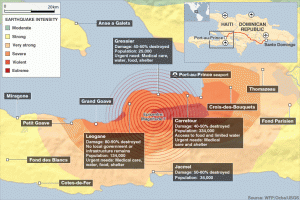
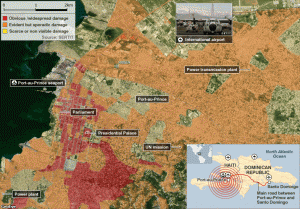
“Our plan worked exactly like it was supposed to,” says Wendy Harman, social media manager, at the American Red Cross.
“We have a ‘cabinet' of 30 celebrities, who have agreed to ask their Twitter followers to spread the word.
“Within three hours of the earthquake, we had our text number ready.
“We tweeted. The celebrities re-tweeted. And then others quickly followed. People like Michelle Obama, Jane Seymour and Craig Newmark (of Craigslist) got on board. And after that, the appeal spread like wildfire.”
My friends who served in the military speak of the pride with they performed what they viewed as their duty. This duty included the obligation to act with honor, including, above all, following the Geneva Conventions when handling detainees and prisoners of war. My friends tell sadly of the despair they felt in seeing this obligation shredded during the Bush administration as word came down that they should do “whatever it takes.” Some of them resigned in disgust. Others resisted what they viewed as moral decay from within.
A new story by attorney Scott Horton at Harpers reveals yet another very disturbing episode of dishonor. Horton reveals strong credible evidence that three alleged “suicides” at Guantanamo in June 2006 were really homicides. The official story is that during the night of June 9, 2006, three prisoners were found hanging in their cells in Alpha Block of Guantanamo's Camp 1.
Hubris means extreme haughtiness or arrogance. Hubris often indicates a loss of touch with reality and overestimating one's own competence or capabilities, especially for people in positions of power.
In its modern usage, hubris denotes overconfident pride and arrogance; it is often associated with a lack of humility, not always with the lack of knowledge. An accusation of hubris often implies that suffering or punishment will follow, similar to the occasional pairing of hubris and nemesis in the Greek world. The proverb “pride goes before a fall” is thought to sum up the modern definition of hubris. It is also referred to as “pride that blinds”, as it often causes someone accused of hubris to act in foolish ways that belie common sense. Victor in Mary Shelley's Frankenstein manifests hubris in his attempt to become a great scientist by creating life, but eventually regrets this previous desire. More recently, in his two-volume biography of Adolf Hitler, historian Ian Kershaw uses both ‘hubris' and ‘nemesis' as titles. The first volume, ‘Hubris'[7], describes Hitler's early life and rise to power. The second, ‘Nemesis' [8], gives details of Hitler's role in the Second World War, and concludes with his fall and suicide in 1945.
Wiki Government: How Technology Can Make Government Better, Democracy Stronger, and Citizens More Powerful
“A sweeping visionary yet highly pragmatic book! Beth Noveck concretely shows how to leverage the participatory nature of web 2.0 technologies to build a new kind of participatory democracy and a smart, lean government. She speaks from experience. A must read not just for policy folks and the digerati but for any of us wanting to understand how to tap the collective and diverse wisdom of the America to create a better, more connected style of democracy.”
Phi Beta Iota: Focuses on the patent process–use Look Inside to study contents before making a purchase decisioin. We have ordered the book and will review it within the week.
Amazon Page
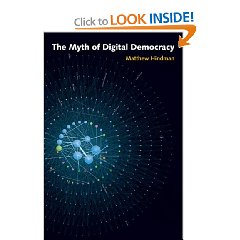
The Myth of Digital Democracy
Both utopian and dystopian interpretations have been made of the Internet's influence on many spheres of life–and democracy is no exception. . . . Absent from much of this debate is evidence-based analysis of the effects of the Internet on the business of politics. Many theories have been built on nothing more than anecdote, inference and assertion. In The Myth of Digital Democracy, political scientist Matthew Hindman fills important gaps in the evidence base, and does so accessibly.
Simon Johnson, former chief economist of the IMF, lays out the political case for “Trust Busting” in the 21st Century — it is a political argument that Andrew Jackson and Teddy Roosevelt would have understood and probably approved of.
At this stage in the electoral cycle, Democrats should be running hard against big banks and their consequences. Some roots of our current economic difficulties lie in the Clinton 1990s, but the real origins can be traced to the financial deregulation at the heart of the Reagan Revolution – and all the underlying problems became much worse in eight years of George W. Bush’s unique brand of excess and neglect.
The theme for the November midterms should be: Which part of the 8 million jobs lost [since December 2007] do you not understand? The big banks must be reined in and forced to break themselves up, or we’ll head directly for another such crisis.
Instead, the Democrats have fallen into a legislative and electoral trap that – amazingly – they built for themselves.
1) US Intelligence Community does not actually “know” where Iran is on nuclear, where Yemen is on Al Qaeda, where the Taliban is on Afghanistan….the list is long.
2) CIA and DoJ ares out of control on assessments and investigations–or they are consistently politicized. One or the other, which is it?
3) Terrorism is still the crutch for those unable or unwilling to comprehend Grand Strategy and a more mature appreciation for all of the threats, all of the policies, all of the information, all of the time. The USA remains government by uninformed sound-bite.
4) India matters, so we are told, as a recipient of expensive U.S. war-fighting technology and as a partner against terrorism. Never mind the deeply shared problem of poverty in America and India, a problem quickly addressable by the redirection of a fraction of the Pentagon budget toward “peaceful preventive measures.”
Herewith, then, is an all-inclusive guide to the scandal of the New Black Panther Party voter-intimidation case, based largely on documents unearthed by The Washington Times, along with other original reporting – and why it is important:
The FBI illegally collected more than 2,000 U.S. telephone call records between 2002 and 2006 by invoking terrorism emergencies that did not exist or simply persuading phone companies to provide records, according to internal bureau memos and interviews. FBI officials issued approvals after the fact to justify their actions.
The Christmas Day episode highlights three critical points. First is how much progress U.S. intelligence has made. . . . Second, the Christmas Day plot demonstrates that much of what passes for security is a waste of time and money. . . . Third, the public furor over the foiled plot shows that more perspective on terrorism is essential.
Rep. Peter Hoekstra, Michigan Republican and ranking member of the House Permanent Select Committee on Intelligence, said in an interview that “they wrote a political document in 2007 to embarrass President Bush which everyone uniformly agrees was a piece of trash.”
That said, there are still more opportunities for closer cooperation that will allow us to share technology and increase the flow of information and expertise. . . . Perhaps the greatest common challenge India and the United States face is terrorism.
NIGHTWATCH Afghanistan: Multiple news services reported today’s bold Afghan Taliban attacks in Kabul. The coordinated multiple attacks killed at least 15 and injured 62, as reported in this Watch
Four militants also were killed, including two suicide bombers who detonated their explosives, and Afghan forces were searching several other areas in the city for more attackers, a government spokesman said.
It was the biggest attack in the capital since 28 October when gunmen with automatic weapons and suicide vests stormed a guest house used by U.N. staff, killing at least 11 people including three U.N. staff.
The attack coincided with the investiture of those Cabinet members in the Karzai government who had been confirmed by the Parliament. A majority of his choices have been rejected twice.