As a publisher who is also an author, I continue to be outraged by the prices being charged for “trade” publications. This book is properly-priced–other books on GIS I would have bought are priced at three to four times their actual value, thus preventing the circulation of that knowledge. Those publishers that abuse authors and readers refuse to respect the reality that affordably priced books are essential to the dissemination of knowledge and the perpetuation of the publishing industry.
The book loses one star for refusing to address Google Earth and elements of the Google offering in this industry space. While Google is predatory and now under investigation by the anti-trust division of the Department of Justice, to ignore Google and its implications for cloud management of data in geospatial, time, and other cross- cutting contests, is the equivalent of poking one eye out to avoid seeing an approaching threat.
Having said that, I found this book from ESRI charming, useful, and I recommend it very highly, not least because it is properly priced and very well presented. Potential clients of ESRI can no doubt get bulk deliver of this volume for free.
Return on Investment factors that ESRI highlights up front include:
+ Cost and times savings
+ Increased efficiency, accuracy, productivity of existing resources
+ Revenue generation
+ Enhanced communications and collaboration
+ Automated workflows
+ More efficient allocation of new resources
+ Improved access to information.
The book consists of very easy-to-read and very well-illustrated small case studies, most previously published in Government Matters, which appears to be a journal (there are a number listed by that title).
Here are the highlights of this book for me personally:
+ Allows for PUBLIC visualization of complex data
+ Framework for “seeing” historical data and trends
+ Value of map-based dialog [rather than myth-based assertions]
+ Allows for the visualization of competing perspectives past and future
+ Illuminated land population dynamics, I especially like being able to see “per capita” calculations in visual form, especially when per capita can also be sliced by age, sex, income, religion, race, and so on.
+ Mapping derelict vessels underwater is not just a safety function, but opens the way for volunteer salvage and demolition
+ GROWS organically by attracting new data contributors who can “see” the added value of contributing their data and then being able to see their data and everyone else's data in geospatial terms. This is a POWERFUL incentive for information-sharing, which more often than not receives lip service. GIS for me is the “key” to realizing sharing across all boundaries while also protecting individual privacy
+ Shows “pockets” of need by leveraging data gaps in relation to known addresses (e.g. immunizations, beyond 5 minute fire response, etc.)'
+ Gives real meaning to “Intelligence Preparation of the Battlefield (IPB)” and–not in this book–offers enormous potential if combined with a RapidSMS web database that can received text messages from hundreds of thousands of individuals across a region
+ Eliminates the time-energy cost of data collection in hard copy and processing of the individual pages into an aggregate database.
The book discusses GIS utility in the routing of hazardous materials, but avoids the more explosive (pun intended) value of GIS in showing the public as well as government officials where all the HAZMAT is complacently stored now. For a solid sense of the awaiting catastrophe, see my review of The Next Catastrophe: Reducing Our Vulnerabilities to Natural, Industrial, and Terrorist Disasters.
The book also avoids any discussion of the urgency as well as the value of GIS in tracking and reducing natural resource consumption (e.g. water usage visible to all house by house), and the enormous importance of rapidly making it possible for any and all organizations to channel their data into shared GIS-based aggregations. For a sense of World Brain as EarthGame, see my chapter in Collective Intelligence: Creating a Prosperous World at Peace the chapter is also free online at the OSS.Net, Inc. website forward slash CIB.
The latter remind me that GIS will not blossom fully until it can help the humanities deal with emotions, feelings, and perceptions across tribal and cultural boundaries. Right now, 23 years after I first worked with GIS in the Office of Information Technology at CIA, GIS is ready for the intermediate leap forward: helping multinational multiagency data sets come together. ESRI has earned deep regard from me with this book and I will approach them about a new book aimed at the UN, NGOs, corporations, and governments that wish to harmonize data and in so doing, harmonize how they spend across any given region, e.g. Africa. This will be the “master leap” for GIS, enabling the one billion rich to respond to micro-needs from the five billion poor, while also increasing the impact of aggregated orchestrated giving by an order of magnitude.
On balance, I prefer the workbook to the text. It was much easier to read, it provided for the development of dialog among participating team members, and in general struck me as more likely to produce the desired outcome.
Having said that in no way demeans the value of this primary text discussing the five dysfunctions:
01 Absence of Trust
02 Fear of Conflict
03 Lack of Commitment
04 Avoidance of Accountability
05 Inattention to Results.
I read this book a bit more critically than Crucial Conversations, in part because I have a continuing concern about the context within which we hire and manage people in the US Intelligence Community and the US Government at large–the hypocrisy, duplicity, and lack of strategic coherence at the top (see my article, “Fixing the White House and National Intelligence”).
I do not wish to lead–or mislead–individuals who work 60 hour weeks and more, only to be told that the Quadrennial Defense Review has already been sketched out by the Undersecretary for Policy, it will focus on China (space), China (maritime), and China (infowar), and no all-source intelligence is needed, thank you very much.
This books emphasis on individual accountability is one of its strengths, and long overdue in both government and the private sector Not only do we have too many employees going through the motions, but with all the money that has been invented since 9-11 and the financial crash of 2008, we now have TWO contractors for every government employee, and “the Borg” just keeps on growing.
Of the two books, this is harder to read and also the more rewarding if you believe that by leading your patch properly, this kind of open, effective leadership will spread upwards. I am not so sure.
There are several other reviews (be sure to read the reviews for the workbook as well) that go into detail, for me, even with the remediation provided by over a decade in the appreciative inquiry, deliberative dialog circles (see my recommended books below), the elements this book defines that I lacked in my days of seeking to slay dragons include:
01 Who you are is impacted by where you sit. Don't make it personal. Good people do bad things for reasons that have nothing to do with you personally, or their inherent nature.
02 Fear of conflict is natural, especially when rankism prevails, and it will be very hard, but by taking the first step in offering civil “full and open” dialog, you can change the game for everyone to the better. The opposite of this–my own mortal sin–is to seek and create conflict as a means of flushing the issue, which I now realize is counter-productive.
03 The book talks the talk about “cascading communications” but it lacks the information technology savvy to make this practical. It has been shown that Wikis reduce meeting times by half and email by two thirds (roughly). I see this as three things that must be managed in harmony: the top bosses must actually value openness and diversity as a foundation for effectiveness; the IT infrastructure must be geared to this (IntelWiki is far removed from the totality, and employees still spend a quarter of their time logging in and out of disparate systems, most of which are not geospatially-rooted for ease of access).
04 Accountability makes me crazy. We lack strategic coherence (what is our mission?) operational connectivity (who is doing what across the Whole of Government), and tactical effectiveness (do we really need to carpet bomb civilians instead of one man – one bullet precision?) I admire the various strategic plans that exist, but the higher you go the more surreal they get. Accountability for me means that the QDR will be intelligence-driven; that OMB and GAO will be full-partners; and that we will recognize that our own misbehavior is costing us vastly more than anyone attacking us could hope to achieve with kinetic weapons; and that we lack global situational awareness because we have over-invested in technical collection while neglecting human intelligence and processing. Yes, we need to hold individuals accountable, but I shy away from crucifying individual Marines for a handful of civilian casualties “mano a mano” when the Air Force takes out entire city blocks without a second of remorse.
I guess the highest compliment I can pay this book is that it set me off. It is a righteous book, and it is a superb book for getting rising leaders to think about leadership fundamentals: integrity, clarity, education, empowerment. The context in which our rising leaders do that is troubling, and so I put this book down with a sense of despair. Good people, all, trapped in a bad system. Who teaches “the system?” Can a “system” learn? These are my questions.
Two officials from the Office of the Secretary of Defense look at a changing and challenging world and what it means for the future of American power.
The world is undergoing a profound and lasting shift in the relative balance of power among nations. While the United States will remain the single most powerful nation well into the century, globalization, combined with the rise of new powers such as China and India, will undeniably reshape the contours of global power.1 This evolution in international affairs offers as many opportunities as it does challenges. The challenge for U.S. strategists and policymakers is to develop and implement a grand strategy that can protect our people, preserve our interests, promote our values, and position America to lead during a century of complex change.
A core task of senior leaders at the Department of Defense is to ensure that hard-fought wartime lessons are institutionalized at all levels to win the wars we are in while simultaneously preparing for future challenges-not all of which are apparent today. Finding and maintaining the right balance between these imperatives remains the guiding principle as DOD develops and eventually implements the Quadrennial Defense Review.
In broad terms, America's recent wartime experience, combined with insights derived from other contemporary conflicts, suggest that the U.S. military will increasingly face three types of challenges: rising tensions in the global commons; hybrid threats that contain a mix of traditional and irregular forms of conflict; and the problem of weak and failing states.
Three Challenges
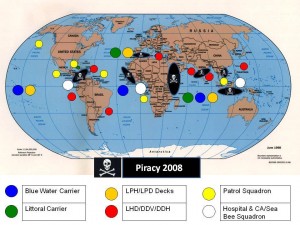
First, as rising nations and non-state actors become more powerful, the United States will need to pay more attention to emerging risks associated with the global commons, those areas of the world beyond the control of any one state-sea, space, air, and cyberspace-that constitute the fabric or connective tissue of the international system. A series of recent events-including anti-satellite missile tests, piracy in the Gulf of Aden and off the east coast of Africa, and attacks in cyberspace-highlight the need for the United States to work with its allies and partners to maintain relative peace and stability throughout the global commons.
Second, America's continued advantages in traditional warfighting provide powerful incentives for our adversaries to employ a mix of traditional and irregular approaches that span the range of conflict. The 2007 Maritime Strategy was correct to conclude that modern wars are “increasingly characterized by a hybrid blend of traditional and irregular tactics, decentralized planning and execution, and non-state actors using both simple and sophisticated technologies in innovative ways.”2 Defense Secretary Robert Gates has written that “one can expect a blended high-low mix of adversaries and types of conflict . . . being employed simultaneously in hybrid and more complex forms of warfare.”3
Third, as trends ranging from the economic crisis to climate change and globalization continue to put pressure on the modern state system, the number of chronically weak or outright failing states will likely increase. For example, the same factors that may engender the rise of new great powers may also accelerate the decline of other states that-by virtue of poor leadership, economics, and/or geography-are unable to adapt to a new era and meet the basic needs of their populations. Conflict in the 21st century is at least as likely to result from problems associated with state weakness as from state strength.
Sea, Air, Space, and Cyberspace
The problems associated with emerging hybrid threats and weak or failing states are well known to policymakers and analysts, as they are central features in today's wars. Less obvious are the growing challenges to American power and influence that are associated with how we perceive and use the sea, air, space, and cyberspace.
The architecture of the modern international system rests on a foundation of free and fair access to a vibrant global economy that requires stability in the global commons. Alfred Thayer Mahan was perhaps the first strategist to coin the term, describing the world's oceans as “a great highway . . . a wide common” in his classic 1890 work, The Influence of Sea Power Upon History.4
Since the end of World War II, American grand strategy has centered on creating and sustaining an international system that facilitates commerce, travel, and thus the spread of Western values including individual freedom, democracy, and liberty. The construction and protection of such a system was the central pillar of America's Cold War strategy. NSC 68, the 1950 planning document generally credited with establishing the foundation of that strategy, outlined a two-pronged approach:
One is a policy which we would probably pursue even if there were no Soviet threat. It is a policy of attempting to develop a healthy international community. The other is the policy of containing the Soviet system? In a world of polarized power, the policies designed to develop a healthy international community are more than ever necessary to our own strength.5
Pressure on the System
Ensuring relative stability throughout the global commons remains central to the maintenance of U.S. power and influence in the 21st century.6 However, there is a growing consensus that rising state and non-state powers, combined with continued globalization, will put great pressure on the international system as a whole. While assessments point to a changing world, relatively little analysis has addressed when and how such changes will materialize. We are likely entering an era in which a series of strategic trends will make it more difficult for the United States to sustain stability within the global commons.
Recent trends in several dimensions of the global commons illuminate how the international system is beginning to evolve and change:
* Space: China's successful 2007 antisatellite missile test spurred a series of responses, including French, Indian, and Japanese declarations of intent to prepare for challenges in space.7 The Chinese test created the single largest debris field in orbital space, posing obstacles to global use of space for decades.8 The United States demonstrated an antisatellite capability in 2008 by destroying an ailing satellite in a deteriorating orbit.
* Cyberspace: Cyber-warfare is increasingly seen as an inevitable component of state and non-state conflicts. Russian use of offensive cyber capabilities in Estonia and Georgia is well known, as is China's reported use of cyber capabilities. Non-state actors such as al Qaeda and Hezbollah make frequent use of cyberspace as a planning and propaganda tool.9
* Maritime: A host of maritime examples portend future challenges: the 2006 Kitty Hawk (CV-63) incident (in which a Chinese submarine surfaced within the perimeter of a U.S. carrier strike group), recent tensions in the South China Sea (rooted in China's territorial claims), and China's continued investment in a host of surface, submarine, and anti-access capabilities; Russia's claims on wide areas of the Arctic seafloor and increased military operations in the region; the scourge of piracy in and around key sea lanes; and Hezbollah's use of an advanced antiship missile during the 2006 Lebanon War.10
Strategic Trends
These examples are indicative of two strategic trends that will pose significant challenges to the United States and its allies:
First, barriers to entry for both state and non-state actors to develop and field capabilities that can pose challenges to U.S. and allied freedom of action will lower substantially over time. The proliferation of knowledge and technology will allow an increasing number of state and non-state actors to deploy anti-access capabilities and high-end asymmetric technologies that can put allied infrastructure at risk and hamper U.S. power projection.
Second, rising powers will not likely be content to simply acquiesce to America's role as uncontested guarantor of the global commons. Countries such as China, India, and Russia will demand a role in maintaining the international system in ways commensurate with their actual or perceived power and national interests. Such demands are already occurring, from declarations of interest in space capabilities, to indications that the Indian and Arctic oceans will become new global centers of gravity.11
While these trends are already apparent today, their enumeration should not be interpreted to mean that U.S. dominance in, for example, space-based capabilities or in blue-water naval power projection is being eroded at a precipitous pace. Far from it-America's military will remain without peer for some time in the ability to project and sustain substantial military power from the air and sea over large distances.
These trends are, however, harbingers of a future strategic environment in which America's role as an arbiter or guarantor of stability within the global commons will become increasingly complicated and contested. If this assessment is true, then a foundational assumption on which every post-Cold War national security strategy has rested-uncontested access to and stability within the global commons-will begin to erode. To assume away or leave these trends unaddressed as we formulate a new U.S. national security strategy and complete a Quadrennial Defense Review would be unwise, increasing the possibility of a future strategic surprise for which we would be unprepared.
Implications
The consequences of a shift in the international system that opens the global commons for other state and non-state actors to pursue their interests-and perhaps credibly threaten America's use of these domains-are likely to be profound, posing challenges to U.S. security strategy and defense planning. To address such challenges, we need to think hard about their operational and resource implications, particularly as QDR deliberations evolve.
Challenges to American interests in the global commons will have serious implications at the operational level. In the maritime domain, for example, a recent U.S. Joint Forces Command report concluded that, unlike in recent operations, the United States may not enjoy uncontested access to bases from which it can project military power:
Given the proliferation of sophisticated weapons in the world's arms markets-potential enemies-even relatively small powers will be able to possess and deploy an array of longer-range and more precise weapons. . . . Thus, the projection of military power could become hostage to the ability to counter long-range systems even as U.S. forces begin to move into a theater of operations and against an opponent. The battle for access may prove not only the most important, but the most difficult.12
Secretary Gates echoed this concern during his address to the Naval War College in April, stating that potential adversaries do not intend to contest us directly but rather invest “in weapons geared to neutralize our advantages-to deny the U.S. military freedom of movement and action while potentially threatening our primary means of projecting power: our bases, sea and air assets, and the networks that support them. . . . We ignore these developments at our peril.”13
Any state or non-state actor wishing to oppose U.S. or allied forces will look for ways to deter, deny, or frustrate our ability to swiftly employ and sustain combat forces across a variety of scenarios. This is nothing new. What is relatively new is both the scale of the threat posed given the proliferation of advanced high-end systems, and the real potential for non-state actors to employ such technology, as evidenced by Hezbollah's use of advanced antiship and antiarmor weapons.14 While these dynamics are most clearly at play in the maritime domain, there are similar forces at work in other dimensions of the global commons.
These developments challenge us to think creatively about how DOD can best develop the strategy, concepts of operations, and capability mix needed to meet these challenges.
The New QDR
For example, the QDR is exploring several high-end asymmetric threats of the type described here. Adequately preparing for these challenges may be more about identifying where new operational concepts and discrete investments are needed than in focusing on major shifts in force structure. From a naval perspective, it is clear that several issues need to be addressed, including the future of amphibious landing capabilities, the role of naval unmanned combat aerial vehicles, and the overall mix between ships designed for littoral environments and blue-water surface combatants.
Similar dynamics should influence the debate over how the Air Force pursues more capable unmanned aerial systems and the next-generation bomber. All the services must prepare for a future in which power-projection can be sustained at greater distance than in the past and vulnerabilities reduced through better defense and dispersion.15 These operational imperatives must be balanced with the strategic need to ensure that America's global posture remains strong enough to assure our allies and dissuade and deter potential adversaries.
Finally, the security of America's space- and cyberspace-based information architecture has become a matter of national concern. The QDR and other defense and interagency reviews are examining how we can improve the ability to organize America's instruments of national power to ensure the security of these vital networks. Far more than a military matter, stability and security in space and cyberspace will depend on working with our allies and partners to develop a common framework and advance international norms that can shape the choices and behavior of others.
Opportunity to Lead
While this article focuses on security, it would be unwise to react to the emergence of tensions in the global commons by simply altering the mix of military investments and adapting America's global network of defense alliances and relationships. They are necessary but insufficient responses to what will be a lasting shift in international affairs. The task for the United States is to respond to these challenges with a whole-of-government approach that advances our interests while legitimizing our power in the eyes of others.16
One way the United States could respond would be to (re)embrace a grand strategy that focuses on sustaining a healthy international system, the maintenance of which is not only central to our national interests but is also a global public good-something everyone can consume without diminishing its availability to others. Such a strategy would essentially update and make explicit what had been a consistent theme in U.S. grand strategy since the early years of the Cold War, but has been underemphasized in the post-Cold War period.
These developing challenges in the global commons also offer the United States a profound opportunity to reassert a leadership role in an area that will only grow in importance. Because stability on and within the global commons is a public good, others have powerful incentives to work with us on issues involving governance of cyberspace, ensuring peace in space, and settling contentious maritime issues. Protecting and sustaining stability throughout the global commons cannot be achieved by America alone.
We must lead in the creation of international norms and standards that can help advance the common good and expand the rule of law in these domains of growing importance. Helping to build the capacity of our partners and allies and working toward a common agenda on these increasingly complex issues should be a critical pillar of America's national security and defense strategy.
The 21st century will see momentous change in the international system. There is every reason to be hopeful that the shifts under way in the global system can improve the prospects of peace and security. By virtue of its size, geography, economy, and values, the security of the United States is directly related to the security of the broader international system. As the Obama administration prepares a new national security strategy, and as DOD conducts its Quadrennial Defense Review, the time is right to both reframe American grand strategy and rebalance the U.S. military to succeed in today's wars while preparing for tomorrow's challenges.
1. See National Intelligence Council, Global Trends 2025: A Transformed World (November 2008), and the 2008 Joint Operating Environment: Challenges and Implications for the Future Joint Force (Suffolk: JFCOM, 2008).
2. ADM Gary Roughead, GEN James Conway, ADM Thad Allen, A Cooperative Strategy for 21st Century Seapower (October 2007), p. 6.
3. Robert Gates, “A Balanced Strategy,” Foreign Affairs (January/February 2009).
4. Alfred Thayer Mahan, “The Influence of Sea Power Upon History,” in David Jablonsky, ed., Roots of Strategy: Book 4 (Mechanicsburg, PA: Stackpole Books, 1999), p.79.
5. NSC 68, reproduced in Ernest May, ed., American Cold War Strategy: Interpreting NSC 68 (New York: St. Martins, 1993), p. 41.
6. Barry Posen, “Command of the Commons: The Military Foundation of U.S. Hegemony,” International Security (Summer 2003), pp.5-46.
7. David Sands, “China, India Hasten Arms Race in Space,” The Washington Times, 25 June 2008, p. A01, Marc Kaufman, “U.S. Finds It's Getting Crowded Out There,” The Washington Post, 9 July 2008, p. A01. See also Pavel Podvig and Hui Zhang, Russian and Chinese Responses to U.S. Military Plans in Space (Cambridge, MA: American Academy of Arts and Sciences, 2008).
8. See Bates Gill and Martin Kleiber, “China's Space Odyssey,” Foreign Affairs (May/June 2007), pp. 2-6.
9. See Office of the Secretary of Defense, Military Power of the People's Republic of China (Annual Report to Congress, 2009); Shane Harris, “China's Cyber-Militia,” National Journal, 31 May 2008; Jonathan Adams, “Chinese Hacked Computers, U.S. Lawmakers Say,” Christian Science Monitor, 12 June 2008; Sandhya Somashekhar, “Wolf Warns of Foreign Attacks on Computers,” The Washington Post, 12 June 2008, p. B3.
10. See “The Long March to be a Superpower: China's Military Might,” The Economist, 4 August 2007, p. 20; Robert Kaplan, “America's Elegant Decline,” The Atlantic Monthly, (November 2007), pp. 104-112. See “Into the Wide Blue Yonder; Asia's Navies,” The Economist, 7 June 2008, p. 6; Ronald O'Rourke, “China Naval Modernization: Implications for U.S. Navy Capabilities-Background and Issues for Congress” CRS Report for Congress, RL33153, 16 April 2008; David Lague, “Chinese Submarine Fleet is Growing, Analysts Say,” The New York Times, February 25, 2008, p. 10.
11. See Robert Kaplan, “Rivalry in the Indian Ocean,” Foreign Affairs (March/April 2009), pp. 16-32; Scott Borgerson, “Arctic Meltdown,” Foreign Affairs (March/April 2008); and Marc Kaufman, “U.S. Finds It's Getting Crowded Out There,” The Washington Post (9 July 2008), p. A01.
12. 2008 Joint Operating Environment: Challenges and Implications for the Future Joint Force (Suffolk: JFCOM, 2008), p. 44.
13. Robert Gates, Speech to the Naval War College (Newport: RI, 17 April 2009).
14. Mark Mazzetti and Thom Shanker, “Arming of Hezbollah Reveals U.S. and Israeli Blind Spots,” The New York Times (19 July 2006). See also Stephen Biddle and Jeffery Friedman, The 2006 Lebanon Campaign and the Future of Warfare (Carlisle, PA: U.S. Army Strategic Studies Institute, 2008); Andrew Erickson and David Yang, “On the Verge of a Game-Changer,” U.S. Naval Institute Proceedings (May 2009), pp. 26-32; Office of the Secretary of Defense, Military Power of the People's Republic of China (Annual Report to Congress, 2009); and Roger Cliff, et al, Entering the Dragon's Lair: Chinese Antiaccess Strategies and their Implications for the United States (Washington: RAND, 2007).
15. Tom Ehrhard and Robert Work, Range, Persistence, Stealth, and Networking: The Case for a Carrier-based Unmanned Combat Air System (Washington: CSBA, 2008).
16. See Joseph Nye, “Recovering American Leadership,” Survival (February-March 2008), pp. 55-68.
Ms. Flournoy is the Under Secretary of Defense for Policy. Mr. Brimley is a strategist in the Office of the Secretary of Defense.
What does maritime domain awareness mean, and does it represent a flawed analytic agenda?
A pillar of the new maritime strategy, A Cooperative Strategy for 21st Century Seapower, published by the Navy, Marine Corps, and Coast Guard in October 2007, is an “increased commitment to advance maritime domain awareness” (MDA).1 It is unclear, however, whether the lessons the Navy has learned in almost a decade of operations prosecuted in support of the global war on terrorism, or the current manifestations of terrorism and illicit behavior at sea, are reflected in the prominence played by MDA in the maritime strategy.
The national and Navy plans to achieve MDA are predicated on the assumption that automated systems can identify terrorists, pirates, or other illicit actors such as smugglers by passively detecting “anomalous” or unusual behavior, an assumption unsupported by any review of the events of the recent past. In the post-Cold War maritime environment, terrorism and other illicit activities have instead been conducted by those who conform to accepted norms of maritime activity precisely by not doing anything that can be described as uncommon or unexpected. An MDA plan focused on finding anomalies will be good for little more than identifying unusual (yet probably explainable) ship movements, ignoring smaller craft and elements of maritime behavior conducted on land, thus not providing the deep understanding of maritime activity necessary to both provide sufficient warning and drive future operations, especially against nonmilitary targets.
Both the National Plan to Achieve Maritime Domain Awareness and the Navy Maritime Domain Awareness Concept define MDA in broad and unobjectionable terms. They describe MDA as “the effective understanding of anything associated with the maritime domain that could impact the security, safety, economy, or environment of the United States.”2 This vision of a “multilayered, multi-domain picture that links the identity, location, known patterns and present activity of ships, cargo, people, and hazards within and adjacent to the maritime domain” is an affirmation of exactly the kind of all-source analysis that forms the bedrock of what Naval Intelligence believes it has provided to the Fleet throughout its history.3 MDA is ideally not “just vessel tracking,” “just intelligence,” or “just more sensors,” but an attempt to gain a truly comprehensive understanding of what is happening at sea, a task much more daunting than simply monitoring tracks on a display.4
Ship-centric Focus
Unfortunately, the details of the national and Navy MDA plans reveal a course of action not well suited to achieve this ambition, and instead provide the framework for what amounts to the implementation of a platform-centric ship tracking system, rather than a system that provides a broad and deep comprehension of activity at sea. According to the Navy's MDA concept, it will be achieved through “Maritime Change Detection,” a process defined as “the identification of anomalies from established trends and patterns.”5 The assumptions of this anomaly-focused form of MDA are misguided, however, because this anomalous behavior at sea (especially when defined solely in the context of vessel movements) is not necessarily suspicious or even important, particularly if what the system has defined as a trend or pattern does not serve as an accurate or explanatory model of maritime behavior.
Despite claims that it is not “just vessel tracking,” the Navy's MDA concept is clearly ship-centric, due to its repeated assertions that identifying anomalous behavior will be the critical element in developing actionable intelligence capable of targeting maritime terrorists or other illicit activity. Claiming that “forensic analysis has discovered that most terrorist activity is preceded by criminal events or aberrant behavior,” the MDA concept calls for “correlating seemingly unrelated criminal activity with anomalous maritime behavior” through “continuous assessment of the maritime domain and automated tools that alert commanders when suspicious items are uncovered.”6
The fundamental flaw with this premise is the assumption that maritime terrorism or other illicit maritime activities are correlated with suspicious, illegal, or unusual behavior. A review of recent maritime terrorist acts demonstrates that this is clearly untrue. The boat used to attack the USS Cole (DDG-67) in Yemen in October 2000 was bought (not stolen) in the Saudi port of Jizan.7 The “most destructive act of terrorism in maritime history,” the bombing of Superferry 14 in the Philippines in 2004, was conducted by a passenger who concealed the explosives in a television he brought aboard.8 Better security and safety practices on board Filipino ferries may have prevented that attack (or saved lives), but there was nothing anomalous about how the attack happened. Until they turned to ram the structures, there was nothing particularly unusual about the boats that attempted to strike the Al Basra and Khor al Amaya oil terminals in April 2004, killing three U.S. servicemen in the Persian Gulf.
In November 2002, al Qaeda-affiliated terrorists used small boats to escape after attempting to shoot down an Israeli airliner and destroying a hotel near Mombasa, Kenya. Such travel was not at all unusual in a region where small craft are commonly used to move along the East African coast.9 Loai Saqa, a Syrian associate of Abu Musab Zarqawi, was arrested by Turkish authorities in August 2005 while reportedly planning to attack Israeli cruise ships. The Turks were led to Saqa not through unusual maritime behavior, but because of an explosion and chemical fire in an apartment where attack preparations were being conducted.10 All accounts of the interrogations of the lone surviving gunman from the November 2008 attacks in Mumbai, India, indicate that the attackers traveled on board at least two vessels from Pakistan to Mumbai, hijacking at least one of them along the way.11 It is unclear, however, whether even a perfect, NORAD-like system for maritime traffic control would have detected that the routes used by those ships to transport the attackers to India were somehow anomalous.
Anomalies fail as an effective indicator or predictor of other forms of illicit maritime activity as well. For example, widespread smuggling of fuel has taken place in the northern Persian Gulf since the 2003 Coalition invasion of Iraq, with “an estimated 1,000 tons of diesel fuel per day” being smuggled on board Iraqi vessels during 2006.12 Meanwhile, according to the Office of the United Nations High Commissioner for Refugees, at least 43,500 Africans were smuggled across the Gulf of Aden to Yemen in 2008, an increase from 29,500 in 2007.13 Are illicit activities such as these two examples actually anomalous if they are also normal in the sense that they occur daily and in large numbers? Would the algorithms and systems currently being devised as part of the Navy and Coast Guard's MDA efforts provide advanced warning of these activities?
Ignoring the Variables
A system using anomalous or unusual vessel movements to identify suspicious behavior is inherently skewed, and misses out on many of the most important aspects of commercial maritime behavior. There are numerous reasons, for example, that a ship calling at a port where it had never previously visited would not be suspicious, including new ownership, new management, an emergency, engineering casualty, service to a new port, the particular cargo it is carrying, etc. Multiple scenarios are plausible for a maritime terrorist event in which the crew of a ship could be completely unaware that illicit cargo is on board. By focusing analytic effort on where a ship moves, one ignores many other variables that may provide better indicators of a potential illicit event. The ability of intelligence analysts to answer a broader set of questions and explain a vessel's behavior (including that of its cargo, crew, or passengers at a particular time) in the context of commercial maritime practices is much more important than being able to point out that a particular ship has never called at Djibouti or Singapore before. A ship is simply a tool. Making her movements the decisive variable in an anomaly-detecting algorithm will ensure that analysts miss out on truly important data.
Models that try to identify other anomalies, such as unusual passengers or cargo, may prove to be more useful than one analyzing vessel movements. But even those approaches have weaknesses, as author William Langeweische notes in his description of a new generation of illicit maritime actors capable of using “the methods and operational techniques of the shipowners,” in order “to escape the forces of order not by running away, but by complying with the laws and regulations in order to move about freely and to hide in plain sight.”14
The notion that systems will be able to detect unusual or suspicious maritime behavior automatically, and provide the cue to bring in human analytic power to solve the maritime intelligence problems of the future, is seductive. Yet while that idea has some merit, the MDA concept instead lays out a process focusing primarily on one element of maritime behavior. That element, vessel movement anomaly detection, has proved irrelevant in terms of providing indicators before most recent examples of maritime terrorism.
Statistical analysis can be a powerful tool, and the Navy should be making a greater effort both to use it and expand its potential applications for solving new problems. Making anomaly detection the primary analytic workhorse, however, will ensure that indicators of future maritime terrorism will be missed, and if not accompanied by a significant investment in training and hiring people truly knowledgeable in the maritime realm, will contribute toward the atrophy of that knowledge and expertise.
The new maritime strategy and maritime domain awareness concept have the right goal-a Navy, working hand-in-hand with the other Sea Services and interagency partners, maximizing its ability to collect data and truly understand what is happening at sea around the globe. The manner in which these documents call the Navy to accomplish these goals are very narrow and not particularly insightful, however. If implemented, the Navy of the future will have the computing power to sift through mounds of vessel movement data. However, that Navy may not have analysts who deeply comprehend how the maritime world works (particularly its commercial component), or the ability to leverage the unprecedented collection opportunities of the future to enhance that understanding.
1. A Cooperative Strategy for 21st Century Seapower, October 2007, http://www.navy.mil/maritime/MaritimeStrategy.pdf.
2. National Strategy for Maritime Security: National Plan to Achieve Maritime Domain Awareness, October 2005, http://www.uscg.mil/hq/cg5/docs/MDA%20Plan%20Oct05-3.pdf (accessed 8 July 2008).
3. Navy Maritime Domain Awareness Concept, 29 May 2007, http://www.navy.mil/navydata/cno/Navy_Maritime_Domain_Awareness_Concept_FINAL_2007.pdf (accessed 8 July 2008).
4. Ibid.
5. Ibid.
6. Ibid.
7. James Risen and Raymond Bonner, “A Nation Challenged: Fatal Attack; Officials Say Bomber of the Cole was in Yemeni Custody Earlier,” The New York Times, 7 December 2001, http://query.nytimes.com/gst/fullpage.html-res=9C0CE5D7133CF934A35751C1A9679C8B63&sec=&spon=&pagewanted=all (accessed 25 June 2008).
8. Peter Chalk, The Maritime Dimension of International Security: Terrorism, Piracy, and Challenges for the United States (RAND Corporation, 2008), 51.
9. Counter-Terrorism in Somalia: Losing Hearts and Minds? (Nairobi/Brussels: International Crisis Group, 2005), 9.
10. Amberin Zaman, “Syrian Charged in Plot to Attack Israeli Ships; The suspected Al Qaeda militant planned to use a speedboat filled with explosives, a Turkish court alleges. The Jewish state will lift travel alert,”Los Angeles Times,12 August2005, http://www.proquest.com (accessed 25 June 2008).
11. Geeta Anand, Matthew Rosenberg, Yaroslav Trofimov, and Zahid Hussain, “India Names Mumbai Mastermind,”The Wall Street Journal,3 December2008, http://online.wsj.com/article/SB122823715860872789.html(accessed 11 January 2009).
12. Terence B. Moran, “Port of Umm Qasr: Challenges and Opportunities,” U.S. Naval Institute Proceedings, 1 July 2006, 72-74, http://www.proquest.com/ (accessed 21 February 2008).
13. “Gulf of Aden: 20 Die as Smugglers Force Migrants Overboard,” UNHCR Briefing Notes, 2 December 2008, http://www.unhcr.org/news/NEWS/49351e202.html.
14. William Langewiesche, The Outlaw Sea: A World of Freedom, Chaos, and Crime (New York: North Point Press, 2004), p. 7.
Lieutenant Munson currently serves as the intelligence officer at Naval Special Warfare Group Four, at Little Creek, Virginia. He has previously served on board the USS Essex (LHD-2), and at the Office of Naval Intelligence. He received a M.A. in security studies in Middle East Affairs from the Naval Postgraduate School.
[1] M4IS2: Multinational, Multi-Agency, Multi-Disciplinary, Multi-Domain (M4) Information-Sharing and Sense-Making (IS2). Originally a Swedish concept, it has been enhanced by the Earth Intelligence Network, a 501c3.
Commandant of the Marine Corps
Click on portrait to read General Gray's “Global Intelligence Challenge in the 1990's” as published in American Intelligence Journal (Winter 1989-1990).
This book (Africa Unchained) is really two books in one, and as I conclude this summative review, will suggest to the author a third book needed now to complete the trilogy.
BOOK ONE: Chapters 2-7 focus on the problems of the past and are less interesting to me than the author's clear rejection of all tendencies to blame the past, the West, the banks, or anyone other than Africans themselves, for the failure to develop. These chapters merit careful reading if one is to be fully engaged in Africa, but here I sum them up as “four strikes and out” in the author's own words:
Strike One: State control model never worked
Strike Two: Rush to modernize industry while neglecting agriculture (where 65% of African live and die in largely subsistence mode)
Strike Three: Aped (sic) alien systems and ignored–demeaned indigenous political and economic systems that had worked for centuries
Strike Four: All the above required massive external investments and dependencies
BOOK TWO is the Chapter 1 and Chapters 8-11. It opens with a dedication by name and circumstance to investigative journalists and publishers who were killed for seeking and sharing the truth. The recurring theme within this book as well as the other three I experienced this week is that Africa's biggest problem is ignorance among the 80% that are dirt poor, and Africa's potential “great leap forward” could be fueled by inexpensive locally-oriented Information Operations (IO), my term for a diversity of examples the author puts forward in the last chapter.
While published in 2005, I sense this book remains a best in class effort. Three short quotes from the Prologue:
“They [the cheetah generation] understand and stress transparency, accountability, human rights, and good governance.”
“They have vowed to work tirelessly to expose the crimes committed by African despots and to block the grant of political asylum to any such despot.”
“They teach petty traders, hawkers, small artisans, market women, and those in the informal and traditional sectors about simple accounting techniques, how to secure microfinance, how to secure a job, and how to improve the productivity of their businesses, among other things, so as to make these self-employed artisans self-sufficient.”
Other “IO” elements about this book that truly inspired me:
+ South African music legend Bonginkosi Thuthukani Dlamini and his isi-camtho kwaito “wicked cool talk” could be used by South Africa to carry the message of bottom-up self-sufficiency and hope across the continent.
+ The intellectual in Africa have betrayed the public as much as the corrupt despots, they have become “intellectual prostitutes” to those in power.
+ Indigenous knowledge, including centuries of self-governance and participatory democracy as well as valued medicine men and women combined with majimbo–a Swahili word for local initiative and trust in traditional wisdom, is still there.
+ West does not understand Africa and has been “feckless and impotent” across all fronts (government aid, corporate exploitation). I take this to mean that there is a need for Africans to educate the West and the varied parties seeking to engage Africa for whatever reason, at the same time that all Africans must be educated to understand that the aid is being stolen at the top and should be refused.
The over-all thrust of BOOK TWO is that only Africans can save Africa, and more specifically, only the poorest of Africans–the 65% engaged in subsistence farming–can save Africa by creating agricultural productivity and self-sufficiency.
The author observes the insanity of receiving $18.6 billion a year in aid while paying the same amount to import food to a continent that is rich in resources, is NOT over-populated, and is also enjoying the emergence of women with common sense as key players in community leadership.
Chapter 8 outlines why the state system fails even if corruption is eliminated; Chapter 9 is for me very important, a discussion of the indigenous economic system (more aptly, localized political-economic-social-cultural system). Chapters 10 and 11 are the heart of BOOK TWO and full of specifics.
On page 327 “how Africa loses money” lists $148B to corruption, $20B to capital flight, $15B to military, $15B to civil war damages, $18B to food imports, and $216B to all other leakages.
The author concludes that Africa has all it needs to invest in itself, less the vanquishing of the corrupt leaders across the region, a “challenge” the author never addresses, other than stating his view that the African Union (AU) is hopeless. I'm not so sure, between Brotherly Leader Al-Gathafi and President Zuma in ZA, there are some possibilities.
Among the author's recommendations:
+ Leverage the 3rd industrial revolution (communications and information technologies).
+ Move away from high-end aid projects and instead focus on bottom-up assistance at a level of a goat that gives milk, a foot-pump to move water, a donkey for transport, micro-credits, and so on. From page 392 there are numerous ideas, all relevant.
+ Return to the African model of peace making, a four-party model in which the two belligerents are not brought together by the UN so they can agree to a “joint plunder” deal, but rather use trained facilitators and add the civil society–the victims and residents being plundered–to the mix for a longer-term settlement achieved by holistic consensus.
The author focuses on the village development model (Cf. p 369) and discusses how “African solutions are less expensive, and further, reform that is internally generated endures.” (Cf. 417).
The bibliography is extraordinary, a lifetime of reflections by others that the author has integrated.
BOOK THREE is needed, perhaps with Wangari Maathai, actually providing both a handbook that is short and easily translated into AUDIO TAPES in all languages and dialects, and an online “Regional Range of Needs Table.”
The author, a Nobel Peace laureate for the Green Belt Movement, delivers a very straight-forward, practical “woman's voice” account of both the past troubles, present tribulations, and future potential of Africa. This book is replete with “street-level” common sense as well as a real sense of nobility.
Early on the author addresses the reality that uninformed subsistence farming, what 65% of all Africans do, is destroying the commons. I find that ignorance–and the need to educate and inform in their own local language (no easy task when speaking of thousands of local languages)–is a recurring theme in this book. I see *enormous* potential for the application of what the Swedish military calls M4IS2 (multinational, multiagency, multidisciplinary, multidomain information-sharing and sense-making).
The author provides an ample tour of the horizon of aid, trade, and debt imbalances, of the dangers of culture and confidence of decline, of the need to restore cultural and environmental diversity, and of the need to reprioritize agricultural, education, and environmental services instead of bleeding each country to pay for the military and internal security (and of course corruption).
CORE POINT: The *individual* African is the center of gravity, and only Africans can save Africa–blaming colonialism is *over*. The author's vision for a revolution in leadership calls for integrity at the top, and activism at the bottom, along with a resurgence of civil society and a demand that governments embrace civil society as a full partner.
CORE POINT: The environment must be central to all development decisions, both for foster preservation and permit exploitation without degradation. Later in the book the author returns to this theme in speaking of the Congo forests, pointing out that only equity for all those who are local will allow all those who are foreign to exploit AND preserve.
I am fascinated by the author's expected discussion of the ills of colonialism including the Berlin division, the elevation of elites, arbitrary confiscations of lands, and proxy wars, what I was NOT expecting was a profound yet practical discussion of how the church in combination with colonialism was a double-whammy on the collective community culture of Africa.
The author observes that any move away from aid, which has been an enabler of massive corruption at the top, and toward capitalization and bonds [as the author of Dead Aid proposes in part] will be just as likely to lead to corruption absent a regional awakening of integrity.
The author discusses China, observing that China has used its Security Council veto to protect African interests, and the author observes that the West continues to destroy Africa with arms sales, France and Russia especially, followed by China, with the US a low fourth.
I learn that patronage and the need for protection are the other side of corruption as a deep-seated rationalization for keeping power, and I learn that pensions in Africa are so fragile that retirement is fraught with risk, another reason to seek long-term power holding. I am inspired to think of a regional pension fund guaranteed by Brotherly Leader Muuamar Al-Gathafi.
On a hopeful note the author praises the election of Ellen Johnson-Sirleaf as leader of Liberia, and sees real promise in the AU leadership summits that she attends.
CORE IDEA: Leadership training at all levels must keep pace with the changes in technology and the complexity of Africa's engagements. Civil Society in particular must be understood and embraced by government leaders at all levels.
The author spends time around page 134 discussing her pilot project to create local empowerment, devolving decision-making to create a multi-layered structure that establishes priorities while also providing accountability and transparency, minimizing corruption. Using a trained facilitator, the author brought together around 40 fifteen-person committees to create a strategic plan, and that is now useful as a map regardless of turn-over.
On page 158 the author briefly discusses ECOSOC (Economic, Social, and Cultural Council of the African Union) founded in 2005 to bring the voices of the people into the AU deliberations; to educate the peoples of Africa on all aspects of African affairs; and to encourage civil society throughout Africa.
My reaction: ECOSOCC is a center of gravity and could be the lever needed to create a regional M4IS2 network that substitutes information for violence, capital, time, and space. A harmonization of investments to address regional cell phone access (Nokia ambient energy devices), regional radio stations using solar power; and a regional public information program on the basics of mosquito control and other key public health topics, all call out for action in partnership with ECOSOCC.
Later in the book the author equates misinformation with alcohol and drugs. Ignorance is a recurring theme.
The conclusion of the book is full of deep wisdom on re-imagining community, restoring family by returning the men, stopping the brain drain, and making it easier for remittances to return; of the need to create micro-nation forums within each macro-nation; of the need to create local radio stations in each of the local languages and dialects; of the need to address energy shortfalls while stopping the march of the desert; and finally, of the need to address the pressing twin issues of land ownership and tourism management so as to restore the primacy of African interests.
The book ends on a hugely positive note calling for Africans to reclaim their land; reclaim their culture; and reclaim themselves.