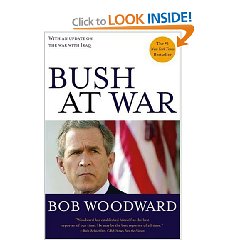
Review: Bush at War

4 Star, Empire, Sorrows, Hubris, Blowback, Executive (Partisan Failure, Reform), Intelligence (Government/Secret), Iraq, Military & Pentagon Power, Power (Pathologies & Utilization)
0Shares

Amazon Page
Amazon Page

4.0 out of 5 stars If You Favor Impeachment Over Iraq, Start Here….,

July 12, 2003
Bob Woodward
Edit of 22 Dec 07 to add links. We now know that Dick Cheney has hijacked the Presidency and subverted Article 1 of the Constitution for eight years and all the way back to the Ford Administration. The question begs to be asked: why on earth are the Democratic contenders ignoring the need for both Electoral Reform, and impeachment of Dick Cheney?

—–

As America confronts the very real probability that the Administration manipulated and distorted and fabricated intelligence in order to go to war against Iraq, and as calls rise for the impeachment of the President and the Vice President (the one naive, the other conniving), this book takes on added value–Bob Woodward has done a superb job of documenting both the “keystone cops” nature of the Administration's “strategic deliberations”, and the very specific manner in which Paul Wolfowitz (too controversial to be Secretary of Defense but a power in his own right) guided the Bush team toward a war on Iraq as a “solution” to problems they could not deal with directly, to wit, the war on terrorism.

There is an Alice in Wonderland quality to this book–or more properly stated, to the conversations that are quoted among the principals. Their wandering short-hand conversations, the degree to which the President is mis-led about our capabilities, the inability of the Secretary of Defense to answer a direct question, always having to go back to his office for an answer–the entire book is, as one reviewer suggests, practically a recount of a handful of recollections about scattered conversations, as if the center of the world were one room in the White House, and nothing outside those walls really mattered. It is also somewhat revisionist–as I recall from published news at the time, all of the principals wanted to delay the taking of Kabul until the spring, and it was President Putin of Russia, speaking directly to President Bush, who made the case, based on his superior intelligence sources on the ground, for how quickly Kabul would fall, leading to the US acceptance of rapid advances by the Afghan warlords. The absence of this essential and openly known fact casts doubt on the entire process of writing the book, and how information was researched and selected for inclusion.

There are, however, some major gems that make a careful reading of this book very worthwhile and I list them for consideration by other readers:

1) The Directorate of Intelligence does not appear as a listed player–CIA special operations rather than CIA analysis appears to have been the DCI's best card to play;

2) The clandestine service, as Dewey Claridge notes in concluding his “Spy for All Seasons,” died in the 1990's, with only 12 case officers in one year's class–the book misrepresents the increase from 12 to 120 as stellar–it was actually a return to the norm before a series of mediocre leaders destroyed the Directorate of Operations;

3) The CIA had been “after” bin Laden for five years prior to 9-11, the DCI even “declaring war” on him, to zero effect. Worse, post 9-11 investigations determined that bin Laden had been planning the 9-11 attack for two years without any substantive hint being collected by U.S. intelligence–and at the end of the book, Rumsfeld reflects on how the three major surprises against the U.S. prior to 9-11 not only happened without U.S. intelligence detecting them, but we did not learn of them for five to thirteen years *after the fact* (page 320);

4) Presidential-level communications stink–the Secretary of State could not talk to the President when flying back for seven hours from Latin America, and the National Security Advisor could not get a reliable secure connection to the President from her car right in Washington, D.C.

5) The Secret Service idea of security for Presidential relatives in a time of crisis is to take them to the nearest Federal Center–the kind that got blown up in Oklahoma.

6) Throughout the discussions, it was clear to the principals that the U.S. military is designed to find and destroy fixed physical targets with obvious signatures; it cannot do–it is incompetent at–finding mobile targets, whether vehicles or individuals (cf. page 174)…and of course as General Clark documented in his book, and David Halberstam repeats in his most recent tome, and as the principals learned again vis a vis Afghanistan, the U.S. Army does not do mountains.

There are three remarkable aspects of this story, only one even remotely hinted at in the book: we failed to get bin Laden. The CIA went to Afghanistan with the right orders: “bin Laden dead or alive.” They promptly forgot their orders and settled for spending $70M to play soldier. The two stories that are not told in this book, but are clearly apparent: 1) Russia saved the day, both for the CIA and for the Department of Defense; and 2) Saudi Arabia never came up as a serious problem that needed to be dealt with sooner than later.

Finally, and this only became clear to me after the early months of 2003 when the obsession of a few people in the Administration brought the world to a crisis over Iraq, the book provides really excellent documentation of how a tiny minority, led by Paul Wolfowitz, basically pushed the President to treat Iraq as an alternative to substantive action on global terrorists networks, and the book documents how the uniformed leadership of the Pentagon clearly opposed this line of thinking that is unsupported by intelligence, either on Iraq, or on the relative threat of Iraq (not imminent) in relation to many other threats that are both more imminent and more costly if not addressed now.

This is a useful book, worthy of reading, but the real story with all the details will not be known for some time. However, in the aftermath of the failed effort in Iraq, and the clear and compelling evidence that the American people and Congress were deceived about the Iraq threat, this book has an added luster, an added value, and become a “must read.”

Other books (see also my lists, one on Evaluating Dick Cheney, the other on The Case for Impeachment).
Vice: Dick Cheney and the Hijacking of the American Presidency
Running on Empty: How the Democratic and Republican Parties Are Bankrupting Our Future and What Americans Can Do About It
Breach of Trust: How Washington Turns Outsiders Into Insiders
The Broken Branch: How Congress Is Failing America and How to Get It Back on Track (Institutions of American Democracy)
Independents Day: Awakening the American Spirit
Day of Reckoning: How Hubris, Ideology, and Greed Are Tearing America Apart
The Tao of Democracy: Using Co-Intelligence to Create a World That Works for All
A Power Governments Cannot Suppress
Democracy's Edge: Choosing to Save Our Country by Bringing Democracy to Life
Society's Breakthrough!: Releasing Essential Wisdom and Virtue in All the People

Vote on Review
Vote on Review

Review: Bureaucratic Politics and Foreign Policy

5 Star, Congress (Failure, Reform), Diplomacy, Executive (Partisan Failure, Reform)
0Shares

Amazon Page
Amazon Page

5.0 out of 5 stars Essential Reference for Understanding Bad as Well as Unethical Decisions,

July 12, 2003
Morton H. Halperin
Edit of 22 Dec 07 to stress importance of this book today, and add links. This books says that one of the rules of the game is to lie to the President if you think you can get away with it. Dick Cheney has created three new rules:

1. Ignore the President, Hijack the Presidency

2. Subvert Congress and Article 1 of the Constitution

3. Lie to the People, Over and Over, Even After the Lie is Known to be a Lie

This book is quite extraordinary. It is one of perhaps ten that I consider to be lifetime essential references for any national security official–not because I condone the rules for subverting and manipulating policy that the book documents, but in order to defend against them, for in the aggregate, they all undermine both the Constitution and the power of Congress.

Part I is an introduction to national security interests, the organizations within the government that each take on a life of their own and interpret both what our foreign policy should be and how it should be pursued in their own terms, how Presidential interests–predominantly defined by domestic constituencies–compete with the bureaucracy, and how the various players from career officials to political appointees to others play against one another.

Part II, the heart of the book, dissects the many strategies for manipulating decisions within the bureacracy. The “rules of the game” include the manipulation of which agency gets the lead (tending to suppress all dissenting opinions from other agencies) to which staffer in the White House has the lead (pre-determining the outcome), to means of using foreign officials, the press, and business leaders to present supporting opinions, to manipulating the President. [Although not cited in this book, having occurred many years later, John Lehman's ability to get President Reagan to pick three names for three aircraft carriers, was sufficient to blow away the Secretary of Defense view that only two were needed…as related in his Command of the Seas.]

Part III is, if you will, the guerrilla campaign that follows a decision. As George Shultz, then Secretary of State, is on record in Congressional testimony as saying–we paraphrase from recollection: “nothing in this town is ever decided–every decision has to be refought every single day.” The author concludes his extraordinary book with the rules of the game for distorting, undermining, or extending decisions through implementation decisions and actions in the field far from Washington. We are reminded of Harry Truman's reflections on CIA, after he retired, to the effect that he had never intended for CIA to become an action arm or anything other than a central analysis organization.

I cannot recommend a more useful nor more important book to those who would seek to understand how a handful of neo-conservatives, led by Dick Cheney, were able to manipulate the President, Congress, the Armed Forces (including the silent Joint Chiefs of Staff) and the American public, into an unjust war with Iraq. Cheney knows the “rules of the game” better than anyone else including the President….this book reveals his methods of operation in a concise and easy to understand manner.

Other books that build on this one:
Vice: Dick Cheney and the Hijacking of the American Presidency
Running on Empty: How the Democratic and Republican Parties Are Bankrupting Our Future and What Americans Can Do About It
Breach of Trust: How Washington Turns Outsiders Into Insiders
Breaking the Real Axis of Evil: How to Oust the World's Last Dictators by 2025
9/11 Synthetic Terror: Made in USA, Fourth Edition
Legacy of Ashes: The History of the CIA

Books that go in the right direction:
A Foreign Policy of Freedom: Peace, Commerce, and Honest Friendship
The Paradox of American Power: Why the World's Only Superpower Can't Go It Alone
The Unconquerable World: Power, Nonviolence, and the Will of the People
The Tao of Democracy: Using Co-Intelligence to Create a World That Works for All

Vote on Review
Vote on Review

2003 Information Peacekeeping & The Future of Intelligence: The United Nations, Smart Mobs, and the Seven Tribes

Articles & Chapters, Civil Affairs, Civil Society, Complexity & Resilience, Decision-Making & Decision-Support, Information Operations, Information Society, Intelligence (Government/Secret), Intelligence (Public), Security (Including Immigration), Stabilization & Reconstruction, Strategy, Survival & Sustainment, Terrorism & Jihad, Threats (Emerging & Perennial), True Cost & Toxicity, Truth & Reconciliation, United Nations & NGOs, Values, Ethics, Sustainable Evolution, Voices Lost (Indigenous, Gender, Poor, Marginalized), War & Face of Battle, Water, Energy, Oil, Scarcity
0Shares
PKI UN Smart Mobs Seven Tribes

Chapter 13: “Information Peacekeeping & the Future of Intelligence: The United Nations, Smart Mobs, and the Seven Tribes” pp. 201-225

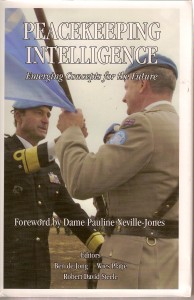
2003 PEACEKEEPING INTELLIGENCE: Emerging Concepts for the Future

Books w/Steele, Decision-Making & Decision-Support, Intelligence (Government/Secret), Intelligence (Public), Peace, Poverty, & Middle Class
0Shares
Free PDF Text
Free PDF Text

With a tip of the hat to the Netherlands Intelligence Studies Association and the Netherlands Defence College who hosted the most original conference on this topic ever, butdid not plan a book, I stepped in to meet the need for such a book.Ā  I learned from this group, especially fromĀ  co-editors Ben de Jong and Wies Patje, and General Patrick Cammaert, RN NL (featured on the cover, in blue uniform) .

The United Nations continues to lack organic decision-support (the same is true of NATO).Ā  Being dependent on Member states that either do not invest in decision-support to begin with, or if they do, focus almost exclusively on secret sources and methods, is a certain prescription for issuing uninformed strategic mandates, poorly-devised force structure requets, dangerous tactical rules of engagement, and insufficient technical authorizations.

The book includes excerpts from the Brahimi Report and a Leadership Digest for Peacekeeping Intelligence.

Free Chapter
Free By the Chapter
Amazon Page $34.95++

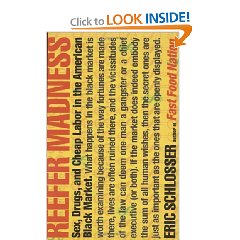
Review: Reefer Madness–Sex, Drugs, and Cheap Labor in the American Black Market

3 Star, Capitalism (Good & Bad), Civil Society, Consciousness & Social IQ, Culture, Research, Economics
0Shares

Amazon Page
Amazon Page

3.0 out of 5 stars Three Articles, Lightweight Sequel to Fast Food Nation,

July 6, 2003
Eric Schlosser
Although the author is gifted, this is a very light-weight sequel to Fast Foot Nation and the author's next book on prisons is therefore already suspect. This could have been a great book–indeed it could have been three great books–but in the rush to publish a second book in order to profit from the justifiable applause for his first one, the editor and publisher and author have all failed.There are three articles here: the first is about the inconsistencies of the drug versus the murder laws, the number of people in jail for marijuana, and the social implications of all this; the second is on the underground economy of illegal workers and profiteering abusive corporations (McDonald's is especially evil in this depiction); and the third is about pornography but with a twist, focusing on how hotels and other major corporations are profiting.

The books ends with a very short but thoughtful observation regarding the need to change the law and punishment so as to back away from life-ending punishments for individual behavior that is merely self-destructive or distastement, and focus the heaviest punishments on those who commit economic crimes against society and entire sub-sections of society.

In each of these three cases, there are other books that are better–Deep Cover by Michael Levine on the futility of drug enforcement and the corruption of Drug Enforcement Agency “suits”; Forbidden Knowledge by Roger Shattuck, on pornography among other things; and The Informant by Kurt Eichenwald, on the sweetheart triangle between national-level white collar corporate criminals, big law firms, and a compliant Department of Justice that lets the richest bad guys off easy.

I would caution the author to not do this again–the next book had better be as good as Fast Food Nation, or he will fall into the second rank of serial writers rather than culture-changing authors, where he deserves to stay.

I would also encourage anyone considering buying this book to do so–it does have useful information–but more importantly, if you have not read Fast Food Nation, go to that page and think seriously about buying and reading it now–as McDonald's gets blamed overseas for being the epidemy of all that is hateful to Islamics, as Kraft Food pays lip service to healthy food in its realization that Oreo cookies are killing kids, what Eric Schlosser did in Fast Food Nation is being appreciated more and more each day–with that book, he did indeed change national consciousness, an achievement that will stand in history as a turning point in creating a healthier America.

Vote on Review
Vote on Review

Review: Fast Food Nation–The Dark Side of the All-American Meal

5 Star, Capitalism (Good & Bad), Consciousness & Social IQ
0Shares

Amazon Page
Amazon Page

5.0 out of 5 stars A *Nation-Changing* Book of Extraordinary Value,

July 6, 2003
Eric Schlosser
Edit of 22 Dec 07 to add links.

This is an utterly extraordinary book, and I am going to review it not from the point of view of fast food as a vice, like tobacco, with individual health consequences, but rather from a national security point of view, with obesity and the loss of the warrior ethic, of fitness, of the ability to run down and kill terrorists in your neighborhood. Strategically, in both political and economic terms, this book is a *major* contribution to how politicians, corporate chiefs, university and school administrators, religious leaders, and individuals themselves should think about their national diet.

In combination with “Pandora's Poison” by Joe Thorton (a book about how chlorine-based chemistry is killing both America and the Earth), this book cuts to the very innermost corners of the national soul.

It is also more timely, in 2003, than when first published in 2001 to such acclaim, because a book called “Why People Hate America” has ably documented the Islamic and general foreign perception of how McDonald's embodies the “hamburger virus” of capitalism run amok, and Kraft Food, among others, had just recently (July 2003) announced that it is completely revisiting its edibles, now that folks are realizing that Oreo's kill kids and sodas have ten tea-spoons of sugar in every can. Food has become a fighting matter! Food has become a cultural litmus test, and America is failing the test.

We have also seen SARS, monkeypox, and multiple re-emerging infectuous diseases since this book was published. Infected fast food is a clear and present danger to the American nation.

What I find so dazzling about this work is its thoughtful integration and explanation of how fast food not only increases the gap between the rich and the poor by killing family farms and skilled labor as fast food corporations take over both farms and animal food chains so as to de-skill them and extract every penny of profit possible, but it is increasing the prospects for deadly disease entering the national bloodstream. If Microsoft is a “Dutch Elm disease” threat to national security in cyberspace (a view published in ComputerWorld by Paul Strassman recently after leaving his post as Director of Defense Information), then McDonalds and the other fast food companies are a threat to national security in multiple ways–by destroying diversity among farms and in eating habits that support unique food chains, by increasing the numbers of people in poverty, by creating massive means by which several different nation-wide epidemics could occur.

Obesity is actually the least threatening outcome of a political economy that permits fast food (and still does not regulate and enforce healthy meat processing).

At every level, from the philosophical architecture of the book, with its concern about the targeting of children as both direct clients and intermediaries in getting parents to accept bad food for their whining children, to the selection of the topics to be covered by the individual chapters, to the earnest and richly-developed sources that are quoted, this is one of the finest books among the 375 plus that I have reviewed here on Amazon.

This book is beyond five stars. In relation to poverty, corporate corruption, government ineffectiveness, fast food as a disease vector, and in relation to obesity as a symbol of a nation in decline, this book is about as important as a book can get. Totally, totally awesome. It's not about diet–its about the health of the American Republic in every way conceivable.

See also:
The Blue Death: Disease, Disaster, and the Water We Drink
Betrayal of Trust: The Collapse of Global Public Health

Vote on Review
Vote on Review