It is amazing that nowhere in this article does it mention the media coup that the Taliban scored. I also am not sure that the information released by NATO is accurate. If so, it contradicts previously reported Taliban strength levels. Nor does NATO address the recent high profile security breaches…..
KABUL, Afghanistan — NATO said Monday that it has significantly weakened the Taliban insurgency, capturing or killing thousands of militants in Afghanistan during the past three months.
Humanity and technology continue to co-evolve at an ever increasing pace, leaving traditional institutions (and mindsets) calcified and out of date. A new paradigm is emerging, where everything is increasingly connected and the nature of collaboration, business and work are all being reshaped. In turn, our ideas about society, culture, geographic boundaries and governance are being forced to adapt to a new reality.
While some fear the loss of control associated with these shifts, others are exhilarated by the new forms of connectivity and commerce that they imply. Transactions and interactions are growing faster and more frictionless, giving birth to what I call a “superfluid” economy.
Business will not return to usual. So let's discuss 4 key concepts to help us better understand the shifts that are underway:
1. Quantifying and mapping everything
2. Everyone has access to the internet
3. Self-organizing expands
4. Peer-to-peer exchange changes the future of money
I’m excited to be nearing the completion of my dissertation research. As regular iRevolution readers will know, the second part of my dissertation is a qualitative and comparative analysis of the use of the Ushahidi platform in both Egypt and the Sudan. As part of this research, I am carrying out some content analysis of the reports mapped on U-Shahid and the SudanVoteMonitor. The purpose of this blog post is to share my preliminary analysis of the 2,700 election monitoring reports published on U-Shahid during Egypt’s Parliamentary Elections in November & December 2010.
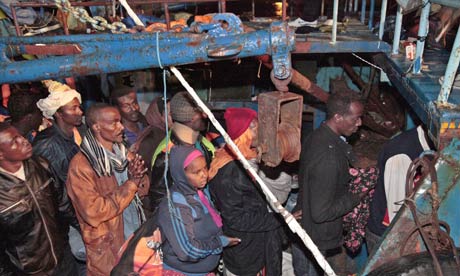
Boat trying to reach Lampedusa was left to drift in Mediterranean for 16 days, despite alarm being raised
Dozens of African migrants were left to die in the Mediterranean after a number of European and Nato military units apparently ignored their cries for help, the Guardian has learned.
Click on Image to Enlarge
A boat carrying 72 passengers, including several women, young children and political refugees, ran into trouble in late March after leaving Tripoli for the Italian island of Lampedusa. Despite alarms being raised with the Italian coastguard and the boat making contact with a military helicopter and a Nato warship, no rescue effort was attempted.
All but 11 of those on board died from thirst and hunger after their vessel was left to drift in open waters for 16 days. “Every morning we would wake up and find more bodies, which we would leave for 24 hours and then throw overboard,” said Abu Kurke, one of only nine survivors. “By the final days, we didn't know ourselves … everyone was either praying, or dying.”
A few weeks ago, I gave a talk at TEDxUSC, in which I laid out the basic argument for MondoNet, a new project I'm working on with a few of my grad students at Rutgers. My basic point is that, despite the many amazing cultural, economic and political uses to which it's been put, the Internet has a fundamental flaw preventing it from being an effective tool for democratic political action and cultural innovation.
The flaw lies in its centralized architecture and hierarchical governance; no matter how much people resist against institutional power through innovative cultural forms, and no matter how much we lobby against oppressive and exploitative uses of the technology (e.g. the current battles over net neutrality), the network provides its operators with an excess of power that will necessary be exploited.
We propose to remedy this situation with an architectural intervention: namely, using ad-hoc, mesh networking technology to create a global network that is fundamentally resistant to censorship, surveillance and exploitation, because no single individual or institution can control the information flow on any significant scale.
Clearly, there is a lot to discuss here; we plan to publish a full-length academic article in The Information Society in July, and a pre-publication copy can be read at MondoNet.org. But we're still working on developing funding and fleshing out the engineering, so I welcome your feedback, criticisms and offers of help!
While the political elite obsesses over the rise in public debt, the US is on the cusp of an era of deleveraging — or more bluntly, a massive liquidation of private debt — the ramifications of which, in the best of times would be colossal, but could well be disastrous the irrational obsessions of our political elites work their magic.
The real policy question that will determine the future well-being of the vast majority of Americans is how liquidation of their private debts unfold — rapidly via rising waves of bankruptcies, foreclosures, and repudiations, as happened in the 1930s, or more gradually, which will require some kind of active intervention by government, and for which there is no real precedent, and clearly no acumen among the elites in Versailles on the Potomac.
Either evolutionary pathway will be painful, because the liquidation of private debt will require cutbacks that reduce aggregate demand and investment, thereby slowing growth and pushing the economy into a period of sluggish growth over the long term or into a depression (some economist argue we are already in a depression).