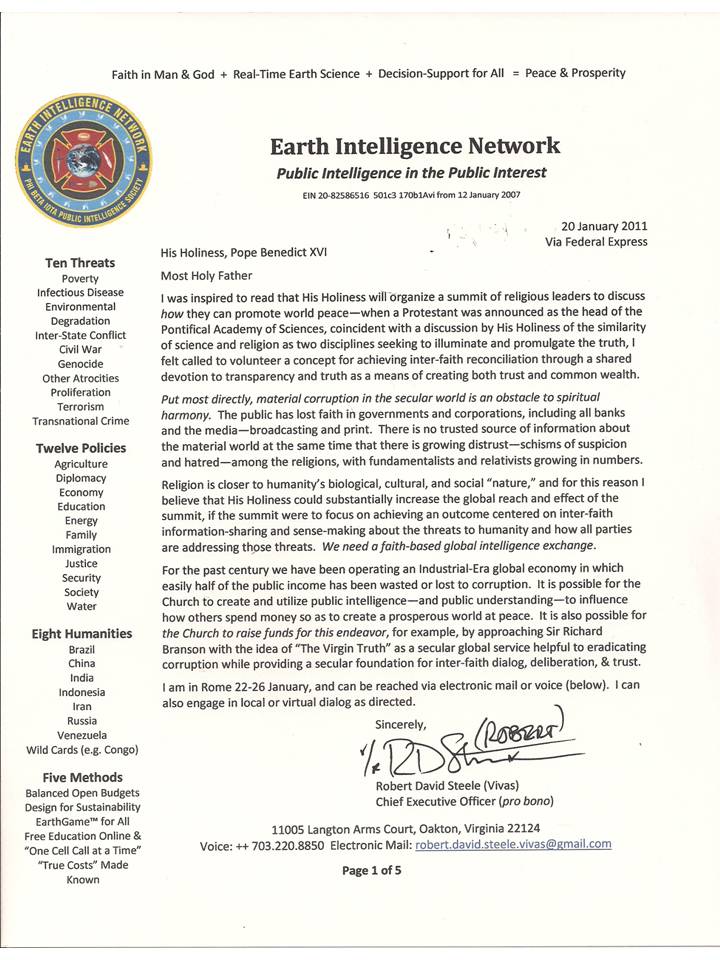
Letter to His Holiness Pope Benedict XVI
Resume Robert David STEELE Vivas M4IS2
See Also:
28 Jan Seven Answers–Robert Steele in Rome
27 Jan Assisi-Rome 2nd Meeting
27 Jan Reference: Correspondence on Assisi Intelligence

The truth at any cost lowers all other costs — curated by former US spy Robert David Steele.
Letter to His Holiness Pope Benedict XVI
Resume Robert David STEELE Vivas M4IS2
See Also:
28 Jan Seven Answers–Robert Steele in Rome
27 Jan Assisi-Rome 2nd Meeting
27 Jan Reference: Correspondence on Assisi Intelligence

The USAF claim that the tragic killing of 23 innocent Afghan civilians last February by one of its Predator UAVs was due to “information overload” reflects an appalling lack of critical thinking on the part of senior Air Force officers. General Mike Hayden (USAF ret.) when director of the NSA used regularly entertain the U.S. congress with the same complaint again reflecting the same lack of critical thought.
The problem for both the USAF and the NSA is that both seem to be following collection and processing strategies that belong to the Cold War era before the information revolution.
The Soviet Union may have been the most incompetent super power in world history, but it was extremely good at information denial. When the NSA could actually find and collect a signal containing exploitable information emanating from the USSR, it was common practice to collect and process everything from that signal 24/7 because it was such a rare occurrence. Because of the Soviet practice of immediately shutting down any signal that there was even as hint had been comprised the material so obtained was compartmentalized and distribution was tightly controlled. All this was possible because the information collected from such a signal at best was miniscule by today’s standards. In the same manner before such neat things as down linking digital images, the number of images to be processed were absurdly small and scarcely time sensitive. So again ‘full take’ was the best, and indeed, the only option.
Continue reading “Richard Wright: MILITARY INTELLIGENCE: All Eyes No Brain Part II”
Online promo flyer with graphics from Cognito
Who: Author Stephen Kinzer, Grand Theft Auto Director Navid Khonsari, Newscaster Amy Goodman, Emmy-nominated Mike de Seve, Columbia University Chair of Iran Studies Hamid Dabashi
Where: 2 West 64th St. & Central Park West, NYC, (New York Society for Ethical Culture)
When: Tuesday, January 18, 2011, 7 p.m.
CONTACT: Natalia Mount, Natalia@mountrehbein.com (315) 440-5036
New York, NY, Jan. 12, 2011 – This January 20 marks the 30th anniversary of the end of the Iran Hostage Crisis, when students and militants imprisoned 52 Americans in Tehran for 444 days. The event will occur two days before the anniversary, on Tuesday, Jan. 18th at the Society for Ethical Culture, 2 W. 64th St. at 7:30 pm.
To commemorate the 1981 event, New York Times veteran and best-selling author Stephen Kinzer (All the Shah's Men) joins Amy Goodman and Columbia's Dr. Hamid Dabashi (Chair, Iranian Studies) to re-examine this historic incident, and discuss its impact on current events.
Contributing: Media and tech pioneer Daniel Burwen, founder of Cognito Comics and publisher of Operation Ajax (an interactive iPad app about the crisis' roots); Emmy-nominated Ajax author Mike de Seve; and eBook innovator Harold Moss of FlickerLab. They'll present breakthrough ways history can be brought to new audiences in today's wired world.
 M-Paisa: Ending Afghan Corruption, one Text at a Time
Monty Munford Oct 17, 2010
Afghanistan supplies 92% of the world’s opiates. According to the latest available figures, the country produced 8,200 tons of heroin in 2008, more than double the the amount three years earlier.
But even being the heroin capital of the world, bringing in more money than most Afghans can dream of, the on-going war and rampant corruption means the money goes to the wrong people and the country has no infrastructure. There are no decent roads, no railways… But they do have mobile phones.
Four months ago, the Afghan National Police began to pay salaries through mobiles (using a text and Interactive Voice Response system), rather than in cash. The platform used was based on the M-Pesa service that has become highly successful in Kenya. Branded M-Paisa in Afghanistan, it was introduced by the operator Roshan in partnership with the Ministry of the Interior (MOI) and had an immediate effect.
Thanks to Vinod Khosla via his Twitter feed.
Related: Could Tiny Somaliland Become the First Cashless Society?
Also see: Afghanistan War Wealth + Corruption Cycle (Opium, Hashish, Minerals, Past Pipeline Attempts)
A film by Helena Norberg-Hodge, Steven Gorelick & John Page
‘Going local' is a powerful strategy to help repair our fractured world – our ecosystems, our societies and our selves. Far from the old institutions of power, people are starting to forge a very different future…
FeaturingVandana Shiva, Bill McKibben, David Korten, Michael Shuman, Juliet Schor, Richard Heinberg, Rob Hopkins, Andrew Simms, Zac Goldsmith, Samdhong Rinpoche
See Also:

