Communication through voice, sms/text, mobile internet, basic features to mobile touchscreen interfaces, GPS capabilities, and the emerging “augmented reality” features, and mobile projection.
Right now the Categories include, in this order: Video Games, Television, Commercials, Current Events, Sports, Movies, Music.
Phi Beta Iota: Now imagine this in all languages, available on the cell phone, as an educational tool that also harnesses the cognitive surplus–the distributed intelligence–of the Whole Earth. Our view of YouTube is now such that we consider it more important than Google.
September 9, 2010
By Frederik Balfour and Tim Culpan
Foxconn founder Terry Gou might be regarded as Henry Ford reincarnated if only a dozen of his workers hadn't killed themselves this year. An exclusive look inside a postmodern industrial empire. On a crushingly hot mid-August day at Foxconn's Longhua factory campus in Shenzhen—where a dutiful army of 300,000 employees eats, sleeps, and churns out iPhones, Sony PlayStations, and Dell computers—workers indulged in a rare moment of celebration. First, there was a parade, an Alice in Wonderland spectacle of floats, blaring vuvuzelas, and workers dressed up as Victorian ladies, geishas, cheerleaders, and Spider-Men. This was followed by a two-hour rally inside a vast sports stadium featuring acrobats, musical performances, fireworks, and life-affirming testimonials punctuated by chants of “treasure your life” and “care for each other to build a wonderful future.”
Foxconn, the secretive Taiwanese company that produces Apple's iPhone and iPad, the Sony PlayStation, Nintendo Wii, and Dell computers, was forced into the limelight in May 2010 after a dozen employees committed suicide, most by jumping from company dormitories. As part of a much needed public relations effort, Foxconn granted Bloomberg Businessweek unprecedented access to the company's factory floors, worker dorms, suicide helpline operators, and the company's charismatic chairman and founder, 59-year-old Terry Gou. Here are some images of its sprawling facility in Longhua, a suburb of Shenzhen, China, where more than 300,000 migrant laborers work.
“Hacker News” has a welcome page and guidelines page offering an overview of what the organizers expect from those planning on posting comments and why it's good overall for the community. I (Jason Liszkiewicz) was impressed with this. Hacker News has a solid number of participants and provides a simple and mature format for exploring and contributing thoughtful feedback, insight and resources.
It has a jobs link (mainly for engineers and programmers) and the “Ask Hacker News” link which enables the community to share information and reply to what is shared. Such a model (deemed an “experiment”) that provides mature and thoughtful information-sharing is something we need more of. Communities inter-linking with communities (or at least over-lapping) to spill over each others insights can be invaluable and potentially priceless.
This simple and useful model is something I hoped would emerge + converge from the SMS/text messaging developers at ChaCha.com (humans online responding to text messaged questions) or somewhere else. Converging multi-community info-sharing online, offline, and through the mobile world on a global scale is an exciting possibility.
The next level to all of this exists in the form of ideas or fragmented applications but it seems not beyond that, yet.
Email earthintelnet|at|gmail.com or post something at this new forum to discuss these ideas. Or, provide some mature and thoughtful feedback at the Hacker News community.
FrontlineSMS is an open-source software that enables two-way text messaging between cheap mobile phones and laptops over cellular (GSM) networks.
FrontlineSMS: Credit
FrontlineSMS:Credit aims to make every formal financial service available to the entrepreneurial poor in 160 characters or less. By meshing the functionality of FrontlineSMS with local mobile payment systems, implementing institutions will be able to provide a full range of customizable services, from savings and credit to insurance and payroll.
FrontlineSMS: Learn (not finished yet) FrontlineSMS:Learn leverages ubiquitous mobile technology—SMS or “text messaging”—to support and strengthen education and training initiatives and human capacity development and make learning opportunities available anytime and anywhere. Using the application knowledge and higher-order reasoning and decision-making skills can be developed, reinforced and assessed leading to improved transfer of learning, increased knowledge retention, long-term changes in behavior and, ultimately, improvements in service delivery.
FrontlineSMS: Legal (new)
These low-cost systems enable remote coordination between informal dispute resolution workers and the formal legal system, improving service delivery, range, and cost efficiency.
In addition to this core platform, FrontlineSMS:Legal is developing additional plug-ins that will add value to local organizations working to provide legal services. FrontlineSMS:Legal products offer several key functionalities:
Huawei Android Smartphone ‘Ideos' Going To T-Mobile: Report
A few weeks into the future and an ad in the newspaper may look like this– looking for a Google powered smart phone? just spend $50- Amazed? Well that is what is the target of HUAWEI TECHNOLOGIES and T-MOBILE US inclusive. The former a Chinese telecom equipment provider and the latter the fourth largest US mobile carrier.
The Ideos was unveiled on Thursday in Berlin. Ideos is an Android 2.2, the latest version of Google Inc.'s free mobile operating system; ensembles a 2.8-inch touch screen; and can be a Wi-Fi hotspot, allowing other devices to connect to the Internet. Ideos is better option to all these who aren't willing to pay exorbitant for devices such as Apple Inc.'s iPhone or Verizon Wireless's Droid lineup. Such brands typically retail for more than $500 without a contract, or $200 with a two-year contract.
Phi Beta Iota: Free cell phones to the poor, and call centers that educate them free “one cell call at a time,” are the foundation for creating infinite new wealth. What most do not appear to understand is that just as with the genius of Gillette (sell the shave, not the shaver), in the 21st Century the cell phone and connectivity should be free, and it is the transmitted knowledge that is monetized (not sold, but monetized, e.g. early warning from farmers on disease strains, Twitters on earthquakes, etcetera.)
The National Geospatial-Intelligence Agency (NGA) has a requirement to provide a secured, hosted environment that provides web-based access to geospatial visualization services and Open Geospatial Consortium complaint web service interfaces. The Schedule of Supplies/Services provides for the period of performance from 20 September 2010 through 19 September 2011 and two 12-month option years.
This acquisition is for Commercial Geospatial Visualization Services for NGA. Google is the only source that can meet the Government's requirement for worldwide access, unlimited processing, and Open Geospatial Consortium complaint web service interfaces. See Full National Geospatial-Intelligence Agency Release |
“Most of my sources say that Google and Facebook have been bankrolled by the NSA and CIA vendors and they are in complete collusion with each other. I believe Americans will live to regret their participation with Facebook and Google.” –Glen Woodfin (source)
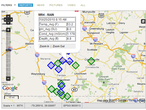
+ Collect information from cell phones, news and the web.
+ Aggregate that information into a single platform.
+ Visualize it on a map and timeline.
Crowdmap is designed and built by the people behind Ushahidi, a platform that was originally built to crowdsource crisis information. As the platform has evolved, so have its uses. Crowdmap allows you to set up your own deployment of Ushahidi without having to install it on your own web server.





 FrontlineSMS