Live Crisis Mapping: Routing Around Old Mindsets

03 Environmental Degradation, 08 Wild Cards, 10 Security, 11 Society, Analysis, Augmented Reality, Civil Society, Collective Intelligence, CrisisWatch reports, Ethics, InfoOps (IO), IO Mapping, IO Multinational, IO Sense-Making, Maps, Mobile, Real Time, Tools
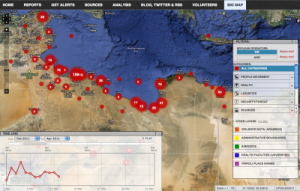
Click for Live Map with Substance Links

OCHA, UNOSAT and NetHope have been collaborating with the Volunteer Technical Community (VTC) specifically CrisisMappers, Crisis Commons, Open Street Map, and the Google Crisis Response Team over the past week.

The CrisisMappers Standby Task Force has been undertaking a mapping of social media, news reports and official situation reports from within Libya and along the borders at the request of OCHA. The Task Force is also aiding in the collection and mapping of 3W information for the response. UNOSAT is kindly hosting the Common Operational Datasets to be used during the emergency. Interaction with these groups is being coordinated by OCHA’s Information Services Section.

The public version of this map does not include personal identifiers and does not include descriptions for the reports mapped. This restriction is for security reasons. All information included on this map is derived from information that is already publicly available online (see Sources tab).
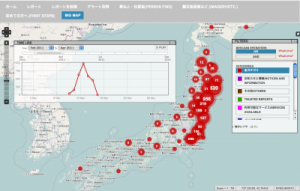
Click for Live Map with Substance Links

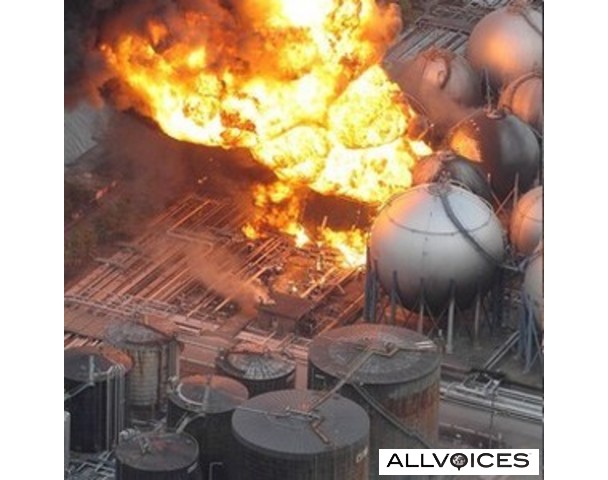
In the midst of this transition in Libya, one of the most devastating earthquakes in centuries hit northern Japan, causing one of the most destructive tsunamis in recent memory. Just hours after the earthquake, a member of Japan's OpenStreetMap community launched a dedicated Crisis Map for the mega-disaster. A few hours later, Japanese students at The Fletcher School (which is where the Ushahidi-Haiti Crisis Map was launched) got in touch with the Tokyo-based OpenStreetMap team to provide round-the-clock crisis mapping support.

Over 4,000 reports have been mapped in just 6 days. That's an astounding figure. Put differently, that's over 600 reports per day, or one report almost every two minutes for 24 hours straight over 6 days. What's important about the Japan Crisis Map is that the core operations are being run directly from Tokyo and the team there is continuing to scale it's operations. It's very telling that the Tokyo team did not require any support from the Standby Volunteer Task Force. They're doing an excellent job in the midst of the biggest disaster they've ever faced. I'm just amazed.

Tip of the Hat to Patrick Meier and Team at iRevolution.

Bruce Sterling at SXSW 2011–Brilliance on Twitter

11 Society, Advanced Cyber/IO, Augmented Reality, Civil Society, Counter-Oppression/Counter-Dictatorship Practices, Cultural Intelligence, Real Time
Bruce Sterling

The South by Southwest® (SXSW®) Conferences & Festivals offer the unique convergence of original music, independent films, and emerging technologies. Fostering creative and professional growth alike, SXSW is the premier destination for discovery.

Phi Beta Iota: Jon Lebkowsky, himself a hero of the Hacker Revolution, has done something cool here.

  • 01 At Southby, science fiction authors talk like they know what’s going on.
  • 02 “There are people here who are younger than the event.”
  • 03 All the political language has been rendered toxic.
  • 04 Polarizing brand management. Culture wars. Politics from POV of a design critic.
  • 05 As a design critic, I criticize stuff that doesn’t exist yet.
  • 06 Bruce Sterling shows Worldchanging 2.0 (the book) at sxsw.
  • 07 Passionate virtuosity…. the ideas in Worldchanging 2.0 are passionate but lack virtuosity.
  • 08 We’ve got a series of problems that are poorly recognized.
  • 09 In our society, we don’t have any passionate virtuosity.Our political situation is the opposite, disgusted incompetence.

Continue reading “Bruce Sterling at SXSW 2011–Brilliance on Twitter”

TED: Salman Khan–Use video to reinvent education

04 Education, 11 Society, Advanced Cyber/IO
Salman Khan

Salman Khan talks about how and why he created the remarkable Khan Academy, a carefully structured series of educational videos offering complete curricula in math and, now, other subjects. He shows the power of interactive exercises, and calls for teachers to consider flipping the traditional classroom script — give students video lectures to watch at home, and do “homework” in the classroom with the teacher available to help.

Salman Khan: Let's use video to reinvent education

Phi Beta Iota: The huge insight here is that today's digital natives not only learn better with video than in person, but it optimizes everyone's time: the learners can “control” the content to repeat as needed, while not hearing “do you understand” over and over; and the teacher can do more and more videos that can be used by more and more people.  This flips the system–the lectures become homework, and “homework” becomes interactive teamwork in the classroom.  Technology humanizes the classroom by moving the rote outside the classroom.

See Also:

TED: Sugata Mitra–The child-driven education

Graphic: Digital Learners versus Analog Teachers

Fight Global Warming: Free Fiber to the Home….

11 Society, Autonomous Internet, Earth Intelligence, InfoOps (IO)

Executive Summary

This blog is about a novel new business model for delivering Fiber to the Home. A proposed pilot deployment is underway in Ottawa Canada.

See slideshow with  detailed business plan.

Background

One of , if not, the greatest threats to our future society and economy is global warming. Governments around the world are wrestling with the challenge of how to reduce carbon dioxide emissions. The current preferred approaches are to impose “carbon” taxes and/or implement various forms of cap and trade systems. However another approach to help reduce carbon emission is to “reward” those who reduce their carbon footprint rather than imposing draconian taxes or dubious cap and trade systems. Consumers will generally respond more positively to voluntary reward mechanisms as opposed to mandatory solutions imposed by government or other authorities. For more details on carbon rewards see http://green-broadband.blogspot.com/

This paper discusses one possible reward system where consumers are provided with free true high speed Internet if they reduce their overall energy consumption. Not only does the consumer benefit, but this business model also provides new revenue opportunities for network operators and builders.

Read more….

Tip of the Hat to Patrick Anderson at the Freedom Box discussion and the Building a Decentralized and Distributed Internet Google Groups

Afghanistan Elective War: A Study of Citizen Minds

04 Inter-State Conflict, 05 Civil War, 07 Other Atrocities, 08 Wild Cards, 09 Justice, 10 Security, 11 Society, Advanced Cyber/IO, Civil Society, Corruption, Counter-Oppression/Counter-Dictatorship Practices, Government, Military, Officers Call, Peace Intelligence
DefDog Recommends...

65% of Americans Believe Afghan War Not Worth Fighting

Tuesday, 15 Mar 2011 01:41 PM

By Henry J. Reske

Almost 65 percent of Americans now believe that the war in Afghanistan is not worth fighting. The number is up 20 points from results in 2009 when 44 percent did not think the war worth fighting, according to a new Washington Post-ABC News poll.

Read more….

Phi Beta Iota: Afghanistan, like Iraq, is an elective war founded on hundreds of lies to the public by a pair of Administrations who have substituted ideology for intelligence and profiteering for public service.  The seismic change occurring today is centered on what can the public know, when.  Public intelligence in the public interest is destined to kick in sooner with each passing year.  One day, elective wars will be impossible.

Poverty & Nuclear Power: Pros and Cons

05 Energy, 11 Society, Civil Society, Commerce, Commercial Intelligence, Cultural Intelligence, Earth Intelligence, Government, Key Players

Poverty to Dictate Future Power Play

Geoffrey T. Smith, Wall Street Journal

March 17, 2011

Those who believe that economics, rather than individuals or events, is the driving force behind history are going to have their faith sorely tested in the coming weeks.

Emotion and experience say the revival of nuclear power can not and should not continue after the events at Fukushima. Economics, and the political imperatives that it creates, say it is inevitable.

Read full article….

Continue reading “Poverty & Nuclear Power: Pros and Cons”

Open Source Governance, Open Source Funding — End of Earmarks, Fraud, Waste, and Abuse

03 Economy, 11 Society, Advanced Cyber/IO, Augmented Reality, Budgets & Funding, Collaboration Zones, Collective Intelligence, Communities of Practice, Counter-Oppression/Counter-Dictatorship Practices, InfoOps (IO), Methods & Process, microfinancing, Mobile, Reform, Strategy, Technologies
Michel Bauwens

Open Source Governance

Peergovernance (Category)

Metagovernment Active Projects

Cognitive Capitalism

Crowdsourcing

Crowdrules Blog

Crowdfunding

Open Money

Over-Arching Starting Point:

P2P Governance, Politics, Social Movements

Continue reading “Open Source Governance, Open Source Funding — End of Earmarks, Fraud, Waste, and Abuse”

noble gold