PART ONE: The Political Class
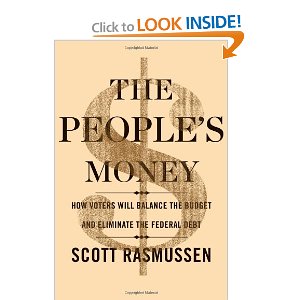
1. What the Political Class Thinks Voters Think
2. How the Political Class Deceives
PART TWO: How Voters Would Spend the People's Money
3. How Voters Would Fix Defense
4. How Voters Would Fix Social Security
5. How Voters would Fix Medicate and Health Care
6. How Voters Would Fix the Tax System
7. How Voters Want to Be Generous
PART THREE: How Voters Would Save the People's Money
8. Ending Corporate Welfare
9. Giving the People a Return on Investments
10. Tightening the Belt of the Beltway
11. Adding it All Up
CONCLUSION: The End of the Political Class
Phi Beta Iota: This book will be released on 31 January 2012. It has been ordered and a full review will be provided right away. This may be one of the most exciting books to be released in 2012, and one of the most relevant, for it is certain to break the back of the political class with transparency and truth. The fact is that the two-party tyranny is corrupt and Congress in criminally neglectful of the public trust.
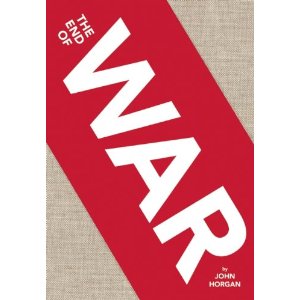
The best book I've read in a very long time is a new one: The End of War by John Horgan. Its conclusions will be vigorously resisted by many and yet, in a certain light, considered perfectly obvious to some others. The central conclusion — that ending the institution of war is entirely up to us to choose — was, arguably, reached by (among many others before and since) John Paul Sartre sitting in a café utilizing exactly no research.
Horgan is a writer for “Scientific American,” and approaches the question of whether war can be ended as a scientist. It's all about research. He concludes that war can be ended, has in various times and places been ended, and is in the process (an entirely reversible process) of being ended on the earth right now.
Amazon Page
The war abolitionists of the 1920s Outlawry movement would have loved this book, would have seen it as a proper extension of the ongoing campaign to rid the world of war. But it is a different book from theirs. It does not preach the immorality of war. That idea, although proved truer than ever by the two world wars, failed to prevent the two world wars. When an idea's time has come and also gone, it becomes necessary to prove to people that the idea wasn't rendered impossible or naïve by “human nature” or grand forces of history or any other specter. Horgan, in exactly the approach required, preaches the scientific observation of the success (albeit incomplete as yet) of preaching the immorality of war.
Answer: Private interests take control of the machinery of state to enhance and protect their profitability.
In some cases, this results in simple looting (like the US mortgage fiasco and EU meltdown). In others, Byzantine laws and rules are enacted that crush innovation and trample personal rights.
Unfortunately, based on this measure, the US and the EU is well on the way to becoming hollow. There's no going back.
Take today's example. At the behest of the Copyright Cartel, the US Justice Department's FBI raided the offices, seized the assets, and criminally indicted/arrested the senior management of the Hong Kong based firm, Megaupload. The crime? Copyright infringement MAY have happened on this extremely popular file sharing site.
What?
And this was on the heals of the attempt to pass the global censorship bills SOPA/PIPA. Here's an amazingly lucid video, by the new media professor Clay Shirky, on what those bills actually do and the contorted thinking behind them.
The first example Clay provides has the feel of the last days of the USSR. A government/private enforcement regime, so intrusive, it stops kids from doodling on birthday cakes. Wow!
Clay Shirky has the best overview I’ve seen/heard/read of PIPA and SOPA and the context from whence they emerged; the bottom line: the legilsation’s about wanting us to be passive consumers, not producing and not sharing.
Phi Beta Iota: To this we would add it is also about a criminally negligent and corrupt Congress exercising its power against the public interest (treason), and a criminally negligent and corrupt combination of Hollywood and Internet Service Providers seeking to legitimize vigilante arbitrary untempered attacks on anyone anywhere without due process.
I know this is framed in U.S. terms, because that is where I and most of the people on my list live. I hope, if you are not living in the U.S., that it can be adapted to the country where you live – because the impact of corporate power on our political lives is now a global phenomenon.
My own preference, of course, would be to find a co-intelligent approach. I can imagine advocates of these various strategies coming together around one integral strategy – one that includes and/or effectively transcends most or all of the different strategies – a super strategy more powerful and wise than anything currently being proposed. If the diverse strategists cannot do this among themselves, perhaps someone could convene a deliberation in which the deliberators are dozens if not hundreds of the most influential activists and organizations whose work is impeded by corporate power. The advocates and opponents of the various strategies would then present their arguments to these powerful political players. With help – perhaps with Dynamic Facilitation – these leading activists and organizations would then discover or design a strategic vision they could all agree on, which embraced the values of all the approaches in a synergistic way.
1. Community declarations of independence from corporate domination.
2. A Constitutional amendment to declare corporations are not natural persons and therefore don't have the civil rights of persons.
3. A Constitutional amendment to require that all campaigns for federal office be financed exclusively with public funds and prohibit any expenditures from any other source, including the candidate, and prohibit independent support or opposition ads.
4. Congress declares that the federal courts, including the Supreme Court, do not have jurisdiction over political matters (as per the Constitution) and simply reassert Congress' Constitutional right to manage elections.
5. Pass federal laws that reduce the range of corporate political power without directly tackling the underlying challenge.
6. Promote the capacity for citizens, communities and states to generate empowered public wisdom which, to the extent it is developed, can create a wise We the People capable of resisting any attempt to control them unjustly or unwisely.
7. Reduce the power of giant corporations by building alternative (mostly local and green) economies.
8. See if corporate domination will die from a million cuts or mosquito bites.
Phi Beta Iota: A most interesting melange with a strong focus and organized sections on policy reform, activism, the 2012 election, electoral reform, open primaries, the economy, energy and water, and the Independent Report.
This nation’s fast-growing populist movement against unbridled corporate power scored an astonishing trifecta this week.
In the span of just a few hours on Wednesday, three vastly different protest movements all achieved startling success the same way: by mobilizing the fury of tens of thousands of ordinary citizens.
. . . . . .
By the end of the day, several stunned senators and congressmen who had originally supported the legislation — including both Democrats and Republicans — had jumped ship, and the bills in their current forms now seem dead.
Phi Beta Iota: What is NOT happening is a coalescence of Tea Party, Occupy, Ron Paul and Dennis Kucinich supporters, and independents. This should all be a dry run for first demanding Electoral Reform Act of 2012, and then electing We the People Reform Coalition.