5.0 out of 5 stars Spectacular Integrative and Pioneering Work, July 27, 2011
This is a pioneering work that not only explains the true worth of open source intelligence, but also illuminates the institutional bias against it and the pathologies of a culture of secrecy. The use of primary data from interviews makes this an original work in every possible sense of the word. I strongly recommend the book to both professionals and to faculty seeking a provocative book for students.
The book opens with a Foreword from Senator Gary Hart, who cites Senator Daniel Patrick Moynihan's point that secrecy is used against the US public more often than it is used to withhold information from the alleged enemy. He also makes the observation that the collapse of the Soviet Union and the emergence of the web occurred almost simultaneously (1990-1991). See Senator Hart's three most recent books, The Thunder and the Sunshine: Four Seasons in a Burnished Life; The Shield and the Cloak: The Security of the Commons, and my favorite The Minuteman: Returning to an Army of the People. The concept of an “intelligence minuteman” is at the foundation of the Open Source Intelligence movement, and highly relevant to this book by Dr. Hamilton Bean.
In his Preface Dr. Bean makes the point that his book is about institutional change and resistance, and the open source intelligence story is simply a vehicle for examining both the utility of his methods with respect to the study of communications and discourse, and the ebbs and flows of institutional change.
Global poverty did not just happen. It began with military conquest, slavery and colonization that resulted in the seizure of land, minerals and forced labor. Today, the problem persists because of unfair debt, trade and tax policies — in other words, wealthy countries taking advantage of poor, developing countries. Renowned actor and activist, Martin Sheen, narrates THE END OF POVERTY?, a feature-length documentary directed by award-winning director, Philippe Diaz, which explains how today's financial crisis is a direct consequence of these unchallenged policies that have lasted centuries. Consider that 20% of the planet's population uses 80% of its resources and consumes 30% more than the planet can regenerate. At this rate, to maintain our lifestyle means more and more people will sink below the poverty line. Filmed in the slums of Africa and the barrios of Latin America, THE END OF POVERTY? features expert insights from: Nobel prize winners in Economics, Amartya Sen and Joseph Stiglitz; acclaimed authors Susan George, Eric Toussaint, John Perkins, Chalmers Johnson; university professors William Easterly and Michael Watts; government ministers such as Bolivia's Vice President Alvaro Garcia Linera and the leaders of social movements in Brazil, Venezuela, Kenya and Tanzania.
By IAN MacDOUGALL, Associated Press – 34 minutes ago
OSLO, Norway (AP) — Anders Behring Breivik said he was a boy when his life's path began to turn. It was during the first Gulf War, when a Muslim friend cheered at reports of missile attacks against American forces.
“I was completely ignorant at the time and apolitical but his total lack of respect for my culture (and Western culture in general) actually sparked by interest and passion for it,” the suspect in Norway's bombing and mass shooting wrote in his 1,500-page manifesto.
The 32-year-old Norwegian said it was the NATO bombing of Serbia in 1999 that “tipped the scales” for him because he sympathized with Serbia's crackdown on ethnic Albanian Muslims in Kosovo. A year later he said he realized that what he called the “Islamization of Europe” couldn't be stopped by peaceful means.
Phi Beta Iota: There has been ample warning of the growing anger of European and North American populations over the Muslimization of their countries. The Muslims are more devout/radical than the Catholics, who have lost a great deal of faith in the Church's stance against birth control–the failure of all Western governments is complex–on the one hand, they have failed to be intelligent or retain their integrity about domestic population policies; and on the other, they have perpetuated virtual colonialism, unilateral militarism (Libya being the latest example), and predatory capitalism (Goldman Sachs being the most outrageous, hurting its own as well as all others). The gap between the “elites” and the general public is catastrophically wide. The corruption of the West is its own demise.
Deborah Avant, Martha Finnemore, Susan Sell (editors)
5.0 out of 5 stars Pioneering work too slow to be published,July 24, 2011<
This is a very fine book that is also available free in conference form (search for <Who Governs the Globe conference>), but of course not paginated, formatted, indexed, and generally edited, all values of the book form.
Although I have been a student of revolution my entire life, it was not until 2003 when J. F. Rischard, then Vice President for Europe of the World Bank, published High Noon 20 Global Problems, 20 Years to Solve Them that I started to focus on hybrid governance, and it was in the same year that Dr. Col Max Manwaring edited The Search for Security: A U.S. Grand Strategy for the Twenty-First Century, a book that began my deeper questioning of the lack of authenticity and legitimacy within the U.S. Government.
The book should have been brought to market much sooner–three years in this modern era is very disappointing, especially when combined with the lack of follow-up. The Institute for Global and International Studies appears to have begun winding down in 2009 and its website is a a real disappointment. In brief, the collaboration represented in this book, which is superb, has not been continued. While it does not address the criminal underbelly of what Matt Taibbi calls the blending of finance and government into a massive crime family (see Griftopia: Bubble Machines, Vampire Squids, and the Long Con That Is Breaking America), it is a fine foundation effort that touches on standards, norms, successes, and failures. It does not create a proposed methodology for further research, it does hit on the high points of authority, legitimacy, and accountability–attributes that many governments and corporations and NGO/IOs cannot claim to possess.
Everyone else is writing about governments that do not work, or NGOs that lies, cheat, and steal, or corporations that run amok and are predatory and corrupting. This book taps into norms and standards and possibilities, but it leaves a great deal unsaid, and clearly needs a follow-on volume that integrates academics, civil society, commerce, government, law enforcement, media, military, and NGOs/non-profits, with a deliberate focus on how they might strive to achieve what the UN High Level Panel on Coherence called for, the ability of disparate organizations to “deliver as one.” One policy-harmonization option is multinational multiagency multidisciplinary, multidomain information-sharing and sense-making (M4IS2), and sadly no one anywhere seems interested in this foundation topic.
With my last remaining link, I will mention Nonzero: The Logic of Human Destiny, a book that was recommended to me by Tom Atlee (see his two books here on Amazon, one on co-creation the other on evolutionary activism). Today's “system” is corrupt in the extreme, not least because of the information asymmetries between the 1% wealthy and the rest of us. What the book–and the general literature on IO/NGO empowerment with information technologies–do not address is how one achieves shared intelligence (decision support) such that corruption and waste are eradicated, and disparate entities are harmonized into delivering just enough just in time voluntarily–sharing information in real time is the key. If the authors and the Institute can delve into this more deeply, their potential contribution is potentially priceless.
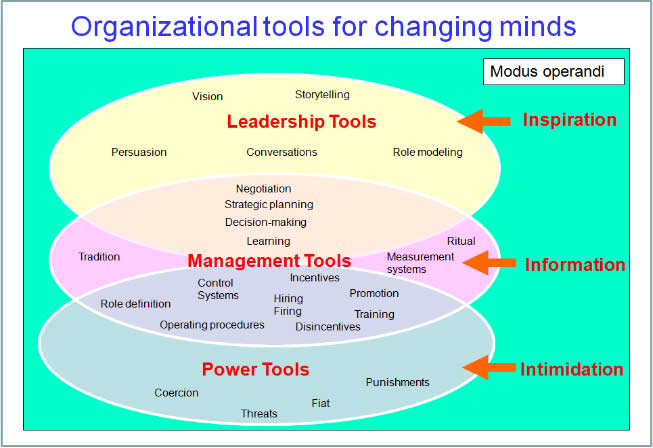
Changing a culture is a large-scale undertaking, and eventually all of the organizational tools for changing minds will need to be put in play. However the order in which they deployed has a critical impact on the likelihood of success.
Click on Image to Enlarge
In general, the most fruitful success strategy is to begin with leadership tools, including a vision or story of the future, cement the change in place with management tools, such as role definitions, measurement and control systems, and use the pure power tools of coercion and punishments as a last resort, when all else fails.
Phi Beta Iota: Missing from this depiction is education, and the 21st Century role of leaders in eliciting and facilitating bottom-up co-creation.

 Hamilton Bean