Obama can't catch a break. His Republican opposition gained control of the House, seats in the Senate, and control of more statehouses. He lost big in the center, with both GOP moderates and Blue Dog Democrats dropping like flies. Even the Progressive wing is calling, if not for his hide, for his vertebrae.
How did it get that way? Perhaps there is a clue in one of the Obama administration's earliest decisions. The subject was not a big, profound issue like nuclear arms, health care, or tax policy. It was quite literally a tiny issue: the President's Blackberry.
A new study on white ibis breeding has discovered that mercury pollution is resulting in males of the species mating with each other.
Dr. Peter Frederick of the University of Florida embarked on the five-year research to determine what was significantly impacting the reproduction of the birds, but even he was stunned by the findings. “We knew mercury could depress their testosterone levels but we didn't expect this,” Frederick told the Telegraph.
According to Nature.com, coal-fired plants and gold mining are the main sources of global mercury pollution, though the burning of medical and municipal waste is likely the prime culprit in Florida, ingested by the wetlands birds through their food sources.
Phi Beta Iota: We did a double-take, and then checked to make sure this was not in the Comedy section. This helps emphasize what many books have been reviewing, which is the unanticipated and now unaddressed impact on humanity of the many toxins and pollutants that corporations are allowed to not just externalize, but include within their products or as a side effect of their services. “True costs” is the meme, and Transparency is the method.
Navy Plan for Littoral Ships Is Winning Support, Despite Lack of Price Tag
By John M. Donnelly, CQ Staff
Lawmakers are suddenly voicing new support for a Navy plan to acquire cutting-edge warships, despite continuing apprehension about not being given enough information or time to consider it.
EXTRACT: Today “Wikileaks” makes the McLibel case look like child's play. Corporate executives should watch closely as diplomats cringe under the sudden and violent spotlight. The same scrutiny is coming to the corporate world. Wikileaks founder Julian Assange has already announced the private sector is his next target. It may be that governments find a way to silence Assange (Wikileaks.org is already undergoing shadowy cyber attacks to shut it down) but it wont stop the wave of involuntary transparency that the Internet provides. Transparency is the Internet's killer CSR app. You can either get out in front of it or fall prey to it.
Phi Beta Iota: The post is an elegant, concise articulation such as has not appeared elsewhere to our knowledge. The lines are drawn, all that is lacking is the precipitating factor to launch the revolution. “Profit Recovery” is going to join “True Cost” as the new meme, but instead of secretive beltway bandits maurading across the health industry–to take one example–it will be the public willfully exposing that which must be restored to the Commonwealth.
There is a war underway. I'm not talking about Washington's bloody misadventures in Afghanistan and Iraq, but a war within our own borders. It's a war fought on the airwaves, on television and radio and over the Internet, a war of words and images, of half-truth, innuendo, and raging lies. I'm talking about a political war, pitting liberals against conservatives, Democrats against Republicans. I'm talking about a spending war, fueled by stealthy front groups and deep-pocketed anonymous donors. It's a war that's poised to topple what's left of American democracy.
Phi Beta Iota: A detailed and devastating article that recommends the book, Winner-Take-All Politics, and places the beginning of today's economic divide with President Jimmy Carter, not Ronald Reagan. We place it further back, in the 1920's, when Carnegie and Rockefeller structured the role school system and also oversaw the destruction of all public transportation systems they could buy and then liquidate. It provides details on the specific organizations and their leading lights unleashed by the Citizens United decision of the Supreme Court, and decision that in our view should suggest the need to first fire Congress and then pass legislation overturning all Supreme Court decisions permitting corporate “personality” and its requisite privileges that could be reserved for individual citizens.
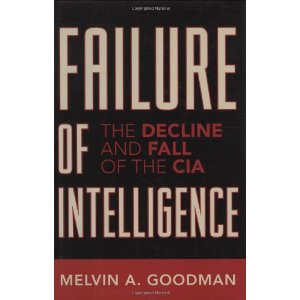
This is an astonishingly well balanced book that while deeply critical of CIA and its senior management also credits its strengths and successes. The author, Melvin Goodman, spent some 34 years as an analyst within the Directorate of Intelligence (DI) of CIA. His principal criticism is that CIA directors in collusion with the executive branch have routinely politicized not merely intelligence products, but the very processes of research and analysis basic to intelligence production. He further argues that most intelligence `failures' can be traced to the practice of far too many at CIA to distort the intelligence process to support policy decisions and even to suppress sound, contrary intelligence. He also sees the growing `militarization' of the U.S. Intelligence System as further evidence that the Intelligence Community (IC) is moving from producing objective and accurate intelligence to producing intelligence that supports the ideologies and prejudices of its masters.
Goodman supports his argument with a remarkably detailed chronicle of CIA intelligence production over the last 35 years. This chronology emphasizes those instances where political pressure and the need to support a particular point of view took precedence over the need to produce accurate intelligence. Also, although he doesn't say so directly, he demonstrates the truth that intelligence is only as good as the system it serves. Unlike so many books on intelligence, this book actually identifies both the good guys and the bad .guys of CIA over the years. In particular he has a fascinating analysis of CIA Directors from Bill Casey (1980-1986) onward that is quite devastating. Although his principal target is the deleterious effect of the politicization and militarization of intelligence, he also effectively criticizes CIA's analytic and clandestine tradecraft.
This is an absolutely important critique of the course of CIA and by extension the entire U.S. Intelligence Community. However, given the controversial claims made by Goodman and the fact he actually names his heroes and villains, the reader might ask does he really know what he is talking about? In this reviewer's opinion, the answer is yes he does. Having been personally involved in a number of specific intelligence events that he chronicles, this reviewer would argue that Goodman has accurately described them. This is a book that ought to guide any effort to reform the U.S. Intelligence System.




 Gregory Unruh
 —
—