Reference: WikiLeaks Interview in Forbes–Promoting Business Ethics

03 Economy, 07 Other Atrocities, 11 Society, About the Idea, Commerce, Commercial Intelligence, Corporations, Cultural Intelligence, Ethics, Historic Contributions, InfoOps (IO), Journalism/Free-Press/Censorship, Money, Banks & Concentrated Wealth, Officers Call, Power Behind-the-Scenes/Special Interests, Privacy, Reform
0Shares
Andy Greenberg

Nov. 29 2010

Fascinating article, including leaks in the pipeline (banks), whistleblowers, censorship, his story, trying to stop leaks, spying, untrustful competitors, secrecy, war, field of intelligence, etc.  … “our primary defense isn’t law, but technology…courage is contagious” (p.8) —  JAS

Forbes Cover Story . . . Forbes Transcript

Following is an excerpt from page 5 regarding moving in the direction of ethical business — JAS
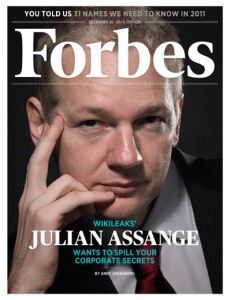
Forbes Cover Story

What do you think WikiLeaks mean for business? How do businesses need to adjust to a world where WikiLeaks exists?

WikiLeaks means it’s easier to run a good business and harder to run a bad business, and all CEOs should be encouraged by this. I think about the case in China where milk powder companies started cutting the protein in milk powder with plastics. That happened at a number of separate manufacturers.

Let’s say you want to run a good company. It’s nice to have an ethical workplace. Your employees are much less likely to screw you over if they’re not screwing other people over.

Then one company starts cutting their milk powder with melamine, and becomes more profitable. You can follow suit, or slowly go bankrupt and the one that’s cutting its milk powder will take you over. That’s the worst of all possible outcomes.

The other possibility is that the first one to cut its milk powder is exposed. Then you don’t have to cut your milk powder. There’s a threat of regulation that produces self-regulation.

It just means that it’s easier for honest CEOs to run an honest business, if the dishonest businesses are more effected negatively by leaks than honest businesses. That’s the whole idea. In the struggle between open and honest companies and dishonest and closed companies, we’re creating a tremendous reputational tax on the unethical companies.

No one wants to have their own things leaked. It pains us when we have internal leaks. But across any given industry, it is both good for the whole industry to have those leaks and it’s especially good for the good players.

But aside from the market as a whole, how should companies change their behavior understanding that leaks will increase?

Do things to encourage leaks from dishonest competitors. Be as open and honest as possible. Treat your employees well.

I think it’s extremely positive. You end up with a situation where honest companies producing quality products are more competitive than dishonest companies producing bad products. And companies that treat their employees well do better than those that treat them badly.

Would you call yourself a free market proponent?

Absolutely. I have mixed attitudes towards capitalism, but I love markets. Having lived and worked in many countries, I can see the tremendous vibrancy in, say, the Malaysian telecom sector compared to U.S. sector. In the U.S. everything is vertically integrated and sewn up, so you don’t have a free market. In Malaysia, you have a broad spectrum of players, and you can see the benefits for all as a result.

How do your leaks fit into that?

To put it simply, in order for there to be a market, there has to be information. A perfect market requires perfect information.

There’s the famous lemon example in the used car market. It’s hard for buyers to tell lemons from good cars, and sellers can’t get a good price, even when they have a good car.

By making it easier to see where the problems are inside of companies, we identify the lemons. That means there’s a better market for good companies. For a market to be free, people have to know who they’re dealing with.
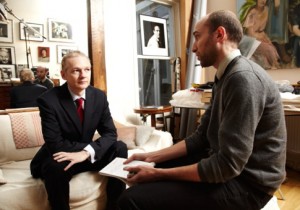
The InterviewYou’ve developed a reputation as anti-establishment and anti-institution.

Not at all. Creating a well-run establishment is a difficult thing to do, and I’ve been in countries where institutions are in a state of collapse, so I understand the difficulty of running a company. Institutions don’t come from nowhere.

It’s not correct to put me in any one philosophical or economic camp, because I’ve learned from many. But one is American libertarianism, market libertarianism. So as far as markets are concerned I’m a libertarian, but I have enough expertise in politics and history to understand that a free market ends up as monopoly unless you force them to be free.

WikiLeaks is designed to make capitalism more free and ethical.

But in the meantime, there could be a lot of pain from these scandals, obviously.

Pain for the guilty.

Do you derive pleasure from these scandals that you expose and the companies you shame?

It’s tremendously satisfying work to see reforms being engaged in and stimulating those reforms. To see opportunists and abusers brought to account.

———————————

Thanks to: Dan Drasin via John Steiner.
Reference: WikiLeaks and Al Qaeda as Open Source Insurgencies

10 Security, 11 Society, Blog Wisdom, Civil Society, Counter-Oppression/Counter-Dictatorship Practices, Cultural Intelligence, Ethics, Money, Banks & Concentrated Wealth, Officers Call, Peace Intelligence, Power Behind-the-Scenes/Special Interests, Reform, Strategy, Threats
0Shares

Journal: The Security and Secrecy “Tax” – Global Guerrillas

By John Robb at Global Guerrillas (Networked tribes, systems disruption, and the emerging bazaar of violence. Resilient Communities, decentralized platforms, and self-organizing futures)

Wikileaks and Al Qaeda's Open Source Jihad are both open source insurgencies. While there are obvious differences between the two, what's more interesting is how they are similar. Namely: as open source insurgencies both groups use systems disruption (the ability…

Tip of the Hat to Mario Profaca at Facebook.

Phi Beta Iota: The deeper interpretation of the similarity of Al Qaeda and WikiLeaks is that they are both finding huge audiences for what they are offering, and they are both playing off of a massive public distaste for Open Veins of Latin America, Killing HopeRule by Secrecy, Sorrows of Empire, Web of Deceit, The Fifty Year Wound, etc.  The USA has created its enemies because of its hubris and the corruption inherent in how it has supported dictators and predatory immoral capitalism, imposing virtual colonialism and unilateral militarism, all without regard to either the rights of the indigenous parties treated as “collateral damage” or the interests of the American citizen-voter-taxpayer whose blood, treasure, and spirit have been consumed by an elite class that comprises an “Other Atrocity” on a global scale.  It troubles us that there is no one in the Administration with the intellectual breadth of mind and the intestinal fortitude to point out to President Barack Obama that he has a game-changing choice in front of him.  We (the 800 contributors, 80 active, 8 frequent) of Phi Beta Iota have always been open, honest, and loyal–these insurgencies are occurring because the US Government failed to heed the early warnings that began in the 1970's and reached a crecsendo in the 1990's.  There is still time for Barack Obama to Change the Game!

See Also:

Legitimate Grievances Part I (Domestic versus US Government)

Legitimate Grievances Part II (Global versus US Government)

Reference: No Labels “Non-Party” = “Four More Years” for Wall Street

Reference: Crash Course on Reality

Journal: Taliban Laughing–the Clowns Dance On…

Journal: Debt, Defense, and the Diem Moment in AF

Worth a Look: Book Reviews on Elite Rule

Worth a Look: Book Reviews on Empire as Cancer Including Betrayal & Deceit

Life & Death by Medicine: The Science & Politics of the Vaccine Wars

02 Infectious Disease, 04 Education, 07 Health, 07 Other Atrocities, Politics of Science & Science of Politics, Power Behind-the-Scenes/Special Interests, Videos/Movies/Documentaries
0Shares

For a look into the vaccine conflict, see Frontline's “The Vaccine War“. For counter-vaccine viewpoints,  Vaccineinitiative.org hosts white papers, articles, opinion pieces, scholarly reports from scientists, physicians, activists, who are offering constructive challenges to the belief of the safety and efficacy of vaccines.


Gary Null Speaking Out at the NYS Assembly Hearing | 10-13-2009 | (part 1 of 3)

Continue reading “Life & Death by Medicine: The Science & Politics of the Vaccine Wars”

Journal: WikiLeaks Next Round BANKS

03 Economy, 07 Other Atrocities, 09 Justice, 10 Transnational Crime, Commerce, Commercial Intelligence, Corporations, Corruption, IO Multinational, IO Secrets, Money, Banks & Concentrated Wealth
0Shares
DefDog Recommends...

WikiLeaks plans to release thousands of internal documents from a major
U.S. bank in early 2011, Forbes magazine reported on Monday.

“You could call it the ecosystem of corruption,” Assange told Forbes
during an interview in London, but refused to provide details about the
bank.

MORE @
http://www.thehindu.com/news/international/article923432.ece?homepage=true

Phi Beta Iota: Our hope for the round after banks would be massive leakage from the Republican National Committee and the Democratic National Committee.  This “open everything” meme is way cool.  Think of it as tough love.

Facebook Question and Answer

Jonathan Kan So, do WikiLeaks make your Open Source Intelligence dream comes true?

The short answer is no–WikiLeaks is the lowest form of open source raw sewage–BUT WikiLeaks is serving an enormous purpose in demonstrating without equivocation that “rule by secrecy” is unethical, inept, and not in the public interest.  It is a catalyst for change, not change itself.  For change the game, see Tom Atlee on politics (search Tom Atlee Change the Game) and for substance see my M4IS2 Briefing to South America, at www.tinyurl.com/SteeleCHILE.  Pass it on.  The revolution has started without a single politician being involved.

Search: global challenges forum dumaine switzerl

Searches
0Shares

Not on the site, but always appreciated as a lead, the event has taken place so it will not be placed in Events.

Rule one with Word Press is to do short simple searches.

Global Challenges Forum does NOT produce the sought after conference but see the interesting results in related hits by clicking on the bold active search set.

Similarly Carol Dumaine does NOT produce the sought after conference (which our network did not notice beforehand) but produces very important hits on Carol Dumaine, who has been, like Carmen Medina, Janet Platt, Dennis McCormick, Diane Webb,  and Andy Shepard and a handful of others in DoD such as Dr. Dr. Dave Warner, Eric Rasmussen, Chris Rasmussen, disciplined in accepting the system's inability to change or even notice the need to change.  Click on her name as highlighted for those results.

Here is the link you were looking for:

Naval Postgraduate School Global Challenges Forum Switzerland

See Also:

2010 M4IS2 Briefing for South America

Search: The Future of OSINT [is M4IS2-Multinational]

2010: Human Intelligence (HUMINT) Trilogy Updated

2010 INTELLIGENCE FOR EARTH: Clarity, Diversity, Integrity, & Sustainability

Reference: Wall Street Does NOT Produce Value

Blog Wisdom
0Shares
Chuck Spinney Recommends....

Attached is a first rate essay that should be studied carefully.  Chuck

ANNALS OF ECONOMICS

WHAT GOOD IS WALL STREET?

Much of what investment bankers do is socially worthless.

by John Cassidy, New Yorker

NOVEMBER 29, 2010

For years, the most profitable industry in America has been one that doesn’t design, build, or sell a single tangible thing.

. . . . . .

Most people on Wall Street, not surprisingly, believe that they earn their keep, but at least one influential financier vehemently disagrees: Paul Woolley, a seventy-one-year-old Englishman who has set up an institute at the London School of Economics called the Woolley Centre for the Study of Capital Market Dysfunctionality. “Why on earth should finance be the biggest and most highly paid industry when it’s just a utility, like sewage or gas?” Woolley said to me when I met with him in London. “It is like a cancer that is growing to infinite size, until it takes over the entire body.”
. . . . . .
Full Source Online

Perhaps the most shocking thing about recent events was not how rapidly the big Wall Street firms got into trouble but how quickly they returned to profitability and lavished big rewards on themselves. Last year, Goldman Sachs paid more than sixteen billion dollars in compensation, and Morgan Stanley paid out more than fourteen billion dollars. Neither came up with any spectacular new investments or produced anything of tangible value, which leads to the question: When it comes to pay, is there something unique about the financial industry?  [Answer: no, they are overpaid but not held accountable.]

. . . . . .

In 1940, a former Wall Street trader named Fred Schwed, Jr., wrote a charming little book titled “Where Are the Customers’ Yachts?,” in which he noted that many members of the public believed that Wall Street was inhabited primarily by “crooks and scoundrels, and very clever ones at that; that they sell for millions what they know is worthless; in short, that they are villains.” It was an extreme view, but public antagonism toward bankers and other financiers kept them in check for forty years. Economic historians refer to a period of “financial repression,” during which regulators and policymakers, reflecting public suspicion of Wall Street, restrained the growth of the banking sector. They placed limits on interest rates, prohibited deposit-taking institutions from issuing securities, and, by preventing financial institutions from merging with one another, kept most of them relatively small. During this period, major financial crises were conspicuously absent, while capital investment, productivity, and wages grew at rates that lifted tens of millions of working Americans into the middle class.

Since the early nineteen-eighties, by contrast, financial blowups have proliferated and living standards have stagnated. Is this coincidence? For a long time, economists and policymakers have accepted the financial industry’s appraisal of its own worth, ignoring the market failures and other pathologies that plague it. Even after all that has happened, there is a tendency in Congress and the White House to defer to Wall Street because what happens there, befuddling as it may be to outsiders, is essential to the country’s prosperity. Finally, dissidents like Paul Woolley are questioning this narrative. “There was a presumption that financial innovation is socially valuable,” Woolley said to me. “The first thing I discovered was that it wasn’t backed by any empirical evidence. There’s almost none.” ♦

Phi Beta Iota: The Republic has lost the art of seeing the Big Picture.  The failure of the US infected all other countries.  Failed states have risen from 25 or so to over 175, and the USA is now on the verge of becoming a failed state itself.

See Also:

Journal: Reflections on Integrity

Worth a Look: Book Reviews on Bankruptcy of US Economy, Federal Reserve Malfeasance

Worth a Look: Book Reviews on Blue Collar

Worth a Look: Book Reviews on Class War (Global)

Worth a Look: Book Reviews on Corporate & Transnational Crime

Worth a Look: Book Reviews on Corporate Lack of Integrity or Intelligence or Both

Worth a Look: Book Reviews on Elite Rule

Worth a Look: Book Reviews on Middle Class

Worth a Look: Book Reviews on Poisons, Toxicity, Trash, & True Cost

Worth a Look: Book Reviews on Poverty

Worth a Look: Book Reviews on War Complex—War as a Racket

Reference: The Modern Big Picture–Two Minds

Analysis, Articles & Chapters, Collective Intelligence, Collective Intelligence, Communities of Practice, Counter-Oppression/Counter-Dictatorship Practices, Earth Intelligence, Ethics, Geospatial, History, InfoOps (IO), IO Sense-Making, Key Players, Methods & Process, Officers Call, Open Government, Peace Intelligence, Policies, Politics of Science & Science of Politics, Real Time, Reform, Secrecy & Politics of Secrecy, Strategy, Technologies, Threats, Tools, Waste (materials, food, etc)
0Shares

Extract from Conclusion in the Above:  I have observed the World Game as a student-participant, and wish it well. I have also observed Bob Pickus's work, as a student-participant in Turn Toward Peace, and wish him well. There are still other alternatives, but whichever road leads us faster into a world without war, what I gain most from Pickus and Fuller is their sense of the Big Picture. No one else can match their indefatigable and comprehensive efforts to see the problem whole, and to steer the world's energy into a grand design of peace.

See Also:

Who's Who in Collective Intelligence

Who's Who in Peace Intelligence

BigPictureSmallWorld

BigPicture Consulting

Design Science Lab

Global Education Lab

EarthGame