Journal: US Secret Intelligence Tasking US Diplomats

02 Diplomacy, Corruption, Cultural Intelligence, Government, InfoOps (IO), Intelligence (government), IO Secrets, Methods & Process, Officers Call
0Shares
Marcus Aurelius Recommends

Insofar as I know, the DoD military Services remain under broad and explicit proscription from accessing the Wikileaks site or the Wikileaks releases in any form.  Some of the Service directives are very intimidating, threatening court martials for military members, loss of security clearances, etc., etc.  From the broadcast media, it appears that major lockdowns of information will shortly follow.  And SPC Bradley Manning, currently confined at Quantico, will probably walk as, I suspect, will Hasan at Fort Hood.  MA

Phi Beta Iota: This demonstrates that the National Clandestine Service (NCS) is completely ignorant of what can be known through open sources, and that the Secretary of State is not doing her job of assuring that diplomacy is not micro-tasked into what are clearly clandestine and covert operations support functions absolutely not appropriate to diplomatic status.  These people should not have message release authority.  The US Government needs a total make-over.  First, however, CIA needs a director that is fully capable on day one.

U.S. Expands Role of Diplomats in Spying

By MARK MAZZETTI

November 28, 2010

WASHINGTON — The United States has expanded the role of American diplomats in collecting intelligence overseas and at the United Nations, ordering State Department personnel to gather the credit card and frequent-flier numbers, work schedules and other personal information of foreign dignitaries.

Revealed in classified State Department cables, the directives, going back to 2008, appear to blur the traditional boundaries between statesmen and spies.

The cables give a laundry list of instructions for how State Department employees can fulfill the demands of a “National Humint Collection Directive” in specific countries. (“Humint” is spy-world jargon for human intelligence collection.) One cable asks officers overseas to gather information about “office and organizational titles; names, position titles and other information on business cards; numbers of telephones, cellphones, pagers and faxes,” as well as “internet and intranet ‘handles’, internet e-mail addresses, web site identification-URLs; credit card account numbers; frequent-flier account numbers; work schedules, and other relevant biographical information.”

Philip J. Crowley, a State Department spokesman, on Sunday disputed that American diplomats had assumed a new role overseas.


Read the rest of this sad story….

Journal: CIA Spastic, Kill It or Fix It (Panetta Goes…)

Government, IO Multinational, IO Sense-Making
0Shares
Marcus Aurelius Recommends

(1) Not sure there's anything new here; (2) not sure the establishment agrees.  MA

Phi Beta Iota: If President Obama wishes to change the game, he needs to change his core staff including the Director of the Office of Management and Budget (OPM), appoint the Coalition Cabinet he has been playing kitchen with, and slam Congress with the Electoral Reform Act (1 page, 9 points) in celebration of President's Day in February 2011.  Anyone voting no in a roll call vote will be scheduled for a recall initiative in their home state or district.   Similarly, if Director Clapper wishes to change the game to something that meets the needs of 100% of his legitimate clients 90% of the time (instead of just meeting the needs of the top tier 4% of the time), he needs to demand the right to appoint a new Director of the Central Intelligence Agency (CIA), someone who is a kick-ass Big Picture thinker with both service across CIA, across the military intelligence functions (rank is a disqualifier) and with outside the wire experiences ideally including direct exposure to 66 countries interested in learning about Open Source Intelligence (OSINT), with M4IS2 deeply embedded as the next big thing “central” to “intelligence,” and a deep commitment to doing the right thing, not doing the wrong thing righter.  CIA could be the turning point for the Obama presidency.  How CIA goes in the next 180 days could well determine whether there is or is not a second Obama Administration.  The chances of anything good happening are under 30%.

CIA Ground Truth

Essay

C.I.A. Agents, Blowing Their Own Cover

By ALEX BERENSON

November 26, 2010

This summer, a former spy who calls himself ­Ishmael Jones got into trouble with his old bosses at the Central Intelligence Agency.

No, the agency didn’t put out a contract on his life or ship him to Guantánamo. Instead, in July, it sued Jones, the author of “The Human Factor: Inside the C.I.A.’s Dysfunctional Intelligence Culture,” accusing him of breaking his secrecy agreement and failing to get the required approval to publish. If the C.I.A. intended to make the book disappear, it failed. When the suit was reported last month, the book — a modest seller when first published in 2008 — shot up the Amazon rankings.

. . . . . .

Such cases [child wanna-bees that self-destruct] are common, Charles Faddis, a case officer for 20 years, argues in “Beyond Repair.” Faddis describes the agency as rife with incompetence at every level and compares its leadership training unfavorably with that of the military. “Sixty years after its founding,” he writes, the agency “has never developed any system for the selection, training and cultivation of leaders.” Even the Sept. 11 attacks did not produce meaningful change. Faddis argues that adding a director of national intelligence to oversee the agency simply imposed another layer of bureaucracy. Of the 4,000 new employees in the director’s office, “not a single one of them runs operations. Not a single one of them recruits assets or produces intelligence. What they do produce, however, is process, lots of it.”

The Real CIA

See Also:

2010 M4IS2 Briefing for South America

2000 ON INTELLIGENCE: Spies and Secrecy in an Open World

Journal: Taliban Laughing–the Clowns Dance On…

Reference: Panetta Puts Lipstick on the Pig (Again)

Secrecy New Headlines–Over-Classification, Leaks, CIA Sues Author of The Human Factor

Journal: Chavez versus CIA–No Contest

Reference: Retired CIA officer–Fix the Agency

Worth a Look: Book Reviews on Intelligence (Lack Of)

Review: The Amish Way–Patient Faith in a Perilous World

5 Star, Complexity & Resilience, Consciousness & Social IQ, Culture, Research, Economics, Environment (Solutions), Nature, Diet, Memetics, Design, Peace, Poverty, & Middle Class, Religion & Politics of Religion, Values, Ethics, Sustainable Evolution
0Shares

5.0 out of 5 stars Three World-Class Authors on Amish Create Single Distillation

November 28, 2010

I bought this book because two colleagues, Howard Rheingold and Kevin Kelly, are both working on books about the Amish in relation to technology, with the key thought being that when the Amish adopt or accept any technology, they do so with deep reflection on how the technology will impact on them and their community for generations into the future.

One of a several books I went through on a trip to Chile and back, this book is immediately of distinction because it is a distillation of the experience and insights of three world-class authors on the Amish with fourteen books specifically on the Amish among them.

I agree with the first reviewer, this is a really excellent work. As I went through it, I learned, I was inspired, and I was grounded in both the grace and the hardship of being Amish.

The authors have organized the book, and the publishers have presented the book, in a very pleasing, easy-to-read, easy-to-appreciate manner.

In four parts (Spirituality, Community, Everyday Life, and Amish Faith and the Rest of Us), the authors achieve–without a single false note–both a synthesis of their broad and deep understanding of the minutia as well as the “big picture” of Amish reality, *and* a communication of what we who are not Amish can take from this practicum.

Most who strive to be converts do not make it. It is simply too hard a life for those who have not been bred to it from birth. It has many blessings, including family held close for generations, and it demands many sacrifices, some of which would assuredly be good for us, such as the refusal to accept industrialization of agriculture with all of its chemical poisons.

To emphasize the big picture importance of the Amish, I would observe that in other words I have read it is made clear that there are only two sustainable models of agriculture in the world today (beyond subsistence): the Amish and the Cuban. The latter developed because of the US embargo, demonstrating that the greatest gift we can bestow on other nations is to keep our chemical garbage away from them.

Permaculture is the third way.

This was an excellent read, and certainly a book that could fruitfully be read more than once. An excellent gift to anyone.

I am loath to waste the ten links allowed by Amazon, so here are some other books, generally centered on faith, that I consider most interesting.

Surrender to Kindness (One Man's Epic Journey for Love and Peace)
Reflections on Evolutionary Activism: Essays, poems and prayers from an emerging field of sacred social change
Global Shift: How A New Worldview Is Transforming Humanity (New Harbinger/Noetic Books) (co-published with the Institute of Noetic Sciences)
Nonzero: The Logic of Human Destiny
Faith- Based Diplomacy Trumping Realpolitik
Nelson's Complete Book of BIble Maps and Charts, 3rd Edition
Reconciliation: Islam, Democracy, and the West
God's Politics: Why the Right Gets It Wrong and the Left Doesn't Get It
Left Hand of God, The: Healing America's Political and Spiritual Crisis
The Bhagavad Gita: A Walkthrough for Westerners

See Also: Worth a Look: Book Reviews on Religion, at Phi Beta Iota the Public Intelligence Blog.

Review: Rebooting the American Dream–11 Ways to Rebuild Our Country

5 Star, America (Founders, Current Situation), Best Practices in Management, Complexity & Resilience, Culture, Research, Democracy, Education (General), Justice (Failure, Reform), Nature, Diet, Memetics, Design, Peace, Poverty, & Middle Class, Politics, Priorities
0Shares
Amazon Page

Thom Hartmann

5.0 out of 5 stars Short Smart List, Not a Roadmap or Game Plan

November 28, 2010

I almost did not buy this book because I know all this stuff already, but out of respect for the author, who is one of a number of individuals including Jim Fallows, William Greider, Matt Miller, Margaret Wheatley, and Tom Atlee that I consider deeply ethical and inspired, I went ahead and bought it.

As expected, the book is a straight-forward, easy-to-understand “checklist” of eleven things in eleven short chapters, that will “save America.” This is where the book almost lost a star, because as good as the list is, it lacks both context and detail–there is nothing wrong with America that cannot be fixed by restoring the Constitution and demanding Electoral Reform legislation by 4 July 2011–and Thom, brilliant as he is, has not connected to the idea of Collective Intelligence and the urgency of harnessing the distributed intelligence of our Commonwealth.

Here is the “checklist” with very short critical comments.

Continue reading “Review: Rebooting the American Dream–11 Ways to Rebuild Our Country”

Who’s Who in Peace Intelligence: Eduardo ALDUNATE Herman

Alpha A-D, Peace Intelligence
0Shares

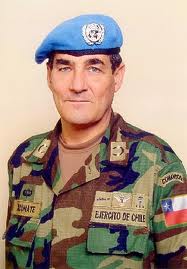
Eduardo ALDUNATE Herman

Major General Eduardo Aldunate has served as a Chilean Army officer since 1973. He has been an instructor and commander in mountain infantry units and special forces units and was the Deputy Force Commander of MINUSTAH between September 2005 and September 2006. He heserved as commander of Military Schools for the Chilean Army. He has written books and academic articles on military leadership and strategic and civilian-military relations for civilian and military publications.

Reference (2): United Nations Intelligence in Haiti

Worth a Look: Backpacks Full of Hope–The UN Mission in Haiti

Worth a Look: Backpacks Full of Hope–The UN Mission in Haiti

5 Star, Disaster Relief, Humanitarian Assistance, Intelligence (Government/Secret), Intelligence (Public), Peace Intelligence, United Nations & NGOs, Worth A Look
0Shares
Amazon Page

Backpacks Full of Hope: The UN Mission in Haiti describes the experience of a Chilean general as Deputy Force Commander of the United Nations Stabilization Mission in Haiti (MINUSTAH) during the particularly turbulent year September 2005 to September 2006. It details the realities of commanding more than 7,000 men from eleven countries while working to fulfill the mandate of the United Nations in Haiti—to ensure a secure and stable environment, to support the transitional government in a democratic political process, and to promote and protect the human rights of the Haitian people.

Despite the enormous challenges of a complex scenario that included local violence and extreme poverty, the UN command succeeded in its mission, stabilizing the local situation and paving the way for Haiti to hold a presidential election.

Originally published as Mision en Haiti, con la mochila cargada de esperanzas, this work provides a new audience with insight on the peace operation and sheds light on the long-term endeavour of civilians, military, and local and international agencies to support Haiti’s path to prosperity.

Co-published with the Centre for International Governance Innovation.

See Free by the Same Author:

Reference (2): United Nations Intelligence in Haiti

Reference (2): United Nations Intelligence in Haiti

05 Civil War, 07 Other Atrocities, 08 Wild Cards, 10 Security, 10 Transnational Crime, 11 Society, Analysis, Augmented Reality, Ethics, Government, Historic Contributions, InfoOps (IO), Intelligence (government), IO Multinational, IO Sense-Making, Law Enforcement, Methods & Process, Military, Officers Call, Peace Intelligence, Real Time
0Shares
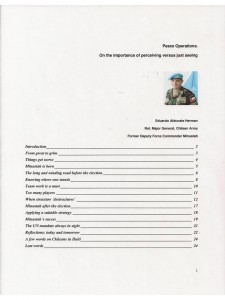
Peace Operations: Seeing

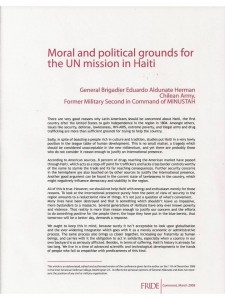
MajGen Eduardo ALDUNATE Herman, Chilean Army (Ret), served as the Deputy Force Commander of the United Nations Force in Haiti (MINUSTAH) in the earliest rounds, and was instrumental in both sponsoring the Joint Military Intelligence Analysis Center (JMAC) concept in its first modern field implementation, but also in evaluating most critically both the lack of useful intelligence from allies relying on secret sources and methods that did not “penetrate” to achieve gangs and neighborhoods; and the astonishing “one size fits all” propensity of the allies to treat every “threat” as one that could be addressed by force.

His contributions are helpful in understanding the more recent failure of allied relief operations in Haiti that again assumed that the use of armed bodies would address the problem, without making provision for real-world ground truth intelligence (CAB 21 Peace Jumpers Plus) or intelligence-driven harmonization of non-governmental assistance (Reverse TIPFID).

See Also:

Reference: Walter Dorn on UN Intelligence in Haiti

Reference: Civil Military Operations Center (CMOC)

2003 PEACEKEEPING INTELLIGENCE: Emerging Concepts for the Future

Books: Intelligence for Peace (PKI Book Two) Finalizing

Reference: Intelligence-Led Peacekeeping

Review: International Peace Observations

Search: UN intelligence peace intelligence