About Dr. Bates Gill (US), New and seventh Director, Stockholm International Peace Research Intitute
Most interesting sentence:
The number of civilians mandated for roles in United Nations missions has increased, as has the number of multilateral civilian peace missions. Yet, the international community’s record in strengthening civilian capacities in peace operations is decidedly mixed. These efforts still lack conceptual coherency and intra- and inter-organizational cooperation, and major operational challenges persist. The emergent ambition to significantly reform and improve civilian operations is timely and much needed but should not have over-expectations of success at this point.
Phi Beta Iota: The UN, despite its ponderous “dumb” bureaucracy and a plethora of spies who are more of a problem for their ignorance about their cover duties than as a welcome source of free meals, is actually maturing as an organization. The signal endeavors are the Brahimi Report, the report of the High Level Panel on Threats, Challenges, and Change; and most recently, the report of the Panel on Coherence, whose signal descriptor, “Deliver As One,” simultaneously defines the incapacity of the UN, and the objective. The UN is also toying–with enormous resistance from the entrenched mandarins–with hybrid efforts such as are represented by the International Commission Against Impunity in Guatemala (CICIG). The latter is very much in keeping with the brilliant analytics and related recommendations of J. F. Rischard, then World Bank Vice-President for Europe, whose book HIGH NOON: Twenty Global Problems, Twenty Years to Solve Them, which remains one of the seminal works of our time–elegant, erudite, relevant, and readable. There is a hybrid, bottom-up, collective intelligence, non-zero revolution going on around the world.
The El Paso Intelligence Center, launched in 1974 to identify drug traffickers south of the border, is all but a complete bust, the Justice Department’s Inspector General reported Tuesday.
The 86-page report was a virtual laundry list of seemingly intractable problems at the border intelligence post, opened by the Drug Enforcement Administration with great fanfare 36 years ago.
“EPIC could not produce a complete record of drug seizures nationwide because of incomplete reporting into the National Seizure System, which is managed by EPIC,” Glenn A. Fine, chief of the Office of the Inspector General, reported.
“EPIC had not sustained the staffing for some key interdiction programs, such as its Fraudulent Document unit, its Air Watch unit, or its Maritime Intelligence unit….” Fine added.
“As a result, EPIC’s service to users in these program areas had been disrupted or diminished for periods of time.”
ABSTRACT: Alexander Wendt begins his paper “Why a World State is Inevitable” with the following concise formulation of his intent: “In this article I propose a teleological theory of the ‘logic of anarchy' which suggests that a world state is inevitable …” (Wndt, 2003). I offer the following equally concise opposition: In this article I propose a teleonomic theory of the ‘logic of panarchy' which suggests that a world state is not inevitable. I suggest that the stable “state” for this teleonomic process is a global “complex adaptive system,” or governance network, in which the ‘logic of anarchy' gives way to the ‘logic of panarchy.” It is essential to note that Wednt and I agree on far more than we disagree, but the pointson which we disagree are fundamental.
Core Quote: “In a teleonomy, the focus is on the adaptive rules, i.e. the processes by which the system explores and exploits new possibilities. Because the system's identity is enacted through a program and not by virtue of an outcome, lourality, diversity, democracy, abnd the navigation of competing rules and norms take on a new urgency. That urgency is enshrined in the voluntary and “freely given” intentionality that is possible only in panarchy.”
Power depends upon context, and the rapid growth of cyber space is an important new context in world politics. The low price of entry, anonymity, and asymmetries in vulnerability means that smaller actors have more capacity to exercise hard and soft power in cyberspace than in many more traditional domains of world politics. Changes in information has always had an important impact on power, but the cyber domain is both a new and a volatile manmade environment. The characteristics of cyberspace reduce some of the power differentials among actors, and thus provide a good example of the diffusion of power that typifies global politics in this century. The largest powers are unlikely to be able to dominate this domain as much as they have others like sea or air. But cyberspace also illustrates the point that diffusion of power does not mean equality of power or the replacement of governments as the most powerful actors in world politics.
Phi Beta Iota: The author served as deputy director of the National Intelligence Council and as an Assistant Secretary of Defense for International Security Affairs. He coined the term “soft power” and is arguably the most astute and coherent observer and analyst of traditional relations among nations now serving in the upper ranks of the elite that pupport to be serving the public interest.
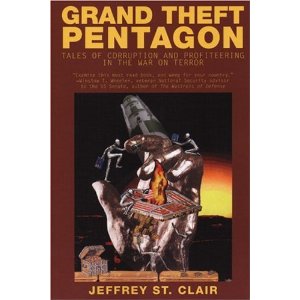
Chapter and Verse But No Footnotes–a Cornerstone Read
June 17, 2010
Jeffrey St. Clair
I come late to this book, published in 2005 and consisting of well-organized Op-Eds published in CounterPunch from 2000-2005. My review is primarily for my own benefit (my notes) and those who follow my reviews of non-fiction at Phi Beta Iota, the Public Intelligence Blog, where you can browse categories in a way that Amazon refuses to implement (e.g. see all my reviews on Corruption or on Pathology of Military Power, or on Government Crime, etcetera).
The lack of footnotes troubles me, not because I doubt the details this extraordinary author brings forward (including many details NOT covered by the 1,600 books I have reviewed, many centered on this very topic), but because I believe the author's body of work would be enhanced if he included footnotes–I would go so far as to respectfully suggest that he write and publish on his personal blog the version with footnotes and links, and then publish the “clean” version at CounterPunch with a link to the notes version.
The best thing I can say about this specific book is that regardless of how many other books you might have read (I list ten suggestions with links at the end of this review), this book has details the other books do not have. It is a must read, and most especially so in the aftermath of Secretary of Defense Robert Gates meeting with Lockheed and other CEO's to assure them that the money will keep on coming–I was utterly stunned when I read that, and realize that for all of his intelligence, Robert Gates has zero interest in actually defending America–he's the Chief Thief. As he attempts to place Jim Clapper in the position as Director of National Intelligence, which oversees $75 billion a year in waste, I can only shake my head–Chief Thief and Mini-Me Thief. It is time the American people, led by Grover Norquist, leader of Americans for Tax Reform, to engaged in a massive tax revolt that redirects all tax revenue to local banks, in escrow for local needs. The Federal Government is OUT OF CONTROL.
As I look over the titles of the 33 Op Ed pieces, I have two thoughts: first, that this really is a spectacular collection of thoughful public interest criticism, very well organized; and second, that this same book could be written about every Cabinet Department, every State Governor, every Mayor across America. We have institutionalized looting in ways that even the most corrupt countries such as Guatemala have not even begun to exploit. The federal government is full of good, well-intentioned people, but it is also managed and manipulated by an elite that considers our tax dollars their privilege to spend, and that has to end.
Especially interesting to me were details on the Bush Family, including worthless relatives that helped companies climb to billions in revenue; details about George Bush Junior that were known before he ran for President but not properly presented to the public; details over the entire book on the treasonous displacement of uniformed personnel by contractors; technical exposes of specific mobility and weapons systems; and the over all DETAILED, balanced presentation of public intelligence in the public interest.
Here are ten other books I recommend to complement this one (if my reviews are buried at Amazon, they are easy to find at Phi Beta Iota, the Public Intelligence Blog, all with links there back to Amazon's page for the book, and to my review at Amazon as well so you can harvest comments if any, and/or vote.
I do not link to my own books, including ON INTELLIGENCE: Spies and Secrecy in an Open World, as they are easy to find and also available free online. The bottom line is that Obama sold out to play Bush in black-face, with zero change in the constant treason that has characterized the Executive and Legislative Branches since at least the 1990's when Newt Gingrich destroyed bi-partisan comity and Bill Clinton inhaled the vapors of Wall Street.
America needs both a tax revolt, and an honest Director of National Intelligence (DNI) able to create a Smart Nation in which we harness our collective intelligence and simultaneously ressurect national education and integrity; national research and integrity; and of course national decision-support (intelligence) and integrity. That alone will bury the current corruption because any DNI smart enough to do that will also be smart enough to tell Congress that intelligence and Whole of Government reform can be job and revenue neutral from state to state and district to district.
When Franklin A. Richards, a CIA agent, readily accepted assignment to Iraq, he knew he might have to take a bullet — some lead — for his
country.
And he says he took plenty, but not because he was shot.
Richards, a firearms expert, was sent to Iraq in August 2003 to provide weapons training. He wasn't hit by a bullet during the three weeks he was there, but according to a lawsuit he has filed, he was seriously wounded by lead poisoning.
Now he can no longer work as an agent, or at much of anything else, he says. The former agent is suing the CIA because of a long list of
ailments that he alleges grew from being ordered to labor in a toxic workplace that even the Army had placed off-limits.
Phi Beta Iota: Obama has betrayed both the public and the government civil servants and uniformed personnel. He is nothing more than a continuation of “business as usual” under Bush-Cheney, and Leon Panetta is obviously nothing more than a placeholder who liked being played for a fool. This case officer (evidently The Washington Post no longer employs editors or fact checkers–in the foreign intelligence world agents commit treason, case officers handle them) deserves better. He should make this a class action lawsuit for $100 million, and seek $10 million for himself and his lawyer. CIA is covering up so many high crimes and misdemeanors, it is hard to get a grip on all of them, but the worse high crime has been CIA mismanagement of the clandestine, analytic, administrative, and so-called scientific and technical services. From the Afghan Eight to the Iraq Thousand, CIA is so morally bankrupt that plowing salt into the ground at Langley would be an upgrade.



 Chapter and Verse But No Footnotes–a Cornerstone Read