Review: Dear Hacker–Letters to the Editor of 2600

5 Star, Asymmetric, Cyber, Hacking, Odd War, Change & Innovation, Games, Models, & Simulations, Information Operations, Information Society, Information Technology, Intelligence (Collective & Quantum), Intelligence (Wealth of Networks), Philosophy, Technology (Bio-Mimicry, Clean)
Amazon Page

5.0 out of 5 stars Half of the Priceless Set

July 16, 2010

Emmanuel Goldstein

I've been browsing this marvelous collection–559 pages–all afternoon, and the afternoon has been broken up frequently with outrageous laughter and occasional gasps of disbelief. This book, organized as it is, is vastly more important and easier to read than the original 2600 Magazine letters that I have been glancing at since first helping and joining this group in 1994.

The other book, The Best of 2600: A Hacker Odyssey now reprinted in a more expensive The Best of 2600, Collector's Edition: A Hacker Odyssey is absolutely essential and the other half of this set.

Hats off to Wiley for having the brains to see the value, and the editorial talent to select, edit, and present so perfectly. This book, thick as it is, has exactly the right amount of white space, the selection and use of fonts is just right, and the index, while not as extensive as I would have liked, is adequate.

“Look Inside the Book” has been set in motion, in the meantime, here is the table of contents that runs from the early days in the 1980's up through today, with absolutely phenomenal selections that provide priceless insights into the mindsets of BOTH bona fide hackers AND the clueless wanna-bes.

1. Question Upon Question
2. Tales from the Retail Front
3. The Challenges of Life as a Hacker
4. Technology
5. Our Biggest Fans
6. Behind the Walls
8. A Culture of Rebels
9. Strange Ramblings

Easily half if not more of the value of the book is to be found is the witty, acerbic, funny, insightful, surprising comments of the author Emmanuel Goldstein (not his real name), who has single-handedly but with many willing volunteers created the legitimate means of enabling information sharing and sense-making among hackers, who I am often at pains to describe as being the same as astronauts and pioneers, pushing the edge of the envelope.

Continue reading “Review: Dear Hacker–Letters to the Editor of 2600”

Worth a Look: Book Review Lists (Positive)

00 Remixed Review Lists, Worth A Look

00 Remixed Review Lists is the persistent URL for all of them as they are updated.  This was done in preparation for the final part of INTELLIGENCE FOR EARTH: Clarity, Diversity, Integrity, & Sustainability.  In contrast to the 98 Review categories where books are cross-listed and appear in multiple categories, in this set of “good news” reviews, each book appears only once.

Worth a Look: Book Reviews on Africa

Worth a Look: Book Reviews on Analysis

Worth a Look: Book Reviews on Atlases

Worth a Look: Book Reviews on Bio-Economics

Worth a Look: Book Reviews of Capitalism Reincarnated

Continue reading “Worth a Look: Book Review Lists (Positive)”

Worth a Look: Book Review Lists (Negative)

00 Remixed Review Lists, Worth A Look

The long list below is organized along the lines of the Revolutionary Prediction Matrix discussed in a short Marine Corps University paper and a longer graduate thesis, to wit: Political-Legal; Socio-Economic; Ideo-Cultural; Techno-Demographic; and Natural-Geographic. It is also available online as Chapter 20: “21st Century Counterintelligence: Evaluating the Health of the Nation” in the new book INTELLIGENCE for EARTH: Clarity, Diversity, Integrity, & Sustainability (Earth Intelligence Network, 2010).

Political-Legal

Worth a Look: Book Reviews on Government Corruption

Continue reading “Worth a Look: Book Review Lists (Negative)”

U.S. Geological Survey: Twitter Earthquake Detector (TED)

03 Environmental Degradation, 10 Security, Citizen-Centered, Civil Society, Collective Intelligence, Earth Intelligence, Geospatial, Geospatial, Government, Graphics, Media

People can receive earthquake data from the @USGSTED Twitter account. The site sends maps of earthquake zones to account holders.

U.S. Geological Survey: Twitter Earthquake Detector (TED)

Sample map output from the Twitter Earthquake Detector prototype  project.

The U.S. Geological Survey is using funds from the American Recovery and Reinvestment Act to support a student who’s investigating social Internet technologies as a way to quickly gather information about recent earthquakes.

In this exploratory effort, the USGS is developing a system that gathers real-time, earthquake-related messages from the social networking site Twitter and applies place, time, and key word filtering to gather geo-located accounts of shaking. This approach provides rapid first-impression narratives and, potentially, photos from people at the hazard’s location. The potential for earthquake detection in populated but sparsely seismicly-instrumented regions is also being investigated.

Social Internet technologies are providing the general public with anecdotal earthquake hazard information before scientific information has been published from authoritative sources.  People local to an event are able to publish information via these technologies within seconds of their occurrence. In contrast, depending on the location of the earthquake, scientific alerts can take between 2 to 20 minutes. By adopting and embracing these new technologies, the USGS potentially can augment its earthquake response products and the delivery of hazard information.

Secrecy News Headlines: Clapper, GAO, Budget

Uncategorized

CLAPPER: MILITARY INTEL BUDGET TO BE DISCLOSED

The size of the annual budget for the Military Intelligence Program (MIP), which has been classified up to now, will be publicly disclosed, said Gen. James R. Clapper, Jr., the nominee to be the next Director of National Intelligence.  He said that he had personally advocated and won approval for release of the budget figure.

SEEKING STRUCTURAL REFORM OF THE INTEL BUDGET

Open government advocates believe that intelligence budget disclosure is good public policy and may even be required by the Constitution's statement and account clause.  But what makes it potentially interesting to policymakers is that it would permit the intelligence budget to be directly appropriated, rather than being secretly funneled through the Pentagon budget as it is now.

CLAPPER EMBRACES GAO INTEL OVERSIGHT, SSCI DOESN'T

The Government Accountability Office (GAO), the investigative arm of Congress, won plaudits for its contributions to intelligence oversight from Gen. James R. Clapper at his July 20 confirmation hearing to be the next Director of National Intelligence.  But in the latest version of the intelligence authorization bill, the Senate Select Committee on Intelligence yielded to White House opposition and abandoned a provision that would have enhanced GAO's role in intelligence oversight.

Phi Beta Iota: The day will come when a Department of Education, Intelligence, & Research has, at a minimum, a National Strategy Center and a national Open Source Agency that are both under diplomatic auspices and enjoy the same hand-off relationship with the Executive that the Broadcasting Board of Governors (BBG) enjoy.  Right now Jim Clapper is feeling his way in uncertain territory–independence from a chain of command that is suffering moral myopia as well as practical cognitive failure.  This fight will have to wait for the next President.  Put bluntly, the IC is doing the wrong things with too much money, and totally divorced from five of the eight tribes of intelligence as well as 184 countries not included in the absurd CIA and DoD “special relationship.”

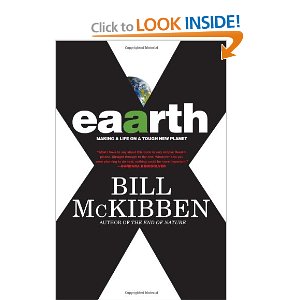
Review: Eaarth–Making a Life on a Tough New Planet

4 Star, Atlases & State of the World, Capitalism (Good & Bad), Civil Society, Complexity & Resilience, Congress (Failure, Reform), Consciousness & Social IQ, Culture, Research, Disease & Health, Environment (Problems), Environment (Solutions), Executive (Partisan Failure, Reform), Future, Nature, Diet, Memetics, Design, Peace, Poverty, & Middle Class, Public Administration, Science & Politics of Science, Survival & Sustainment, Values, Ethics, Sustainable Evolution, Water, Energy, Oil, Scarcity
Amazon Page

4.0 out of 5 stars Starts Weak, Ends Strong, Not the Whole Picture

July 21, 2010

Bill McKibben

EDIT of 2 August 2010: However great the mind or the man, we all make mistakes. Paul Hawkins made his with Monsanto, I've made mine. ClimateGate established with clarity the fraud associated with both the fabricated science and the intended “sub-prime mortgaging” of the Earth's atmosphere. Maurice Strong and Al Gore are pushing fraud, not fixing. Mercury and sulfer and methane are bigger problems than carbon, and global warming is a small element–not even close to being the main event–within Environmental Degradation, threat #3 after poverty and infectious disease. It troubles me when people vote against the messenger–McKibben is a great man–he's also made a mistake. Get over it and do more reading, integrate more, and it will all come out fine.

. . . . . . .

I was so annoyed with the narrow first third that glorifies the likes of Al Gore, Thomas Friedman, and Larry “women can't think like scientists” Summers that I was actually contemplating three stars. This is a weakly researched book that buys into the International Panel on Climate Change (IPCC) and Maurice Strong carbon fraud, while ignoring the vastly more intelligent findings of the High Level Panel on Threats, Challenges, and Change, A More Secure World: Our Shared Responsibility–Report of the Secretary-General's High-level Panel on Threats, Challenges and Change, in which Environmental Degradation is #3 and more broadly defined.

Any book that quotes the discredited James Hansen of NASA and that builds a case around Op-Eds and undocumented assertions is a stain upon scholarship, and the first third of this book falls into that sinkhole. Despite many references to the Copenhagen summit, there is not a word in this book about ClimateGate (see the Rolling Update at Phi Beta Iota the Public Intelligence Blog) and therefore I find this author guilty of active misrepresentation bordering on a lack of integrity in this specific instance. The author is spending too much time with newspapers and not enough time with books representing the distilled reflections of others.

Having said that, and deducted one star for the lapse, I find the balance of the book absorbing, fascinating, and rich in gems of insight and fact. It should be read in conjunction with:

Limits to Growth: The 30-Year Update
Human Scale
High Noon 20 Global Problems, 20 Years to Solve Them
The Future of Life
Acts of God: The Unnatural History of Natural Disaster in America
The Next Catastrophe: Reducing Our Vulnerabilities to Natural, Industrial, and Terrorist Disasters
The Real Global Warming Disaster: Is the Obsession with “Climate Change” Turning Out to Be the Most Costly Scientific Blunder in History?
Biomimicry: Innovation Inspired by Nature
The Fortune at the Bottom of the Pyramid, Revised and Updated 5th Anniversary Edition: Eradicating Poverty Through Profits

My criticism and praise of this important work are based on the above and the other 1,600 non-fiction reviews I have posted to Amazon, all more easily accessible in 98 reading categories at Phi Beta Iota the Public Intelligence Network.

Early points that got my attention:

Continue reading “Review: Eaarth–Making a Life on a Tough New Planet”

Journal: Israel, Left to Right, One-State Reprise

08 Wild Cards
Chuck Spinney Recommends

Another fascinating report by Jonathan Cook,  a freelance reporter based in Nazareth on the West Bank, and one of the best reporters covering the Middle East

One-State Debate Explodes Myth About Zionist Left

by Jonathan Cook, Antiwar.com, July 21, 2010

http://original.antiwar.com/cook/2010/07/20/one-state-debate-explodes-myth/

A version of this article originally appeared in The National, published in Abu Dhabi.

A fascinating debate is entering Israel’s political mainstream on a once-taboo subject: the establishment of a single state as a resolution of the conflict, one in which Jews and Palestinians might potentially live as equal citizens. Surprisingly, those advocating such a solution are to be found chiefly on Israel’s political Right.

The debate, which challenges the current orthodoxy of a two-state future, is rapidly exploding traditional conceptions about the Zionist Right and Left.

FULL STORY ONLINE

Phi Beta Iota: The continued atrocities against the Palestinians disqualify any Israeli government from being considered morally, intellectually, or practically capable of a one-state solution.  The Arab states are equally corrupt on all fronts.  The Middle East needs a mix of tribal boundary restorations, Jerusalem as an international city, a regional water authority, and a fifty-year international protectorate that can raise two generations to live in peace.