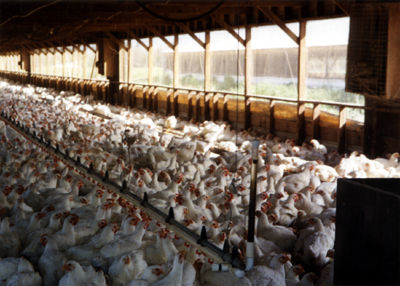
Iowa and Florida are considering bills that make it illegal to film or photograph inside factory farms without permission. Are the CAFOs afraid their unhealthy conditions and animal cruelty will be exposed? Help us put a stop to this madness!
Two weeks ago we reported on the way the FDA is blocking journalistic freedom of speech through the information embargoes they impose. Freedom of speech is taking another hit, this time from state legislatures. Read more….
Phi Beta Iota: It appears that some governments now believe that they have a right to legislate the censorship of truth. Arsenic and antibiotics and other toxins associated with the industrialization of agriculture are a major cause of human illness, deformity, allergies, and other unnatural conditions. This is all part of the “true cost” paradigm for the redesign of society to emphasize the wellness of humans and the sustainability of the Earth. Governments so foolish as to deny that the truth at any cost reduces all other costs should be voted out of office or ignored. Truth is a public power, a public good, and a public right.
“Will it make a beautiful ruin?” That was the question Basil Spence asked about the nuclear power station he was designing in Trawsfynydd, Wales. This was back in the 1960s, but it was forward looking. Spence, an architect (he designed the famous Coventry Cathedral in England), was aware of one simple fact: Nuclear power plants are functional for a relatively short period of time before they are put out of commission and replaced by newer, safer designs and technology. The abandoned plant is filled with radioactivity that makes it unusable for anything for a long time. A cathedral is designed with the idea that it should stand, and function, for a very long time — perhaps beyond time. A nuclear power plant is designed with the knowledge that it must become a ruin, and rather quickly. It is born to die, and then to sit as a corpse, a testimony to the strange and unsettling function it once had.
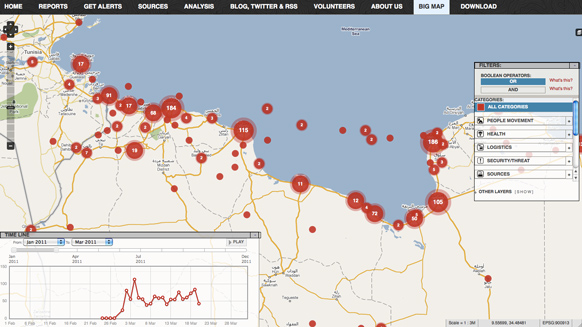
New features could make a Web tool that has helped track events in Japan and the Middle East even more useful.
Monday, March 28, 2011, By David Talbot
MIT Technology Review
EXTRACT: The new feature is known as “check-in,” also used by social sites like Foursquare—in that case as a way of alerting friends to your presence at a particular location.
Click on Image to Enlarge
For Ushahidi, this is “a pretty powerful step forward,” says Ethan Zuckerman, a board member of the nonprofit, and a senior researcher at the Berkman Center for Internet & Society at Harvard University. “Adding check-in to this equation allows me to pull my data apart from the whole. That makes maps usable for multiple purposes—group reporting as well as tracking of my own movements.”
Enabling such tracking simply requires a GPS-equipped phone to allow a quick log-in to record whereabouts
Robyn shares her personal story and how it inspired her current path as a “Real Food” evangelist. Grounded in a successful Wall Street career that was more interested in food as good business than good-for-you, this mother of four was shaken awake by the dangerous allergic reaction of one of her children to a “typical” breakfast. Her mission to unearth the cause revealed more about the food industry than she could stomach, and impelled her to share her findings with others. Informative and inspiring.
Amazon Page
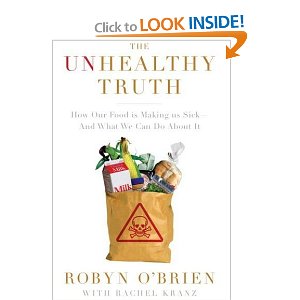
Robyn authored The Unhealthy Truth: How Our Food Is Making Us Sick and What We Can Do About It. A former Wall Street food industry analyst, Robyn brings insight, compassion and detailed analysis to her research into the impact that the global food system is having on the health of our children. She founded allergykidsfoundation.org and was named by Forbes as one of “20 Inspiring Women to Follow on Twitter.” The New York Times has passionately
described her as “Food's Erin Brockovich.”
Phi Beta Iota: Across all twelve “policy” domains from agriculture to water, with food cutting across all domains ans especially Family, Health, and Society, we are seeing the emergence of public intelligence in the public interest. What we are not seeing (yet), is the integration of “true cost” information as a core element that must be available to the public; and the integration of all that we can know about each domain in isolation, into a larger “360 degree” strategic analytic model for getting a grip on how we live and how we spend.
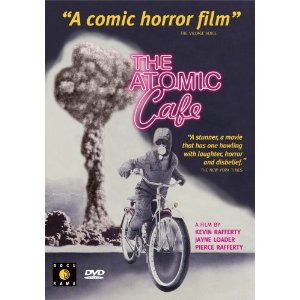
What vintage bomb survival suits have to do with Dr. Stragelove and Richard Nixon.
The recent tragedy in Japan has triggered a tsunami of terror, founded and unfounded, about the potential risks of nuclear reactors.
While there are people better equipped than us to explain the precise implications of the situation, we thought we’d put things in perspective by examining the flipside of these dystopian fears: The exuberant optimism about nuclear power in mid-century America.