

Journal: When are Leaks Good for Society?

04 Inter-State Conflict, 05 Civil War, 07 Other Atrocities, 08 Wild Cards, 09 Justice, 10 Security, Civil Society, Collective Intelligence, Corruption, Ethics, Government, Law Enforcement, Military, Peace Intelligence

Marcus Aurelius Recommends

Charges for Soldier Accused of Leak

The New York Times

By STEVEN LEE MYERS
July 6, 2010
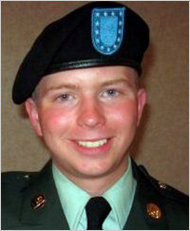
PFC Bradley E. Manning

BAGHDAD — An American soldier in Iraq who was arrested on charges of leaking a video of a deadly American helicopter attack here in 2007 has also been charged with downloading more than 150,000 highly classified diplomatic cables that could, if made public, reveal the inner workings of American embassies around the world, the military here announced Tuesday.

Army intelligence analyst charged in Wikileaks case
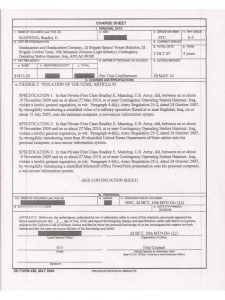
Four Page Charge Sheet

By Leila Fadel

Washington Post Foreign Service
Wednesday, July 7, 2010

BAGHDAD — The military said Tuesday that it has charged an Army intelligence analyst in connection with the leak of a controversial video and the downloading and transfer of classified State Department cables, in a case that is likely to further deter would-be whistleblowers.

Click on headlines to read each full story.

Phi Beta Iota: PFC Manning swore an oath to defend the Constitutions, not the chain of command and not the secrecy of immoral, illegal, and unaffordable policies that are funded by the U.S. taxpayer and done “in our name” but not at all in our interest.  Sunshine is the best disinfectant.

His charge sheet rests on “discrediting the Armed Forces” which is laughable–it is the behavior of our leaders that is a discredit to all of America; and on subverting “good order and discipline.”  His behavior in revealing the webs of deceit and incompetence that characterize our military, our “diplomats,” and our spies is precisely what America needs in order to re-establish good order and discipline in harmony with our Constitution.

America needs MORE leaks, MORE “misbehavior,” because we now suffer a “system” that is so far removed from the Founding Fathers' vision, and so deeply divorced from the principles enshrined in our Constitution, that we must, without question, consider PFC Manning to be a “just man” whose best place in a time of injustice is to be in jail as an example to us all.  BRAVO ZULU for courage and intelligence in the face of the enemy–he is us.  If the lawyer for the defense has any integrity at all, this will be a public jury trial and the PFC will walk free, as he should.  It's time to trash this pathological system and get back to the basics of freedom and a foreign policy of commerce and peace.

Wikipedia on Civil Disobedience

Civil Disobedience (Resistance to Civil Government) is an essay by Henry David Thoreau that was first published in 1849. It argues that people should not permit governments to overrule or atrophy their consciences, and that people have a duty to avoid allowing such acquiescence to enable the government to make them the agents of injustice. Thoreau was motivated in part by his disgust with slavery and the Mexican-American War.

Resistance also served as part of Thoreau's metaphor which compared the government to a machine, and said that when the machine was working injustice it was the duty of conscientious citizens to be “a counter friction” (i.e., a resistance) “to stop the machine”.
Afghan Self-stabilization from Below – and Above

About the Idea, Augmented Reality, Collaboration Zones, Communities of Practice, Counter-Oppression/Counter-Dictatorship Practices, Ethics, Geospatial, info-graphics/data-visualization, InfoOps (IO), International Aid, Journalism/Free-Press/Censorship, Key Players, Methods & Process, microfinancing, Mobile, Policies, Real Time, Reform, Strategy, Technologies, Threats, Tools, True Cost
Lee Felsenstein

As the end game begins for NATO and the US in Afghanistan, and as the potential mineral wealth of that unhappy land is revealed, one confronts despair when contemplating the fate of the Afghans. With the Taliban poised to move once more into the coming power vacuum and exploit a resurgent drug trade as well as establish a protection racket parasitic to the future mining industry, one looks for some glimmer of hope for the Afghan people.

After all, Afghanistan has never been conquered except by the Mongols. The much decentralized, tribal society that makes them vulnerable to decentralized gang rule has confounded each centralized invader who attempted to bring about their own version of order. Is there hope that the Afghan people will be able to expel the Taliban as they expelled the others? After all, the first government of the Taliban was not overthrown by the Afghans themselves, but by military invasion with the passive consent of the Afghan people.

Now, with the outside military forces beginning their final period in-country, and with little if any evidence of a viable government staffed by officials who will not bolt the country with their pockets stuffed, what can give the ordinary Afghans the means to resist as they have resisted other occupations?

The answer, I believe, lies in the essence of government. Government operates by communication. People in government gather, refine, transmit information, both from the populace to the seat of power and in reverse after policies and laws are defined based upon the information gathered. People have political power to the extent that they are included in this process of information flow to the exclusion of others.

Continue reading “Afghan Self-stabilization from Below – and Above”

Aid Data (Beta) fr AidData.org | Tracking Development Finance

01 Poverty, 02 Diplomacy, 02 Infectious Disease, 03 Economy, 04 Education, 06 Family, 07 Health, 11 Society, 12 Water, International Aid, Research resources
website link

AidData attempts to capture the universe of development finance and foreign aid, increase the value of data by providing more descriptive information about development activities, provide data in an accessible format, and strengthen efforts to improve donor and recipient strategic planning and coordination. The PLAID Project — the predecessor to AidData — benefits from significant support given by the Bill & Melinda Gates Foundation, the Hewlett Foundation, Richard and Judy Finch, and the National Science Foundation. PLAID is a partnership of the College of William and Mary and Brigham Young University. Its successor, AidData, is a merger of PLAID and the Development Gateway's Accessible Information on Development Activities (AiDA) Additionally, our work would not be possible without the institutional support of the College of William and Mary, Brigham Young University, and the Development Gateway Foundation.

The AidData team is committed to building an easy-to-use, comprehensive, and timely resource describing the universe of development finance project-by-project, including all grants and loans committed by all major bilateral and multilateral aid donors. We currently have the most comprehensive database on development finance, but have plenty of additional work to do. Better data will help increase aid targeting and coordination, and it will enable better measurement and evaluation of aid effectiveness. AidData is currently developing a publicly-accessible interface that will enable researchers, field workers, and policy makers interested in development finance to access detailed project level data in order to increase transparency, accountability, and effectiveness.

Profiling Hackers (or Attackers?)…Further Blurring of lines Between Crime & Hacking

10 Transnational Crime, Cyberscams, malware, spam, Hacking
The Hackers Profiling Project (HPP)

The project aims to improve the response to ICT crime and the transnational organised crime groups that may be involved in it, by outlining the criminal profiles of the different types of hackers, with particular emphasis on their possible involvement in transnational organised crime activities and cyber-terrorism. Through a better understanding of hackers, HPP will facilitate the prevention and countering of ICT crimes and will improve the operational methods that may lead to the identification of computer intruders.
||

85 page overview

This book is an attempt to apply the behavioural science of Criminal Profiling to the hacking realm. Its main objective is to provide a new means of investigation in order to deal with issues related to cybercrime. But there is a lot more to discover…

Computer networks are commonly thought of as unfathomable and invisible, beyond our grasp; a hacker is someone who can still see the joins and this is what makes him interesting though remaining a complex, original and controversial personality.

Aware of the lack of information, which prevents people from adequately understanding the phenomenon of hacking and its many related aspects, the authors' desire is to provide more insight into this realm by telling interesting anecdotes as well as describing bizarre characters that practice hacking and cracking as an art, following different but established ethical models. Providing an in-depth exploration of the hacking realm, focusing on the relation between technology and crime, the authors reveal hidden aspects and many interesting details answering questions like: Who are real hackers? What life does a hacker lead when not on line? Is it possible to determine a hacker's profile on the basis of his behaviour or types of intrusion?

Event Report: 30 Jun-1 July, NYC – ICSR Peace and Security Summit

01 Poverty, 03 India, 04 Indonesia, 05 Civil War, 05 Iran, 08 Wild Cards, 09 Terrorism, 10 Security, 10 Transnational Crime, 12 Water, Academia, Civil Society, Collective Intelligence, Corruption, Cultural Intelligence, Government, History, Law Enforcement, Methods & Process, Military, Non-Governmental, Peace Intelligence, Policy, Strategy, Technologies
Event link

Peace and Security Summit Event Report/Notes

+ Host: London-based International Centre for the Study of Radicalization and Political Violence

+ Partners, Affiliates, Financial Support: National Defense Univ, Rena & Sami David, The Rockefeller Foundation, Public Safety Canada, Center on Global Counterterrorism Cooperation, Centre for Policy Research, New Dehli, Dept of War Studies , King's College London, Inst for Strategic Threat Analysis & Response, Univ of Penn, International Inst for Counter-Terrorism, Interdisciplinary Center Herzliya, Pakistan Inst for Peace Studies, Regional Centre on Conflict Prevention, Jordan Inst of Diplomacy

> Overall, disappointing but reviewing these notes shows there are some good nuggets to take + connect.

BIGGEST SURPRISE = NOT ONE MENTION ABOUT FINANCING OF TERRORISM

Continue reading “Event Report: 30 Jun-1 July, NYC – ICSR Peace and Security Summit”

Where We Are Winning – Where We Are Losing: Futurologists Publish Annual Report on Major World Problems and Opportunities

01 Poverty, 03 Economy, 03 Environmental Degradation, 04 Education, 05 Energy, 06 Family, 11 Society, 12 Water, Academia, Civil Society, Collective Intelligence, Commerce, Corruption, Government, Key Players, Non-Governmental, Peace Intelligence

Millennium Project / State of the Future web portal

Where We Are Winning – Where We Are Losing:

Futurologists Publish Annual Report on Major World Problems and Opportunities

Berlin 7th July 2010 – Can civilization implement solutions fast enough to keep ahead of the looming challenges? The Millennium Project, a global independent think tank of futurologists, and thought leaders, today published its 14th report on global perspectives in Germany and around the world. Until two years ago the report showed a positive trend in the so-called “State of the Future Index” (SOFI). Triggered by the financial and economic crises and the failure of the climate conference in Copenhagen, the current SOFI shows that the prospects of success in solving some major global challenges have become somewhat clouded.

What the authors see as lacking the most, according to Jerome Glenn,
Director of the Millennium Project, are a serried of serious global
strategies to be implemented by governments, companies, NGOs, UN
institutions and other international bodies.” The world is in a race between
implementing ever-increasing ways to improve the human condition and the
seemingly ever-increasing complexity and scale of global problems. After 14
years of research into the future within the framework of the Millennium
Project it is increasingly clear that the world has the necessary capacity
to cope with its problems. However, it remains unclear whether humankind
will make the right decisions on the scale necessary to meet the global
challenges appropriately”, said Glenn.

Among the regular sections in the ninety page ‘State of the Future' report
are the annually updated analyses of the fifteen key global challenges, as
well as the publication of the State of the Future Index (SOFI). The index
identifies areas in which there has been either an improvement or
deterioration during the past 20 years and creates projections for these
scenarios over the coming decade. All relevant and recognised studies by the
UN or World Bank are distilled as part of these projections.

On individual results of the State of the Future Index:

Where We Are Winning
Continue reading “Where We Are Winning – Where We Are Losing: Futurologists Publish Annual Report on Major World Problems and Opportunities”

Journal: Regurgitated Pablum from David Ignatius

06 Russia, 07 Other Atrocities, 10 Security, Commercial Intelligence, Computer/online security, Government, IO Secrets, Law Enforcement, Mobile

Marcus Aurelius Recommends

Washington Post  July 4, 2010 Pg. 19

Keystroke Spies

By David Ignatius

The alleged Russian spy ring is a pleasant summer distraction (Anna Chapman — call your agent!) and a wonderful opportunity to use the phrase femme fatale. But if you want to ponder a 21st-century intelligence puzzle this July 4 weekend, turn your attention to cyber-espionage — where our adversaries can steal in a few seconds what it took an old-fashioned spy network years to collect.

First, though, let's think about what the Russian “illegals” were up to in their suburban spy nests. U.S. intelligence officials think it's partly that the Russians just love running illegal networks. This has been part of their tradecraft since the 1920s, and it enabled many of their most brilliant operations, from Rudolf Abel to Julius and Ethel Rosenberg. The FBI finds it hard to break its cultural habits, and so does Russia's intelligence service, the SVR.

FULL STORY ONLINE

See Also: Neil Stephenson in SNOWCRASH (first edition late 1980's),

Winn Schwartau in Terminal Compromise: Computer Terrorism is a Networked Society and then in INFORMATION WARFARE: Chaos on the Electronic Superhighway (early 1990's), and

top observers in 1994 in a Memorandum to the National Information Infrastructure (NII) “czar.”

noble gold