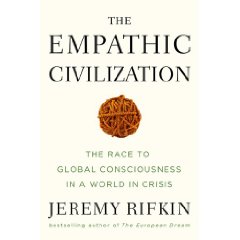
Review: The Empathetic Civilization–the Race to Global Consciousness in a World of Crisis

5 Star, Capitalism (Good & Bad), Change & Innovation, Civil Society, Complexity & Resilience, Consciousness & Social IQ, Culture, Research, Education (General), Environment (Solutions), Future, Information Society, Intelligence (Public), Intelligence (Wealth of Networks), Nature, Diet, Memetics, Design, Peace, Poverty, & Middle Class, Philosophy, Stabilization & Reconstruction, Truth & Reconciliation, Values, Ethics, Sustainable Evolution
Amazon Page

5.0 out of 5 stars HUGE Book, Deep Look From One Perspective

January 14, 2010

Jeremy Rifkin

This is a society-changing piece of work.

This is a magnum opus from a very specific point of view that overlooks both major consciousness figures and major biosphere figures. Herman Daly gets one note, Tom Atlee, Barbara Marx Hubbard, Steve McIntosh are not in this book. Buckminster Fuller, Paul Hawken, the Meadows, E. O. Wilson on Consilience, J. F Rischard on HIGH NOON, etcetera, are not in this book. My review begins after the Table of Contents, which the publisher failed to provide using standard Amazon tools for publishers.

Table of Contents

I The Hidden Paradox of Human History

HOMO EMPATHICUS

2 The New View of Human Nature
3 A Sentient Interpretation of Biological Evolution
4 Becoming Human
5 Rethinking the Meaning of the Human Journey

EMPATHY AND CIVILIZATION

6 The Ancient Theological Brain and Patriarchal Economy
7 Cosmopolitan Rome and the Rise of Urban Christianity
8 The Soft Industrial Revolution of the Late Medieval era and the Birth of Humanism
9 Ideological Thinking in a Modern Market Economy
10 Psychological Consciousness in a postmodern Existential world

THE AGE OF EMPATHY

11 The Climb to Global Peak Empathy
12 The Planetary Entropic Abyss
13 The Emerging Era of Distributed Capitalism
14 The Theatrical Self in an Improvisational Society
15 Biosphere Consciousness in a Climax Economy

– – – – – – – –

If this book is reprinted, it should be single-spaced. The massive bulk (675 pages) is pretentious and not necessary, especially for those of us that read when traveling, and for students having to carry books around. As noted earlier the author leaves out a great deal and I will offer ten links below (and over 300 links at Phi Beta Iota the Public Intelligence Blog where I have posted “Worth a Look: Book Review Lists”). This review focuses on the righteous theme the author has pursued across multiple literatures.

The book's bottom line is well summarized in the jacket flaps and comes at the very end as the author aspires for a combination of biosphere consciousness and distributed capitalism, the latter made possible by a combination of backyard energy and global information and communications technologies (ICT). Early in the book the author discusses how the wealthy dominated water power in the Medieval Period, but the poor were able to use windmills anywhere–this makes an impression on me as it did on the author.

The author has a story to tell and as I go through the book I am constantly reminded of books and points not in this book, but I abandoned my first draft of my review because it focused too much on work by others and not enough on the enormous task this author has taken on. In a nutshell, the author believes that the same revolutions in energy and communications that lead to a growth in human consciousness also lead to a commensurate crisis in earth or biosphere viability. In today's era the potential crisis (widely anticipated in the 1970's and deliberately ignored by the White House and the Senate for selfish corrupt reasons) is playing a forcing function, potentially catalyzing the rethinking of philosophy, economics, and our social models.

There are three negatives to this book that for any other author or theme would have dropped the book to a four, but I feel a five is still warranted for both the heroic personal effort of the author, and the importance of the theme.

#1. There is no appreciation that I can see of the fact that we are returning to the wisdom of the indigenous cultures that we have genocided since 1941, not only in the USA but in Australia, Africa, and elsewhere. This is not new wisdom that the author is bringing to bear, but old wisdom that is being rediscovered.

#2. The author fell prey to the Climate Change manipulation of data and hyperbole as well as nine documented errors in the British law suit against Al Gore, who has been asked to return his Academy Award. I won't belabor this now that the fraud of Climate Change has been adequately exposed, I will just say this: the UN High Level Panel on Threats, Challenge, and Change is the more honest and substantive endeavor, and Environmental Degradation, #3 of 10 after Poverty and Infectious Disease, is properly ranked. Climate Change is less than 10% of that, and within Climate Change carbon emissions are 10% at most, and much less important than sulfur or mercury. Carbon trades are fraud–a form of phantom wealth engineered by Maurice Strong and shilled by Al Gore, with the International Panel on Climate Change director–a railway engineer, not a scientist–happily lining his pockets by making the science fit. Learn more at the ClimateGate Rolling Update at Phi Beta Iota the Public Intelligence Blog.

#3. This is a book for the one billion rich, and it does not really address the five billion poor, and so I felt a continuing sense of annoyance as I read, recognizing this as a “salon” work for funders and the well-off, rather than a grass roots books focused on bottom-up social change. For that, see the books I list below.

Having disclosed those three “nits,” I am hugely positive on this book and its theme. The author observes that historians tend to document the negatives–the wars and the conflicts–and gloss over the periods of peace and prosperity and I buy into that. We don't do enough to isolate and extend the “good news.”

Here are other fly-leaf notes:

+ Empathy is rooted in selfhood, enables dialog that in turn allows reconciliation.

+ Today transparency and cooperation are displacing secrecy and competition.

+ Importance of touch, of reversing the isolation of the individual as a cog in the machine.

+ Herding of humans began in 4000 BC with hydraulic civilizations, not with the Industrial Revolution as some have suggested

+ Energy advances appear to stimulate changes in communications (including computing and intelligence)

+ Mothers and mothering matter, root of selfhood and stability that enables exploring and innovation

+ Darwin's later work looked at empathy among animals and between different species

+ Faith and emotion are an important part of “humanity” and of “intelligence”

+ Religions are NOT inherently empathetic, tend to both focus on the other worldly and to exclude those not of the same religion

+ The author does well as a single individual researcher but there is a lot in this book that is simplistic for lack of access to deeper works by others

+ Soil salinity has collapsed civilizations before ours including the Romans

+ Nice discussion of the Gnostics who felt that the real sin of man was in not understanding self and the human potential for divinity (Barbara Marx Hubbard and Buckminster Fuller have focused on this in more recent times)

+ Medieval Period ran out of wood the way we are running out of oil

+ Interesting discussion of print as a facilitator for both individuality and the scientific method

+ Light discussion of schools, not connected with the broader literature on pedagogy and mass instruction.

+ Energy changes impact on space and time perceptions. Electricity and Morse code took global communications and connectivity to a whole new level

+ Child development runs throughout this book in an interesting manner

+ Disconcerting notes include English as the universal language (Chinese over-taking fast followed by Hindi); everyone is a tourist (this would be news to the five billion poor); no more aliens, decline of religion (not from where I sit).

+ Author is excessively dependent on Climate Change as a stimulus, I totally agree with the author's sense of urgency, but all ClimateGate has done is set science back in the public esteem by at least a decade.

+ The author provides an engaging discussion of the coming 3rd Industrial Revolution in which we will further embrace new indices of immaterial wealth and move from property to access and from co-optation to cooperation.

+ The book closes with a discussion of how social skills are changing and now half theater and half authentic, which may not be as odd as it sounds, as individuals must master both deep multi-cultural empathy and the ability to project open authenticity despite violent disagreement with “the other.”

This book is absolutely worth buying and reading–it would be better if it were single spaced and much less bulky. I hope the paperback version goes to single space; there is no justification for doubling the bulk of this content.

Ten links as allowed by Amazon:
Reflections on Evolutionary Activism: Essays, poems and prayers from an emerging field of sacred social change
Radical Man
Social Change 2.0: A Blueprint for Reinventing Our World
The Compassionate Instinct: The Science of Human Goodness
Conscious Evolution: Awakening Our Social Potential
Integral Consciousness and the Future of Evolution
The Wealth of Networks: How Social Production Transforms Markets and Freedom
Powershift: Knowledge, Wealth, and Violence at the Edge of the 21st Century
Voltaire's Bastards: The Dictatorship of Reason in the West
Collective Intelligence: Creating a Prosperous World at Peace

See all my other reviews relevant to this specific books and its focus at Phi Beta Iota the Public Intelligence Blog, but specifically the “good news” books visible through  Worth a Look: Book Review Lists.

Vote on Review

Review: Rethinking Civilization: Resolving Conflict in the Human Family

3 Star, Civil Society, Complexity & Catastrophe, Complexity & Resilience, Consciousness & Social IQ, Culture, Research, Democracy, Economics, Environment (Problems), Environment (Solutions), Future, Intelligence (Public), Nature, Diet, Memetics, Design, Peace, Poverty, & Middle Class, Philosophy, Priorities, Values, Ethics, Sustainable Evolution, Voices Lost (Indigenous, Gender, Poor, Marginalized), Water, Energy, Oil, Scarcity
Amazon Page
3.0 out of 5 stars Criminal Pricing in Sharp Contrast to Content
January 13, 2010

Majid Tehranian

I read a lot, and quite by accident (or courtesy of Dick Cheney who drove people back to books looking for answers) I am the top Amazon reviewer for non-fiction. I would have bought this book, along with the book I did buy today, Jeremy Rifkin's The Empathic Civilization: The Race to Global Consciousness in a World in Crisis but one look at the price and a one word decision: NO.

This book is CRIMINALLY priced. As a publisher myself, I can assure one and all that in lots of 1,500 in hard cover, it costs at most two cents a page including color cover and graphics. Using the Amazon on demand printing option, the cost is even less. Authors must STOP allowing publishers to price their precious work beyond the reach of most people with a brain. I offer all my books free online as well as via Amazon.

Other books in this vein that are ethically priced include:
Reflections on Evolutionary Activism: Essays, poems and prayers from an emerging field of sacred social change
Nonzero: The Logic of Human Destiny
Integral Consciousness and the Future of Evolution
Conscious Evolution: Awakening Our Social Potential
Collective Intelligence: Creating a Prosperous World at Peace
How to Change the World: Social Entrepreneurs and the Power of New Ideas, Updated Edition
The Cultural Creatives: How 50 Million People Are Changing the World

and many more. Phi Beta Iota, the Public Intelligence Blog, provides easy access to all of my reviews (over 1,500) in each of 98 reading categories including Catastrophe & Resilience, Cosmos & Destiny, and so on.

If the author will post this book free online, or if the publisher can be shamed into pricing it at under $35, I will buy it and review it.

Vote on Review

Review: Social Change 2.0–A Blueprint for Reinventing Our World

5 Star, Change & Innovation, Consciousness & Social IQ, Culture, Research, Democracy, Economics, Environment (Solutions), Nature, Diet, Memetics, Design, Values, Ethics, Sustainable Evolution
Amazon Page

5.0 out of 5 stars Undeniable Genius Isolated from Other Movements

January 4, 2010

David Gershon

This book is a work of undeniable genius and to that I would add peseverence–the author and his wife Gail Straub have been on the forefront of the personal empowerment movement from the late 1970's onward, and in many ways this book is a capstone work that bridges from the personal to the neighborhood and aspires to–but does not quite attain–the goal of being globally meaningful. I previously enjoyed and reviewed Low Carbon Diet: A 30 Day Program to Lose 5000 Pounds–Be Part of the Global Warming Solution! but this is the book that moves the author into my pantheon of a dozen world-class thinkers on social change.

Early on the book grabs me in a Buckminster Fuller sort of way when the author emphasizes that not only do we have to re-invent the world, we have to re-invent the process by which we re-invent the world. Of course Jonas Salk and others have addressed that with Epoch B leadership, but not for mention here.

I am totally impressed by the 30 years of hard work at the grass roots level that the author builds on in this book, one of the reasons it is a solid five stars on its own merits.

QUOTE from page 45: “The intial test results from the first 200 households were very promising. Those households on average reduced their annual solid waste by percent, water use by 32 percent, energy use by 17 percent, vehicle miles traveled by 8 percent, CO2 emissions by 15 percent, and achieved financial savings of $255.”

Those are HUGE accomplishments, and severely under-stated because the author does not factor in the “true cost” of the savings, probably closer to $10,000 a person if not vastly more (fuel is actually a million dollars a gallon if you really value the time it took to create the fossil base).

Continue reading “Review: Social Change 2.0–A Blueprint for Reinventing Our World”

Review: The Living Universe

5 Star, Communications, Complexity & Resilience, Consciousness & Social IQ, Cosmos & Destiny, Culture, Research, Economics, Education (General), Environment (Solutions), Information Society, Intelligence (Collective & Quantum), Intelligence (Extra-Terrestrial), Intelligence (Wealth of Networks)
Amazon Page
Amazon Page

5.0 out of 5 stars Evolutionary Activism Takes On New Life

December 6, 2009

Duane Elgin

I was led to this book by Tom Atlee, whose earlier book, The Tao of Democracy: Using Co-Intelligence to Create a World That Works for All completely redirected my thinking in positive directions, and whose new book on Reflections on Evolutionary Activism (soon on Amazon, now at the Public Intelligence Blog) pointed me toward this book as well as Nonzero: The Logic of Human Destiny, Holistic Darwinism: Synergy, Cybernetics, and the Bioeconomics of Evolution and other books on cultural evolution.

In the face of the almost complete collapse of the post-World War II political, economic, and social paradigms (see my free chapter on Paradigms of Failure at the Public Intelligence Blog or within Election 2008: Lipstick on the Pig (Substance of Governance; Legitimate Grievances; Candidates on the Issues; Balanced Budget 101; Call to Arms: Fund We Not Them; Annotated Bibliography), I feel POSITIVE, and this book and the many human minds and hearts this book represents are the reason I am confident that Conscious Evolution: Awakening Our Social Potential and Integral Consciousness and the Future of Evolution are on the immediate horizon.

Paul Hawkin's captures the spirit of WHY this book on the Living Universe matters–his most recent book, Blessed Unrest: How the Largest Movement in the World Came into Being and Why No One Saw It Coming is the tip of the iceberg.

The greatest value for me of this book is that it is a superb overview of many different concepts from both science and the world of religion–this is a sense-making book not a simple book.

Continue reading “Review: The Living Universe”

Review: Holistic Darwinism: Synergy, Cybernetics, and the Bioeconomics of Evolution

6 Star Top 10%, Best Practices in Management, Change & Innovation, Civil Society, Communications, Complexity & Resilience, Consciousness & Social IQ, Culture, Research, Decision-Making & Decision-Support, Democracy, Economics, Education (General), Education (Universities), Environment (Solutions), Future, Games, Models, & Simulations, History, Information Operations, Information Society, Intelligence (Collective & Quantum), Intelligence (Public), Nature, Diet, Memetics, Design, Survival & Sustainment, Values, Ethics, Sustainable Evolution, Voices Lost (Indigenous, Gender, Poor, Marginalized)
Amazon Page
Amazon Page

5.0 out of 5 stars Beyond 6 Stars–And a Seventh for Accessible Pricing

December 5, 2009
Peter A. Corning
I could spend a lifetime reading and re-reading this book, and each of the cited sources, and not waste the time at all. This is one of the most extraordinary works I have encountered, and while I cannot do it justice, I will summarize it. Four other books that join this one in framing my third and last stage of life:
Consilience: The Unity of Knowledge
Nonzero: The Logic of Human Destiny
A More Secure World: Our Shared Responsibility–Report of the Secretary-General's High-level Panel on Threats, Challenges and Change
The Fortune at the Bottom of the Pyramid, Revised and Updated 5th Anniversary Edition: Eradicating Poverty Through Profits

Bottom line: Humanity can evolve, must evolve, and the Whole Earth, Co-Evolution concepts that Stewart Brand and others pioneered (not mentioned here), that indigenous people's everywhere have understood for centuries, are a natural path for us all. We *can* create a prosperous world at peace.

Short version of the book: Synergy is cool again, synergy and self-organization complement each other and are distinct; bioeconomics is hugely important and supports the premise that the whole is larger than the sum of the parts and that interactions and exchanges can and should be done for the whole, “beyond selfishness,” cybernetics rules, information is the space between, and ethics is both a form of cybernetics and a cultural adaptation that helps the whole evolve and persist.

Continue reading “Review: Holistic Darwinism: Synergy, Cybernetics, and the Bioeconomics of Evolution”

Review: Ecological Intelligence–How Knowing the Hidden Impacts of What We Buy Can Change Everything (Hardcover)

5 Star, Best Practices in Management, Capitalism (Good & Bad), Change & Innovation, Complexity & Resilience, Consciousness & Social IQ, Culture, Research, Economics, Education (General), Environment (Solutions), Information Operations, Information Society, Intelligence (Collective & Quantum), Intelligence (Commercial), Intelligence (Public), Nature, Diet, Memetics, Design, Peace, Poverty, & Middle Class, Survival & Sustainment, True Cost & Toxicity, Values, Ethics, Sustainable Evolution
Amazon Page
Amazon Page

5.0 out of 5 stars From 4 to Five for Gifted Story and Amazon Price Cut

November 29, 2009
Daniel Goleman
I chose this book over Ecological Intelligence: Rediscovering Ourselves in Nature and seeing the author's note about this other book “by a physician, Jungian analyst, and poet” am certain I made the right choice.

The author's “big idea” is called “Radical Transparency,” what the rest of us have been calling “Open Books for decades. I like it, and in the context of his elegant story-telling, I buy in. This book also goes to a five because it is an Information Operations (IO) books, ably focused on data, information, and information-sharing as well as collective sense-making. He author anticipates most of us becoming “active agents” for change, armed with information as Thomas Jefferson understood so well.

CORE NUGGET: Life Cycle Assessment (LCA) is not done for most things, but when done right, it is mainly data and it tracks impacts on human health, ecosystems, climate change, and resource draw-down, for every single component and every single process including transport, packaging, etcetera. Toward the end of the book when the author talks about how an LCA commons is emerging, and quotes Andy Ruben of normally ultra-evil Wal-Mart as saying that LCA innovation “is the largest strategic opportunity companies will see for the next fifty years,” I am seriously impressed.

Review: Not by Genes Alone: How Culture Transformed Human Evolution

5 Star, Change & Innovation, Civil Society, Communications, Complexity & Resilience, Consciousness & Social IQ, Culture, Research, Environment (Solutions), Future, History, Information Society, Intelligence (Public), Intelligence (Wealth of Networks), Nature, Diet, Memetics, Design
Amazon Page
Amazon Page
5.0 out of 5 stars Boring, Original, Don't Know Enough to Give Less Than Five Stars
November 28, 2009
Peter J. Richerson and Robert Boyd
I found this book boring, and not nearly as breath-taking and inspiring as Robert Wright's Nonzero: The Logic of Human Destiny, which altered my perception of everything else, and is right up there with E. O. Wilson's Consilience: The Unity of Knowledge as one of my most respected readings.

Both Wright and these authors acknowledge Richard Dawkins and The Selfish Gene: 30th Anniversary Edition–with a new Introduction by the Author as being instrumental in getting the academy to think new thoughts.

However, and despite other's averaging a four, I feel such a sense of respect for what these two authors have done (with a superb bilbiography and a good index) that I cannot qualify this with less than five stars.

The two nuggets for me, with my interest in Epoch B leadership and self-organizing communities, came at the end:

Continue reading “Review: Not by Genes Alone: How Culture Transformed Human Evolution”