Review: Strategic Intelligence for the 21st Century: The Mosaic Method

5 Star, Intelligence (Commercial), Intelligence (Government/Secret), Intelligence (Public), Uncategorized
Amazon Page
Amazon Page

Alfred Rolington

5.0 out of 5 stars One of four essential books on the future of intelligence, February 2, 2013

I have been holding a gift copy of this book for over a month, waiting for it to be available on Amazon so I could post my review, and as a result have also read — and also recommend as an essential book — Sir David Omand's book Securing the State. I am rating both books at 5, both books are as erudite and perceptive as it gets.

Alfred Rolington can reasonably be considered “P” or the Public counterpart to “M” in the UK, as I have been to the secret world in the US.  He is the master of BOTH the secret process of intelligence and its purposes, AND the very broad multi-lingual multi-cultural world of open sources in unpublished, analog, and digital form that the secret world is — to be blunt — arrogantly ignorant of.  This book is one of a handful truly relevant to the future of intelligence (decision-support) done properly — which is to say, as decision-support for ALL threats and challenges, not as surveillance secrets protecting the few.

This book by Alfred Rolington, former CEO of Janes and someone I have known for over fifteen years — and whom I will testify has been the single most accomplished and imaginative speaker in my conference on international intelligence from 1992-2006, among over 750 speakers — is the better book for students and I strongly recommend it as required reading at the university level.

As I am one of the arch-critics of expensive secret “intelligence” that is done badly, and do not mince my own words, it is with some awe that I read strong critical views articulated in such a graceful manner that I can just see the US Director of National Intelligence with his pants down saying “Thank you, Sir, may I please have three more?” Naturally nothing in this book should be taken to be critical of the British intelligence community that is without peer.

Continue reading “Review: Strategic Intelligence for the 21st Century: The Mosaic Method”
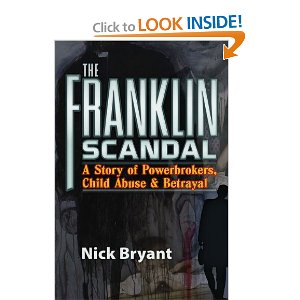
Review (Guest): The Franklin Scandal: A Story of Powerbrokers, Child Abuse & Betrayal

5 Star, America (Founders, Current Situation), Atrocities & Genocide, Banks, Fed, Money, & Concentrated Wealth, Congress (Failure, Reform), Consciousness & Social IQ, Corruption, Culture, Research, Executive (Partisan Failure, Reform), Intelligence (Public), Justice (Failure, Reform), Politics, Power (Pathologies & Utilization), Threats (Emerging & Perennial), Values, Ethics, Sustainable Evolution, Voices Lost (Indigenous, Gender, Poor, Marginalized)
Amazon Page
Amazon Page

Nick Bryant

5.0 out of 5 stars Read it and weep, then seethe… April 22, 2010

By Thomas J. Breidenbach

“Deep politics” is scholar Peter Dale Scott's term for historical machinations such as drug-running and assassinations which form covert if systemic features of the contemporary state and which are all-too naively dismissed as “conspiracy theories.” A number of people who study such matters seriously have long suspected that the scandal centering on Omaha, Nebraska's Franklin Credit Union in the 1970s and `80s forms the conceptual linchpin to a truly critical understanding of the perverse, brutal and predatory nature of power in late-imperial America. Having read former Nebraska State Senator John DeCamp's brave if somewhat desultory 1992 book on the subject, THE FRANKLIN COVER-UP, and watched the unaired British television documentary CONSPIRACY OF SILENCE on the internet, we have also sensed, with a certain despair, that the nature and details of this scandal were so shocking, ugly, confusing and strange as to forever defy broader public credulity and scrutiny. It is with a profound sense of relief, admiration and gratitude, then, that one reads Nick Bryant's THE FRANKLIN SCANDAL, which accomplishes the seemingly impossible: an eminently gripping, thorough and accessible account of perhaps the grimmest aspect of contemporary U. S. history.

It is amusing to see the sole negative reviewer on these pages (as of this writing) suggest that Bryant has gullibly relied only on the apparent victims of the scandal, when in fact the author has taken pains to bolster accusations voiced in his book with the testimony of law-enforcement, governmental, mental health, legal and social-service officials, as well as journalists and others whose professions and/or personal relationships brought them into the orbit of this lurid story.

Continue reading “Review (Guest): The Franklin Scandal: A Story of Powerbrokers, Child Abuse & Betrayal”

Review: Open Source Intelligence Techniques: Resources for Searching and Analyzing Online Information

4 Star, Decision-Making & Decision-Support, Information Operations, Intelligence (Public)
Amazon Page
Amazon Page

Michael Bazzell

4.0 out of 5 stars A Useful Contribution–See the Table of Contents, January 30, 2013

This review is from: Open Source Intelligence Techniques: Resources for Searching and Analyzing Online Information (Paperback)

I started the modern Open Source Intelligence (OSINT) movement in 1988, picking up where earlier pioneers such as Jan Herring, former NIO for S&T, left off. We are still fighting this battle. The CIA Open Source Center (OSC) is retarded — it does less than 10% of what could be done by a proper Open Source Agency (see tiny url forward slash OSA2011), and compounds their ignorance by classifying what they produce.

I *like* this book. If you have any doubts at all, use the superb Inside the Book feature that is one of Amazon's signal innovations. If you believe — as the OSC believes — that OSINT is all about online surfing in English, this is a great book. It is a good complement to Ran Hock's stuff, or Arno Reuser's stuff, and Ben Benavides stuff, and I certainly also recommend the Super-Searcher series and anything by Mary Ellen Bates.

Continue reading “Review: Open Source Intelligence Techniques: Resources for Searching and Analyzing Online Information”

Berto Jongman: Coding Freedom – Ethics and Aesthetics of Hacking

Information Society, Information Technology
Berto Jongman
Berto Jongman

Recommended reading.

An anthropologist explains how hackers are changing the definition of freedom

David Hutchinson
Amazon Page
Amazon Page

Coding Freedom: The Ethics and Aesthetics of Hacking, by E. Gabriella Coleman, dives into the ocean of software hacking: its culture, personalities, and craft. But it's also a legal history of hacking (modifying code) and cracking (illegally modifying code). Working an anthropologist, she haunted cons, chat rooms, and dug into the Linux kernel to unearth nuggets of insight. Though occasionally she uses academic jargon, her book is an intriguing read and connects the dots. What emerges is a picture of the “craft and craftiness” of hackers, how the free/open source movement came into being, and the battles being fought over digital rights in courtrooms, on street cams, and in government offices every day.

Read rest of review.

Phi Beta Iota:  The “Administrative State” is a form of velvet tyranny that strives to micro-manage everything so as to coerce tolls from the wealthy while sacrificing the rights of citizens.    Hacking is both a form of pushing the envelope and demonstrating the right stuff, and a form of civil disobedience in the face of great evil, the corruption of laws to the point that they have no moral standing.

See Also:

PBS: Are Hackers Outlaws or Watchdogs?

THE OPEN SOURCE EVERYTHING MANIFESTO: Transparency, Truth, & Trust

Berto Jongman: Recommended Book — Leaders Make the Future: Ten New Leadership Skills for an Uncertain World

Cultural Intelligence, Leadership
Berto Jongman
Berto Jongman

Rate Your Leadship Skills for the Future – Free Self-Assessment

•    Grounded in the most recent ten-year forecast by the prestigious Institute for the Future
•    Identifies the new skills needed to thrive in the next decade
•    Provides tools, examples, and advice to help develop your expertise in each of the ten future skills

Amazon Page
Amazon Page

Some leadership skills are enduring.  But to be successful in the future, leaders also need an emerging set of skills uniquely suited to dealing with the challenges of the threshold decade we are entering.  Today’s businesses and organizations are operating in a world characterized by volatility, uncertainty, complexity, and ambiguity.  Though they already seemed stressed to the breaking point, Johansen reminds us that we are also more connected than ever before in our history, but we must fully realize the benefits of that connectivity. In the next decade, leaders will not just see the future—they will make it!  But they will not be able to do it alone.

– – – – – – – – – – – –

Bob Johansen was president and CEO of the Institute for the Future from 1996 to 2004 and is now the IFTF Distinguished Fellow, as well as serving on its board. Bob has worked for more than 30 years as a forecaster, exploring the human side of new technologies. He has a deep interest in the future of religion and its impact on business, society, and individuals. Bob works mainly with senior corporate executives across a wide range of industries. Bob is a frequent keynote speaker. He has taught both graduate and undergraduate courses. He is the author of six books, including Upsizing the Individual in the Downsized Organization with novelist Rob Swigart, a guide for organizations undergoing technological change and reengineering, and GlobalWork with Mary O'Hara-Devereaux, a guide to managing global, cross-cultural teams. A social scientist with an interdisciplinary background, Bob holds a BS degree from the University of Illinois, where he also played varsity basketball, and a Ph.D. from Northwestern University. Bob also has a divinity school degree from what is now called Colgate Rochester Crozer Divinity School, where he studied comparative religions.

Review (DVD): Dark Legacy — Compelling Public Indictment of George Bush Senior as CIA Lead for Assassination of John F. Kennedy

6 Star Top 10%, Atrocities & Genocide, Crime (Government), Executive (Partisan Failure, Reform), Impeachment & Treason, Intelligence (Government/Secret), Justice (Failure, Reform), Politics, Power (Pathologies & Utilization), Reviews (DVD Only)
Amazon Page
Amazon Page

John Hankey

5.0 out of 5 stars Six Star Special — Poetic, Compelling — Sufficient to Indict George Bush Sr., January 18, 2013

I have reviewed a number of the non-fiction books about the assassination of John F. Kennedy, and received this film as a gift from an Amazon reader who appreciated my book reviews.

First off, the film is superbly professional and poetic in its opening, a panoramic survey of John F. Kennedy and why he mattered, as a President representing the 99%, as a President striving for peace and against the US military industrial complex (books show that Khruschev had the same problem with his own military complex).

Crucifies ABC's Peter Jennings for being part of a cover-up and nationally-televised propaganda film lying to the public. As an intelligence professional who has written extensively about information pathologies, I hold the captured corporate media in great disdain, and consider all of them to be craven to the nth degree.

I have to say that as good as the movie is, it absolutely had to be valued in the context of the books that provide vastly more detail. This movie is a summary — a very compelling and gifted presentation of the totality of the assassination including details and excellent photographic and video reviews, but the movie is only good enough to INDICT George Bush Senior, not enough to convict.

Continue reading “Review (DVD): Dark Legacy — Compelling Public Indictment of George Bush Senior as CIA Lead for Assassination of John F. Kennedy”

Review: What Has Nature Ever Done for Us?

5 Star, Atlases & State of the World, Capitalism (Good & Bad), Complexity & Resilience, Culture, Research, Economics, Education (General), Environment (Problems), Environment (Solutions), Executive (Partisan Failure, Reform), Future, Intelligence (Public), Justice (Failure, Reform), Misinformation & Propaganda, Nature, Diet, Memetics, Design, Philosophy, Politics, Power (Pathologies & Utilization), Priorities, Science & Politics of Science, Strategy, Survival & Sustainment, True Cost & Toxicity, Truth & Reconciliation, Values, Ethics, Sustainable Evolution, Voices Lost (Indigenous, Gender, Poor, Marginalized), Water, Energy, Oil, Scarcity
Amazon Page
Amazon Page

Tony Juniper

5.0 out of 5 stars MUST READ, gift and share — a roadmap for true cost valuation at citizen level, January 12, 2013

I have long been a fan of Herman Daly's ecological economics and E.O. Wilson's concept of consilience, a form of holistic analytics, and of course Buckminster Fuller and Russell Ackoff, among other systems thinkers. This book, just published, is quite extraordinary, and in the absence of a Look Inside the Book offering, one of Amazon's best features, I want to list the chapters here and point to an online resource that provides compelling information supportive of buying this book and then sharing it or gifting it to others.

Chapter 1: The Indispensable Dirt
Chapter 2: Life from Light
Chapter 3: Eco-innovation
Chapter 4: The Pollinators
Chapter 5: Ground Control
Chapter 6: Liquid Assets
Chapter 7: Sunken Billions
Chapter 8: Ocean Planet
Chapter 9: Insurance
Chapter 10: Natural Health Service
Chapter 11: False Economy?

To get right to the web page that does NOT offer the book for free, only provides the supporting references and comments on each reference, search for:

what-has-nature-ever-done-us-sources-and-references

Continue reading “Review: What Has Nature Ever Done for Us?”

noble gold