Journal: Israel, Neo-Cons, Big Oil, Iraq, & Green

05 Energy, 08 Wild Cards, Analysis, Commerce, Commercial Intelligence, Earth Intelligence, Ethics, Government, Military, Strategy
0Shares
Chuck Spinney

In my last blaster (here), I raised a question of whether the Israelis were trying to hijack the Green Lobby or whether they were ready for the rubber room.  This was made in response to a report by Jonathan Cook that contended Israel was greenwashing war on terror.  It turns out that I may have phrased this question in naive, simplistic terms, if my good friend Pierre Sprey (a justifiably well known weapons analyst, mathematician, and recording entrepreneur) is correct, Israel's motives for  trying to hijack the Green Lobby can be viewed in a larger, longer range context.  Below is his most interesting analysis of Israel's motives for greenwashing the war on terror: Chuck

—–[Comment by Pierre Sprey]—–

I totally agree that the currently faddish alternate energy sources are ludicrously uneconomical and, for the most part, environmentally harmful. The only alternate source that could almost completely supplant oil and that actually makes economic and environmental sense, natural gas, is currently among the most unfashionable.

Nevertheless, there's an important larger perspective to Israel's dead serious push to raise huge amounts of capital (guess where?) to produce non-oil based energy from trendy green sources in large enough quantities to reduce worldwide oil demand significantly.

That perspective is simple: unbeknownst to most, the absolute highest priority objective of Israeli foreign policy, from 1949 to today, has been to break the Seven Sisters oil cartel's stranglehold on world oil production in order to collapse the world price of oil. From Israel's point of view, that's a perfectly rational strategic objective–and, almost certainly, the only Israeli objective I know of that would be a major benefit to the world.

Continue reading “Journal: Israel, Neo-Cons, Big Oil, Iraq, & Green”
Reference: Intelligence Support to Small Arms Acquisition–A Brilliant Indictment

10 Security, Analysis, DoD, Methods & Process, Military, Reform, Strategy, Threats, Tools
0Shares
Full Paper Online

Marcus Aurelius:

(1) US consciously changed from standard main battle rifles firing “full military cartridges” (ie., M-14/7.62×51 NATO, M-1 Garand/cal. 30 M-1) to assault rifles (AR-15, M-16, Stoner System) in the 1960s as we attempted to optimize for short-range engagements in the constrained mountainous/jungle environments of Southeast Asia.  At the time, our primary allies were slight of physical stature;

(2) Concurrently, training and engagement doctrine shifted from carefully aimed individual shots to volume of fire (bursts of various numbers of rounds, the “spray and slay” technique) and various “point and shoot” techniques such as “instinctive aiming,” “quick kill,” etc.;

(3) Ammunition followed suit and emphasis in terminal ballistics shifted from accuracy and kinetic energy to volume of fire and bullet yaw/fragmentation; (4) I attach the SAMS paper by MAJ Ehrhart cited in the article.)

Phi Beta Iota: This one paper is a superb indictment of US DoD leadership from the Secretary of Defense, who claims he does not do “maintenance” but is in fact overseeing “business as usual” for Lockheed et all, to the Undersecretaries (Intelligence does not do intelligence support to acquisitions; Acquisitions could care less about inexpensive individual systems; and Policy simply does not have a clue) to the service leaders responsible for training, equipping, and organizing the forces to be sent into battle by the Combatant Commanders.  The Strategic Generalizations developed by the Marine Corps Intelligence Center in 1989 remain valid–and ignored.

Related Media Article:

April 2, 2010

Army Report: GIs Outgunned In Afghanistan

By David Wood

American troops are often outgunned by Afghan insurgents because they lack the precision weapons, deadly rounds, and training needed to kill the enemy in the long-distance firefights common in Afghanistan's rugged terrain, according to an internal Army study.

Politics Daily Full Story Online

Reference: Intelligence Reform Death Notice

10 Security, Analysis, Budgets & Funding, Commissions, DHS, Director of National Intelligence et al (IC), DoD, Ethics, Government, Hill Letters & Testimony, Law Enforcement, Legislation, Methods & Process, Military, Peace Intelligence, Policy, Reform, Strategy, Threats
0Shares
Full Document Online

Phi Beta Iota: With a tip of the hat to Marcus Aurelius, this document is provided for information.  On balance it is rich with insights that are not available elsewhere and consequently must be very highly regarded as a baseline for where US intelligence reform (and US intelligence) are today: dead, with a $75 billion a year casket that shows no signs of atrophy.  Below are summary extracts both positive and negative.

Continue reading “Reference: Intelligence Reform Death Notice”

Review (Guest): Government of the Shadows–Parapolitics and Criminal Sovereignty (Paperback)

5 Star, Banks, Fed, Money, & Concentrated Wealth, Capitalism (Good & Bad), Empire, Sorrows, Hubris, Blowback, History, Impeachment & Treason, Intelligence (Government/Secret), Military & Pentagon Power, Misinformation & Propaganda, Peace, Poverty, & Middle Class, Politics, Power (Pathologies & Utilization), Security (Including Immigration), Strategy, Survival & Sustainment, Threats (Emerging & Perennial), True Cost & Toxicity, Truth & Reconciliation, United Nations & NGOs, Values, Ethics, Sustainable Evolution, Voices Lost (Indigenous, Gender, Poor, Marginalized)
0Shares
Amazon Page

Review by Guido G. Preparata (Rome, Italy)

5.0 out of 5 stars Innovative and courageous social science

June 8, 2009

Eric Wilson and Tim Lindsey (eds)

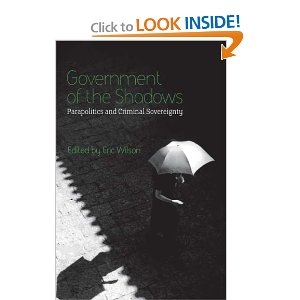
In this recent volume by Pluto Press, Eric Wilson (Monash University) has assembled an all-stars team of politologists with the objective of changing the face of social analysis. This effort stems from the urgency to redefine the conceptual spaces within which we perforce corral our daily experience as citizens of what has become, in fact, an international polity of overwhelming, as well as highly disquieting, complexity. This is not at all to say, however, that the project limits itself to adding “epicycles,” as it were, to the Ptolemaic vulgate of British constitutionalism–i.e., the standard model of the “Liberal State”–which has imposed itself as the sole lens through which one is to contemplate the social dynamics for every single political reality of this world.

Government of the Shadows (GOS) represents in this regard an honest and brave swerve away from the mainstream in two fundamental respects.

First, it wishes to rethink political science entirely, by rejecting definitively the puritanical dichotomization of society into its predominant and “clean” edifice versus the latter's more or less corrupt “covert netherworld” (p. 228)–the prescriptive implication of conventional analysis being that delinquents need only be jailed, and their activities repressed, as the given regime is in the meantime steered (hopefully) toward the eventual and complete assimilation of Liberal institutions, which will naturally cure it of the criminal deviancy.

Second, and no less important, this project seeks to re-endow the movement for social justice of a unity of intent and of thought, which has lately been shattered by an excessive methodological preoccupation with multiplicity and diversity. By denouncing with reason and cogency the inequities suffered by a majority of innocents–throughout our recent history and all over the world–at the hands of identifiable, responsible parties within the power apparatuses in connivance with the world's mafias, and by ordering all such phenomenological mass into theory, this book, as a collective endeavor, acts as a vigorous reminder that realistic sociological analysis is also very much an instrument of pacific dissent. In this sense, GOS stands as a first and decisive installment of a modern anti-oligarchic theory.

To compass the reality of modern power games in its full spectrum, GOS innovates by proposing the new discipline of “parapolitics,” defined in Robert Cribb's introductory as “the study of criminal sovereignty, of criminals and sovereigns behaving as criminals in a systematic way” (p. 8).

Continue reading “Review (Guest): Government of the Shadows–Parapolitics and Criminal Sovereignty (Paperback)”

Journal: The Iran Threat–Boogie Woogie Woo Woo

02 Diplomacy, 04 Education, 05 Energy, 05 Iran, 07 Other Atrocities, 08 Proliferation, 10 Security, 11 Society, Collective Intelligence, Ethics, Government, Peace Intelligence
0Shares

The Iran Threat in the Age of Real-Axis-of-Evil Expansion

by Edward S. Herman and David Peterson

It is intriguing to see how whoever the United States and Israel find interfering with their imperial or dispossession plans is quickly demonized and becomes a threat and target for that Real-Axis-of-Evil (RAE), and hence their NATO allies and, with less intensity, much of the rest of the “international community” (IC, meaning ruling elites, not ordinary citizens).  If and when the need arises, any bit of news that is damaging to the targeted state will be fed into the demonization process — and in the marvelous propaganda system of the West, the grossest distortions will be swallowed and regurgitated without much guilt or apology, even upon the exposure of exceptional gullibility and dishonesty. The dishonesty, gullibility, double standard, and hypocrisy are handled with an aplomb that Pravda and Izvestia could never muster in the Soviet era.

. . . . . . .

Edward S. Herman is professor emeritus of finance at the Wharton School, University of Pennsylvania and has written extensively on economics, political economy, and the media. Among his books are Corporate Control, Corporate Power (Cambridge University Press, 1981), The Real Terror Network (South End Press, 1982), and, with Noam Chomsky, The Political Economy of Human Rights (South End Press, 1979), and Manufacturing Consent (Pantheon, 2002).  David Peterson is an independent journalist and researcher based in Chicago

Phi Beta Iota: See the table at the Monthly Review Zine to truly appreciate the spectacular relevance of the total commentary by the lead author who with Noam Chomsky was a half-century ahead of the pack in understanding how Potemkin Democracy might be foisted on a deliberately disengaged public.

Review: Of Centuars and Doves–Guatemala’s Peace Process

5 Star, Best Practices in Management, Country/Regional, Insurgency & Revolution, Peace, Poverty, & Middle Class, Power (Pathologies & Utilization), Security (Including Immigration), Stabilization & Reconstruction, United Nations & NGOs
0Shares
Amazon Page

5.0 out of 5 stars Absolutely a Core Work for the Region and the UN Role in Enabling Peace–Future Oriented as Well

April 3, 2010

Susanne Jonas

I am stunned not to find numerous reviews of this excellent work, a fleshing out of the author's highly-regarded (within the United Nations and global peace-process circles) “The Mined Road to Peace in Guatemala,” (North-South Agenda Paper #38, September 1999. As of today, 3 April 2010, her paper and her book are still the core references for those who seek to extend the model elsewhere in Central and Latin America.

See also:

The Battle For Guatemala: Rebels, Death Squads, And U.s. Power (Latin American Perspectives Series, No 5) – Spanish edition, with new introduction/update, La Batalla por Guatemala (Caracas, Venezuela: Nueva Sociedad and FLACSO/Guatemala, 1994);

La Ideología Social Demócrata en Costa Rica (San José, Costa Rica: Editorial Universitaria Centroamericana (EDUCA), 1984); and

Guatemala: Plan Piloto para el Continente (translation of Ph.D. dissertation) (San José,: EDUCA, 1981).

This author was at least a decade if not two decades ahead of her peers and the conventional idiocy in Washington, D.C.   Everything she has ever thought, particularly with respect to migrating the process of peace toward a process of prosperity, is relevant right this minute.

The quality of this work overcomes what would normally be a one-star deduction for a lazy unprofessional publisher failing to list the table of contents and provide a sample chapter or even better, assuring Inside the Book information including the Index, one of Amazon's best offerings.

Vote on Review

Video: Israel/Palestine’s Hit (assassination) Parade

Communities of Practice, Government, Intelligence (government), Military, Videos/Movies/Documentaries
0Shares

Watch the 20+ minute Video

It’s thought a single pillow killed a Hamas operative in Dubai this January. Yet this astonishing spy story involved 27 secret agents, some pilfered European passports and countless security cameras.

On January the 19th, an unremarkable parade of foreigners passed through Dubai’s cosmopolitan airport, strode from one CCTV camera to another, and then assassinated Palestinian resistance fighter Mahmoud Mabhouh in his hotel room. For Mossad – the Israeli Intelligence agency thought to be behind it all – the operation was a success. Yet the maelstrom of ugly consequences for the agency, Israel, and the hapless citizens whose passport details were used, have left many baffled. “To describe this as anything other than a fiasco, I don’t see how you can do it”, says former CIA agent, Robert Baer, “why would you sacrifice 27 people?”. Israel’s iron-fisted approach is embedded in its history as a state, constantly defending its survival. There is some speculation that Israelis with dual citizenship may even have agreed for their passport details to be used. “The Israelis want to seem to be invulnerable”, says Baer, “you kill us we kill you – we don’t get caught, and there’s no international condemnation”. Whether or not the killers are to be called to account, a death squad has had its cover blown and a legendary spy agency has been all but outed.

ABC Australia