Review: At War with Ourselves–Why America Is Squandering Its Chance to Build a Better World

4 Star, America (Founders, Current Situation), Complexity & Catastrophe, Culture, Research, Democracy, Economics, Education (General), Environment (Problems), Executive (Partisan Failure, Reform), Insurgency & Revolution, Threats (Emerging & Perennial), True Cost & Toxicity, Truth & Reconciliation
0Shares

Amazon Page
Amazon Page

4.0 out of 5 stars Useful Supporting Views for Prestowitz' Rogue Nation,

September 1, 2003
Michael Hirsh
Edit of 21 Dec 07 to add comment and links.

New Comment: I am distressed to see so many important books no longer available. Even though it makes my summative reviews valuable as a trace, I have tried to get Amazon to realize that it should offer such books electrionically, micro-cash for micro-text, and Jeff Besoz just doesn't want to hear it. I predict that Kindle will fail.

The author has provided a very informed and well-documented view of the competing “axis of thinking” (unilateralism versus multilateral realism) and “axis of feeling” (isolationism versus engagement). The two together create the matrix upon which a multitude of ideological, special interest, and academic or “objective” constituencies may be plotted.

The endorsement of the book by the Managing Editor of Foreign Affairs is a very subtle but telling indictment of the unilateralist bullying that has characterized American foreign policy since 2000–indeed, the author of the book coins the term “ideological blowback” as part of devastatingly disturbing account of all the things that have been done “in our name” on the basis of either blind faith or neo-conservative presumption.

The book received four stars because at the strategic level, Clyde Prestowitz' book, Rogue Nation: American Unilateralism and the Failure of Good Intentions is better in all ways–easier to read, more detailed, more specifics. Historically, I would bracket this book with the collection of Foreign AffairsThe American Encounter: The United States and the Making of the Modern World Essays from 75 Years of Foreign Affairs articles, , and I would add Wilson's Ghost: Reducing the Risk of Conflict, Killing, and Catastrophe in the 21st Century by McNamara and Blight, Kissinger on Does America Need a Foreign Policy? : Toward a Diplomacy for the 21st Century, Boren et al on Preparing America's Foreign Policy for the 21st Century, and finally Joe Nye's, The Paradox of American Power: Why the World's Only Superpower Can't Go It Alone There are many other books I have reviewed on these pages, and one could make a fine evening of reading only the reviews, as they are summative in nature.

In any event, and the reason I mention other books above instead of in the last paragraph, is to make the point that everyone–other than a few obsessive neo-conservatives who happen to hold the reins of power–is saying the same thing: America must engage the real world, in a multilateral fashion.

The author of this book differs from other authors in that he explicitly recognizes, in his preface and then throughout the book, the fact that a coherent U.S. foreign policy cannot be achieved without the U.S. public's first understanding what is at stake, and then making its voice heard.

The author is also noteworthy in detailing the hypocrisy and ignorance of existing U.S. national security policies. Although Prestowitz does this in a more useful fashion, this book is very valuable and has many gifted turns of phrase. Consider this one, from page 10: “Despite a century of intense global engagement, America is still something of a colossus with an infant's brain, unaware of the havoc its tentative, giant-sized baby steps can cause. We still have some growing up to do as a nation.”

A third aspect of this book that I found compelling was the author's continued emphasis on the need to change mind-sets and emphasize *awareness* over “guts”–as he tells this compelling tale, Americans are too quick to show “toughness” when they perhaps should slow down, orient, observe, decide, and then act on the basis of a fully-informed appraisal of all the linkages and potential consequences of their actions.

A fourth valuable feature of this book is the author's focus on one chapter on American vulnerabilities in the age of globalization and super-empowered angry men. He quotes the incoming Chairman of the Joint Chiefs of Staff, in explaining to Congress the military's incapacity to intervene on 9-11, as saying “We're pretty good if the threat is coming from outside. We're not so good if it's coming from inside.”

This leads to the fifth and final aspect of the book that I found noteworthy: the author's discussion of the mismanagement–even lack of management–of the broad spectrum of the varied instruments of national power. As Suzanne Nossel, a top Holbrook aide puts it, “Today, when it comes to U.S. diplomacy, one hand rarely knows what the other is doing. The U.S. government has no central ledger in which bilateral relationships are tracked. There is no place to turn to find out what the United States has done for a particular country lately, or what a country may want or fear.” The book clearly supports what appears to be an emerging consensus within the Senate that some form of “Goldwater-Nichols Act” for civilian and joint civilian-military national security management.

The endnotes are good, the index useful but annoyingly below 8 font type (possibly as low as 6) which is a very foolish act on the part of the publisher. A readable index would have increased the reference value of this book by at least 10%. The book lacks a bibliography, and here we urge the author to consider one for what we hope will be a second printing: books on realism, books on unilateralism, books on blowback (e.g. The Fifty-Year Wound: How America's Cold War Victory Has Shaped Our World, or Why Do People Hate America?), etcetera.

See also:
The Unconquerable World: Power, Nonviolence, and the Will of the People
A Power Governments Cannot Suppress


Vote on Review
Vote on Review

Review: Non-state Threats and Future Wars

4 Star, Asymmetric, Cyber, Hacking, Odd War, Future, War & Face of Battle
0Shares

Amazon Page
Amazon Page

4.0 out of 5 stars Rehash of Old “New” Ideas–Preface is the “Must Read”,

August 31, 2003
Robert Bunker
Edit of 21 Dec 07 to add links.

The authors, with the exception of those writing about intelligence, are world-class, and if you have not read many books about 4th Generation Warfare, non-traditional threats, and non-state actors as forces in their own right, then this is a superb single book to obtain and read.

If, on the other hand, you have read most of the books and articles written by these talented individuals, you will find the book irritatingly “old”–most of these ideas were published ten years ago, and the book is a superb undergraduate publication well-suited for those who have not done the prior reading.

The book is a reflection of its institutional provenance, and brings together a mix of defense writers and the current crop of transnational crime academics and practitioners. It does not adequately discuss the non-violent traditional threats (water and resource scarcity, mass migration and genocide, pollution and corruption, inter alia), and it does not really discuss the future in creative ways.

There is no index and the bibliography is marginal.

There is one bright spot, and it alone makes the book worthy of purchase: Phil Williams, a top academic with superb law enforcement and national security connections at the working level, provides a preface that is concise and useful. He begins by pointing out that Clinton as well as Bush to date have ignored non-state threats, specifically including terrorism, and failed to understand the gravity and imminence of the asymmetrical threat. He lists five realities and three solutions:

Reality #1: International security is more complex. It is not sufficient to focus only on states.

Reality #2: Distinction between foreign and domestic security is gone–one cannot have homeland security in isolation from global security, and vice versa.

Reality #3: States are not what they were–the balance of power now requires that states, corporations, and organizations find new means of coordinating policies, capabilities, and actions.

Reality #4: Non-state enemies are everything that states–and especially the USA–are not. They are networked, transitional, flexible, learn from their mistakes, can embed themselves invisibly into existing financial and other communities, and possess a capacity for regeneration that national policy-makers simply do not appreciate.

Reality #5: Globalization has down and dark sides. It is imposing costs that lead to “blowback” and it is diffusing technologies and capabilities to non-state actors to the point that the complexity of Western infrastructures is now the greatest vulnerabilities of all of these state-based societies.

He concludes with three solutions: get intelligence right (a draconian challenge); change mind-sets (an equally draconian challenge); and revitalize and revamp the entire institutional archipelago through which national security policy, acquisitions, and operations are planned and executed (also a draconian challenge).

This is an excellent and reasonably priced undergraduate paperback, and a fine primer for those who are not already steeped in the literature. It does not significantly advance the literature in and of itself.

See also, with reviews:
A More Secure World: Our Shared Responsibility–Report of the Secretary-General's High-level Panel on Threats, Challenges and Change
Seeing the Invisible: National Security Intelligence in an Uncertain Age
The Unconquerable World: Power, Nonviolence, and the Will of the People
The Eagle's Shadow: Why America Fascinates and Infuriates the World
Imperial Hubris: Why the West Is Losing the War on Terror

Vote on Review
Vote on Review

Review: Defense Facts of Life–The Plans/Reality Mismatch

6 Star Top 10%, Congress (Failure, Reform), Corruption, Crime (Corporate), Crime (Government), Economics, Empire, Sorrows, Hubris, Blowback, Executive (Partisan Failure, Reform), Force Structure (Military), Impeachment & Treason, Intelligence (Public), Military & Pentagon Power, Power (Pathologies & Utilization), Strategy, Survival & Sustainment, Values, Ethics, Sustainable Evolution
0Shares

Amazon Page
Amazon Page

5.0 out of 5 stars Core Ideas Relevant to Imminent Defense Reform,

August 31, 2003
Franklin Spinney
Edit of 21 Dec 07 to add comment and link.

Comment: This book should be updated and reprinted in time for November 2008.

Chuck Spinney, who made the cover of TIME in the 1980's as a whistle-blower on defense waste and mismanagement, has in this book presented a readable, well-documented and well-illustrated account of how virtually every single weapons and mobility system now in the Pentagon system is over-priced, over-weight, over-budget, and not able to perform as advertised. Although out-of-print, there are hundreds of copies of this book that can be obtained via Amazon's used book channels, and the author is writing a sequel that will be easier to understand if this book is digested first.

In addressing the plans reality mismatch, the author is very effectively demonstrating that doctrine, technology and the budget are completely divorced from both real world threats, and real world logistics.

With superb assistance from the editor, James Clay Thompson, who has converted the author's Pentagon-speak to plain English, the author documents the insanity and the irresponsibility of how we continue to spend the taxpayer dollar on so-called defense. I say so-called because the Emperor has no clothes. We can invade a country, but we cannot stop terrorism or keep our electrical system going reliably.

Just one little vignette illustrates how jam-packed this book is with facts. Discussing the F-15 and the move toward replaceable units as a means of reducing forward-deployed repair specialists and spare parts, the author blows the lid off the whole system. It all comes down to the three computers each squadron of 24 F-15's needs to diagnose its 1080 line-replaceable units. 1) It turns out the three computers work 80% of the time. 2) It takes up to 30 minutes to connect the computer to an interface test adapter. 3) It takes an average of three hours and as many as eight hours for the computer to carry out a diagnostic reading of a single line-replaceable unit. 4) Very often the computer fails to replicate the problem, with lack of resolution fluctuating at between 25 and 41 percent of the time. 5) At the time Spinney wrote the book, and probably still today, not a single Air Force avionics technician was re-enlisting, because they could get three times the money, and a much better quality of life, by taking their taxpayer-funded training into the private sector.

Spinney ends his book by saying, “In a nutshell, Pentagon economics discount the present and inflate the future. Put another way, the future consequences of today's decisions are economically unrealistic plans that reduce current ability to meet the threat in order to make room (hopefully) for future money to meet a hypothetical threat. … The across-the-board thrust toward ever-increasing technological complexity is simply not working.”

It is not the book's purpose to propose an alternative national security strategy and a commensurate change in how America devises its concepts, doctrine, and capabilities for making war and enforcing peace, but if one reads the book by Robert Coram, “BOYD: The Fighter Pilot Who Changed the Art of War” and also the book edited by Dr. Col. Max Manwaring et al, “Search for Security: A U.S. Grand Strategy for the 21st Century,” a picture will emerge. People first, ideas second, hardware last. The ideas in this book, although ignored in the 20 years since they were first articulated, are certain to play a large role in the redesign and redirection of the U.S. national security community over the next ten years.

More recent books:
Fiasco: The American Military Adventure in Iraq
9/11 Synthetic Terror: Made in USA, Fourth Edition
The Unconquerable World: Power, Nonviolence, and the Will of the People
Vice: Dick Cheney and the Hijacking of the American Presidency
Rumsfeld: His Rise, Fall, and Catastrophic Legacy

Vote on Review
Vote on Review

Review: Cicero–The Life and Times of Rome’s Greatest Politician

4 Star, History, Philosophy, Politics
0Shares

Amazon Page
Amazon Page

4.0 out of 5 stars Fine Book, Not a Substitute for Broader Reading,

August 31, 2003
Anthony Everitt
Edit of 21 Dec 07 to add links.

This is a fine book. It has one really great sentence that most of those reading the book have undoubtedly passed over quickly, on page 37: …although fighting continued for some time at a terrible cost in human lives and suffering, Rome emerged the military victor–and the political loser.”

As I contemplate all of the other non-fiction books, and especially those with national security wisdom relevant to our times, it is, I must say with all candor, a little irritating to see this book in the top ten. This is what loosely-educated wonks read to appear educated and “steeped in history.” This is a fine book, but if policy wonks don't understand that they need to be putting Schell (The Unconquerable World: Power, Nonviolence, and the Will of the People) and Greider (The Soul of Capitalism: Opening Paths to a Moral Economy), among others that I have reviewed, above this book, then they are demonstrating their myopia.

In addition to Schell and Greider, and much more relevant to the challenges at hand are a few of the following (the entire list can be seen in my lectures on books relevant to national security at OSS.Net): Colin Gray's Modern Strategy; Brzezinski's The Grand Chessboard: American Primacy and Its Geostrategic Imperatives, Charles Kupchan's The Vulnerability of Empire (Cornell Studies in Security Affairs); Dr. Col. Manwaring et al on The Search for Security: A U.S. Grand Strategy for the Twenty-First Century….the list goes on. If you want history, there is always Will and Ariel Durant's The Lessons of History: The Most Important Insights from the Story of Civilization, or the more recent and truly elegant work by John Lewis Gaddis, The Landscape of History: How Historians Map the Past…vital “to interpret the past for the purposes of the present with a view to managing the future.”

This is a good book. If, however, it is the best the policy world can do in terms of selection, then we have a classic illustration of how random and ignorant policy wonks can be–meanwhile, 1400 Middle East scholars and professors throughout the land go unhead, while a handful of talking heads quote Cicero and pretend to be learned.

Vote on Review
Vote on Review

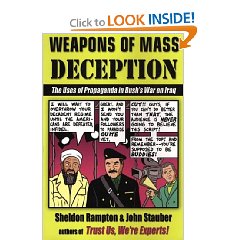
Review: Weapons of Mass Deception–The Uses of Propaganda in Bush’s War on Iraq

Uncategorized
0Shares
Amazon Page

5.0 out of 5 stars Book Cover Cartoon Undermines Really Solid Contents

August 30, 2003

Sheldon Rampton and John Stauber

Do not be deceived by the cover of this book, whose cartoon may suggest that this is light reading or comic level stuff. It is not. This book is a professionally-prepared, well-documented catalog of the “platform of lies” that the incumbent (2000-2004) US Administration has pressed upon the public in the course of executing six wars (two public) and two occupations, both of which are going *very* badly, at great expense.

I have to give very high marks to the authors and their employer, the Center for Media & Democracy, for this book represents a “must read” for every voter.

Among the highlights (please note that all references to the US government actually refer to the political administration, which is abusing the good faith and loyalty of the millions of loyal Armed Services members as well as the civil service):

1) Documentation of US government manipulation of images coming out of Iraq

2) Documentation of how US government emphasis on manipulating the truth for the US public has actually left it unable to listen and hear and understand the truth as spoken by the Iraqi and Afghan people.

3) Documentation of the clear and present need to restore the US Information Agency (USIA) as an independent organization with a considerably expanded budget–in the age of information America is losing the mindwar, the culture war, because it is overspending on a heavy metal military and underspending on information power–what Joe Nye calls “soft power.”

4) Documentation of what the author's call America's “astonishing historical amnesia,” assuming they can go into the Middle East without reference to the history of British and US imperialism, including the deposition of the legitimate rulers of Iran and the continuing acceptance of Israeli disrespect for UN resolutions.

5) Documentation of why Charlotte Beers failed America, in two parts:

a) She did not know how to, was incapable of listening to, Arab voices. According to the New York Times, cited by the book, those who spoke to her “came away shaking their heads, saying American officials do not appreciate [their circumstances and views].

b) The product she was selling, the US “brand”, is simply too defective, too unilateralist, too arrogant, too brutal, too harmful to multi-cultural and multi-national interests, to survive in the marketplace of the real world. This is “unsafe at any speed” writ very large, very global, very angry.

6) Documentation of the blatant (and expensive) manner in which the US government manipulated the message to the US public (if CIA had done this they would have been in violation of the law–when Hill & Knowlton does it is called “public relations” even though everything is a complete fabrication and a betrayal of the public trust). The authors excel at one point in contrasting how Washington listens to a handful of talking heads on the Middle East, while ignoring “the 1,400 full time faculty members who specialize in Middle East studies at American Universities.”

7) Documentation of US government plans, under the abusive grip on power of the neo-conservatives, to carry out future “over-whelming, non-surgical, nonproportional military force” actions against the governments of Iran, Libya, Syria, and Sudan, as recommended by Richard Perle and his colleagues.

8) Documentation, over the course of the book, of both specific lies told to the US public and the world by the US government, and of the vast underlying insinuations, not quite the truth, misleading, and generally deceptive statements of all the senior political appointees, and especially Dick Cheney. The authors essentially compare George Bush and his team to Orwellian vision of governments controlling the people through doublespeak, and they label this US government as being intellectual dishonest, through and through.

9) Documentation (continuing from 8) of how this government's manipulation of the truth can be compared with Hitler's. They quote Goering to make this point: “but, voice or no voice, the people can always be brought to the bidding of the leaders. That is easy. All you have to do is tell them they are being attacked and denounce the pacifists for lack of patriotism and exposing the country to danger. It works the same way in every country.” Sound familiar? Remember Bush (and Clinton) saying that dissent is treason? People, we have a problem here.

There are many other important points documented in this non-fiction work–it is NOT humorous nor should the cover suggest it is told in comic fashion–but I will end with the ultimate point of it all: the author's document, on the pages leading up to page 195, that the US public is hearing and seeing and reading perhaps one tenth (1/10th) of the truth as it is available to European, Asian, Middle Eastern, and other audiences where the media is not under political and corporate control to the extent that exists in the USA. At the end of this book, I was reaffirmed in my view that real patriotism, real national unity, comes from tough love and the full truth, nothing but the truth. Against that criteria, and as documented by the authors of this book, George Bush Junior, Dick Cheney, Karl Rove, and all of their politically-appointed minions are liars who have betrayed the public trust and deserve to be impeached before or after they are thrown out of office in 2004. This is a non-fiction work of vital importance to the future of the Republic.

Other Relevant Books (See also my list on impeachment):
Vice: Dick Cheney and the Hijacking of the American Presidency
Running on Empty: How the Democratic and Republican Parties Are Bankrupting Our Future and What Americans Can Do About It
The Global Class War: How America's Bipartisan Elite Lost Our Future – and What It Will Take to Win It Back
American Fascists: The Christian Right and the War On America
The Fifty-Year Wound: How America's Cold War Victory Has Shaped Our World
The Sorrows of Empire: Militarism, Secrecy, and the End of the Republic (The American Empire Project)
Crossing the Rubicon: The Decline of the American Empire at the End of the Age of Oil
9/11 Synthetic Terror: Made in USA, Fourth Edition
The Cheating Culture: Why More Americans Are Doing Wrong to Get Ahead

Vote on Review

Review: Lies (And the Lying Liars Who Tell Them)–A Fair and Balanced Look at the Right

4 Star, Politics
0Shares

Amazon Page
Amazon Page

4.0 out of 5 stars LOTS of white space, good detail, funny and sad,

August 30, 2003
Al Franken
One star is taken off because this book has way too much white space–125 pages of text stretched to 372.It is a good thing to see this book ranking at this time as #1 in Amazon sales. America *needs* to read this book because the Republic has lost its soul–only by reading about reality and then voting accordingly, can this Republic be saved.

I recommend the book be read together with “Weapons of Mass Deception: The Uses of Propaganda in Bush's War on Iraq”, and the much older but seminal work by Edward Herman and Noam Chomsky, “Manufacturing Consent: The Polical Economy of the Mass Media.” The bottom line is clear: there is a constellation of power in America that integrates the incumbents of the White House right now, the mass media, and the major corporate interests–oil, electrical and water utilities, finance, fast food and military systems–that is both corrupt and using blatant lies to get their way with the public.

As I have personal experience with a certain class of people whose worldview is shaped by the Pat Robertson 700 Club, intense readings of the Bible in isolation from global realities, and a deep, deep feeling that America is perfect and anyone who does not agree is a traitorous moron, I really have to commend Franken for the humorous but well documented manner in which he skewers both the “front fluff” (Ann Coulter, Bernie Goldberg, Bill O'Reilly, Paul Gigot, and the entire Fox “News” Team) and the “backroom mean” (George Bush Junior, Mama Bush–aka in the book from several sources, “Queen Bitch”–and the really really dangerous and unethical Dick Cheney, Karl Rove, Richard Perle, and Paul Wolfowitz) as well as the lesser evils–Rumsfeld chief among them).

The author's use of transcripts for “hard fact” documentation is superb, as are the endnotes. Indeed, the truths that he uses as his raw working material are so powerful that I found some of his satirical untruths or exaggerations to be off-putting–either they should be clearly marked (even put in little boxes so the publishers can add another 25 pages and charge even more for the paperback version) or even eliminated. Put bluntly, this book has so much important stuff to communicate, that the satiracal untruths detract from the value of the endeavor.

The book should have an index. I wanted to look up all references to Dick Cheney and could not.

Special for Fox “News” devotees: If you read just one book *other* than the Bible, this is the one for you. It just might shake you out of your death grip on a cocaine-based, crime-based presidency, and allow you to consider the possibility that all Americans–including those in la-la-land–need to wake up to the difference between manufactured lies and real-world truths that will determine the future of our children and our grand-children. God is *not* amused by the present state of affairs. He just told me so, himself, right after telling Dubya his time is up.

Vote on Review
Vote on Review

Review: Manufacturing Consent–The Political Economy of the Mass Media

6 Star Top 10%, America (Founders, Current Situation), Capitalism (Good & Bad), Censorship & Denial of Access, Communications, Culture, Research, Democracy, Economics, Information Society, Misinformation & Propaganda
0Shares

Amazon Page
Amazon Page

5.0 out of 5 stars 25 Years Ahead of the Crowd–Vital Reading Today,

August 22, 2003
Edward S. Herman
Edit of 22 Dec 07 to add links.

It is quite significant, in my view, that today as I write this Al Franken, Lies and the Lying Liars Who Tell Them: A Fair and Balanced Look at the Right is #2 at Amazon, and Sheldon Rapton and John Stauber, Weapons of Mass Deception: The Uses of Propaganda in Bush's War on Iraqis #114 at Amazon. Not only are the people awakening to the truth, which is that they have been had through a combination of inattention and manipulation, but these two books and several others in this genre are validating what Chomsky was telling us all in the past 25 years.

The ability to set the agenda and determine what is talked about and how it is talked about is at the root of hidden power in the pseudo-democratic society. Chomsky was decades ahead of his time in studying both the power of language and the power of controlling the media message. Today, as we recall that so-called mainstream news media *refused* fully-funded anti-war advertisements that challenged the White House lies (62 of which have been documented with full sourcing in various blogs, notably Stephen Perry's Bush at War blog), we must come to grips with the fact that America is at risk.

Thomas Jefferson said “A Nation's best defense is an educated citizenry” and Supreme Court Justice Branstein said “The greatest threat to liberty is an inert public.” Today we lack the first and have the second, but as Amazon rankings show, the people, they are awakening. It is through reading, and following the links, and informed discussion, that the people can come together, using new tools for peer-to-peer information sharing and MeetUp's, and take back the power.

Chomsky had it right. It took 25 years for all of us to realize he had it right. I rise in praise of this great man.

Other links that validate his ethics and intellect:
Vice: Dick Cheney and the Hijacking of the American Presidency
Running on Empty: How the Democratic and Republican Parties Are Bankrupting Our Future and What Americans Can Do About It
The Battle for the Soul of Capitalism: How the Financial System Underminded Social Ideals, Damaged Trust in the Markets, Robbed Investors of Trillions – and What to Do About It
Independents Day: Awakening the American Spirit
Day of Reckoning: How Hubris, Ideology, and Greed Are Tearing America Apart
Al On America

Vote on Review
Vote on Review