I had real reservations about this DVD based on the write-up, but Meg Ryan carried it over as I was picking out three DVDs to keep me company on an editing marathon.
BE PATIENT with the beginning. Despite Meg Ryan (doing very well playing a stressed out robot lawyer), I almost lost patience and moved on.
On balance the movie is fun, provokes thought, and it has an absolutely killer ending that makes the whole thing totally worth watching from beginning to end, and leaves me chuckling with appreciation for Meg Ryan the actress and Meg Ryan the character as played in the film.
As a former spy who has spent the last 21 years in commercial intelligence, i expected much more from this film with its great actors but I was very disappointed. Had it not been in front of me on background as I edit my new book I would have turned it off completely on more than one occasion.
The ending is sort of clever and I will not spoil it, but there are no clues at the beginning so the movie more or less ends with “fooled you, didn't I, but your going to have to take my word for it.” And about that pink elephant that I am keeping away from your front lawn….
Over-all, this is a cluttered mess.
There are still no really great commercial intelligence films, nor should they be, because those who spend heavily on commercial espionage lack both ethics and brains. 95% of what you need to be a successful ethical commercial intelligence practioner is openly available and your customers should be providing you with the rest, i.e. what they want that no one else has thought to give them.
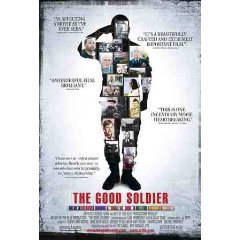
I found this movie very compelling and am putting it into circulation as a shared good. It is built around four specific veterans (one each from WWII, Viet-Nam, and Gulf I) and does a superb job of weaving direct interviews, past photos of the three protagonists, and archival film clips.
The Marine from Gulf I is especially compelling as he tells of his deliberate refusal to accept a Conscientious Objective discharge after killing over 30 people in Iraq, and ultimately, with the aid of a high-powered lawyer, prevails in getting an Honorable Discharge.
The same Marine–and the others–discuss how one must train normal people to kill, and there is no thought of how to untrain them (war dogs get reintegration training, humans do not).
The clear message, in these words: We are One, and War is no way to settle disagreements. That is of course both correct and naive–it discounts the fact that Empire is about money for a few, and the troops are merely cannon fodder. That's the first thing we have to change–take the money out of war and into peace.
Speak the Truth, Lose the Anger, Be Part of the Whole
February 10, 2010
Jack Hawley
It took me fifty years to recognize the deficiencies of the command and control or top down elite-dominated model of governance, and to discover the spiritual and practical integrity of collective intelligence, openness, appreciative inquirty, deliberative public dilaog, and so on. It's taken another seven years to discover detachment from outcome, and that in turn set the stage for what I find to be the absolute essence of this book: speaking truth to power is half the battle, losing the anger is the other half. Harder to do than it sounds, this Westernized version of the Bhagavad Gita does help.
Here are the two paragraphs I pulled from page 129 and then 147 for intelligence (decision-support) professionals:
“Those who transcend the gunas are in essence watchers, beyond the worldly. Although constantly aware of the inevitable cycle of birth, disease, senility, grief, and so forth, they dwell above it all, and merely witness it.
My personal take on the above is that sacred dispassion is a prerequisite for both spirtual vision and professional integrity.
“Always tell the truth, Arjuna, and present it in as pleasant a way as possible. If you cannot do that, remain silent. If something absolutely needs to be said, you must uphold the truth, but find a way to do it that is gentle and obliging.”
I was watching David Walker as he served nine of his fifteen years at Comptroller General, with light-weight whimpers to Congress until he finally got Peter Peterson to bail him out of government and give him a chunk of cash for making movies and writing a book and creating a web site that very few serious under 40 pioneers pay attention to.
I was thrilled to see him tell Congress in 2007 that the US was bankrupt–both Senator McCain and Senator Obama could have cared less–and so he walked quietly back to his holding cell at the General Accountability Office (GAO). His “loyalty” to impeachable masters is just as troubling to me as the loyalty of our military leaders during the neo-con rampage.
This book loses one star for the publishers arrogance and ineptitude in failing to use all of the tools Amazon provides, so that readers like myself who read a great deal and do not buy books on whim, can actually look at the table of contents. If you want a sense what the author has to say, see the Wikipedia page on the US Federal Budget where the author's fingerprints are elegantly visible.
If and when the publisher acts more responsibly and provides Look Inside the Book information as well standard entries via Amazon Advantage (about the book, about the author, editorial reviews), I will buy the book, read it, and review it.
The book loses a second star for being wildly praised by all the unethical losers that got us into this mess in the first place by sacrificing their ethics and selling the two party system out to Wall Street. Bill Bradley in particular is a major disappointment, he slunk off to Allen and Company where George “Slam Dunk” Tenet is also in hiding, and they have profited handsomely for betraying the public trust for over a decade. Edumund Burke said “The only thing necessary for the triumph of evil is for good men to do nothing.” Even better is the following from Chief Justice Louis Brandeis:
The details of how to implement a tribal strategy and work with the Afghan tribes are unique to that country, but the overall strategy of working with tribes is not new at all.
Where has it been done? Maj. Gant mentions what Army Special Forces did with the mountain tribes of Vietnam (known by the French term “montagnards”). Another even more appropriate example is what the CIA’s Bill Lair did with the Hmong of northern Laos and what other CIA officers did with the Ta’oi and other Lao Theung tribes of southern Laos.
There were no American fighting units in Laos at all. The only American military assigned to Laos were the handful of U.S. Air Force forward air controllers, known as Ravens, but they coordinated a very powerful force multiplier, the close air support of Air Force, Navy and Marine Corps aircraft assigned to work for Military Assistance Command, Vietnam (MACV). The tribal strategy in northern Laos was a very few CIA officers working with entirely Lao tribal surrogates. These tribal surrogates fought on our side and helped implement the strategy of keeping the North Vietnamese Army (NVA) occupied in Laos and away from South Vietnam. They also defended the ancient invasion corridor leading from Hanoi to the Lao capital and on into Thailand.
The paperback is cheaper and recommended over the hardcover, but for decidiing to buy purposes, visit the hardcover to use Inside the Book to examine the Table of Contents and other sample views. For some reason Amazon does not transfer Inside the Book the way they do reviews between hard and soft cover issues of the same content.Measuring Globalisation: Gauging Its Consequences
The web site is really rich in resources and free, recommend a look there as well.
Good news: over time, social globalization (e.g. the spread of the Interent and information access) has increased.
Bad news: it is no longer keeping pace with financial globalization (probably because finance is phantom wealth, as in derivatives) and it is leveling off. What most do not realize is that Human Capital is the only inexhausitble resource we have, and scoial globalization is how we leverage all human minds all the time.
Capitalism today, completely apart from the predatory immoral aspects and the outright fraud of Wall Street and especially Goldman Sachs, Citi-Bank, and Morgan, is focused on the one billion rich whose total economy is one trillion a year. As C. K. Prahalad has so brilliantly pointed out in The Fortune at the Bottom of the Pyramid, the five billion poor have an annual gross income of four trillion dollars a year, and capitalism is ignoring them.
For 1500 other reviews sorted into 98 non-fiction categories, visit Phi Beta Iota the Public Intelligence Blog. All book reviews lead back to their respective Amazon page, they are simply easier to browse in a coherent fashion there (Amazon has refused for years to implement this and many other suggestions).