David Swanson: Voice for Activism

Civil Society, Cultural Intelligence
0Shares
David Swanson

David Swanson: A Voice For Never-Ending Activism

For activist, author, and blogger David Swanson, it really is about the never-ending struggle for social and economic justice; the same battle that has been fought since time began.  And for him, “success” or “defeat” cannot be defined by one election or one Supreme Court ruling.  For Swanson, “victory” may be generations away, but that does not deter him from keeping the activism fires burning via every avenue he can find.

“I don’t necessarily tell people not to lose hope,” Swanson said in a recent interview with Wisdom Voices.  “I think there’s a problem with having a dependency on hope. I don’t go through these cycles of being hopeful and then being despondent. I actually enjoy activism. I don’t think activism is something temporary that we do it once and then everything will be fixed and then we stop.  I think it’s permanent and it should be permanent.  Activism is more enjoyable than sitting home and griping.  It provides me a way to enjoy living every day.”

. . . . . . . . .

Activism has been rooted in almost all of Swanson’s adult life.  He holds a master’s degree in philosophy from the University of Virginia. He has worked as a newspaper reporter and as a communications director, with jobs including press secretary for Dennis Kucinich’s 2004 presidential campaign, media coordinator for the International Labor Communications Association, and three years as communications coordinator for ACORN.  John Nichols of The Nation magazine once said:  “David Swanson will be remembered and well recognized as the citizen who held up a lamp in the darkness and cried, as did good Tom Paine: ‘We have it in our power to begin the world over again.’ ”

“The most important work I think is educational,” Swanson said.  “By that I mean activism has to take a kind of broad term organizational effort.  It’s not in passing a particular bill or electing a particular person.  Setbacks shouldn’t get us down.  If all of our hopes lie in (President) Obama turning out to be better than he claimed to be or all of our hopes are in un-electing (Wisconsin Governor Scott) Walker, we’re setting ourselves up for defeat because we can lose a particular battle and because elections can be the wrong place to be putting our emphasis to begin with. I think we should be putting about 95 percent of our efforts into educating and organizing and mobilizing non-violent struggle and maybe 5 percent into elections.


Read full article.

John Steiner: Joseph Stiglitz on 1% Problem and 1% Solution

03 Economy
0Shares
John Steiner

The 1 Percent's Problem

Why won’t America’s 1 percent—such as the six Walmart heirs, whose wealth equals that of the entire bottom 30 percent—be a bit more . . . selfish? As the widening financial divide cripples the U.S. economy, even those at the top will pay a steep price.

By Joseph E. Stiglitz,

Vanity Fair 02 June 12

Adapted from The Price of Inequality, by Joseph Stiglitz, to be published in June by W.W. Norton & Company, Inc. (U.S.), and in July by Allen Lane (U.K.); © 2012 by the author.

Let’s start by laying down the baseline premise: inequality in America has been widening for dec­ades. We’re all aware of the fact. Yes, there are some on the right who deny this reality, but serious analysts across the political spectrum take it for granted. I won’t run through all the evidence here, except to say that the gap between the 1 percent and the 99 percent is vast when looked at in terms of annual income, and even vaster when looked at in terms of wealth―that is, in terms of accumulated capital and other assets.

Consider the Walton family: the six heirs to the Walmart empire possess a combined wealth of some $90 billion, which is equivalent to the wealth of the entire bottom 30 percent of U.S. society. (Many at the bottom have zero or negative net worth, especially after the housing debacle.)

Warren Buffett put the matter correctly when he said, “There’s been class warfare going on for the last 20 years and my class has won.”

Continue reading “John Steiner: Joseph Stiglitz on 1% Problem and 1% Solution”

Mini-Me: Slavery By A Different Name – The Convict Lease System

07 Other Atrocities, 09 Justice, 11 Society, Corruption, Government, Law Enforcement
0Shares
Who? Mini-Me?

Slavery By A Different Name: The Convict Lease System

by Devon DB

GlobalResearch, 1 June 2012

After the Civil War, the 13th, 14th, and 15th Constitutional amendments were passed which aided newly freed slaves in being equally treated under the law, or so the story goes. The fact of the matter is that slavery was- and still is- completely legal in the United States and not only that, but it took on a much different form. The institution of slavery changed as instead of having the direct enslavement of blacks with an entire apparatus that had to be created to keep slaves in their condition, elements of the state apparatus were used to enslave blacks, namely the legal and prison systems. Yet, the enslavement itself was changed as black convicts were no longer slaves to individual masters, but rather they were enslaved to the companies which they were leased out to. To create this system there not only had to be the involvement of the Southern judicial system and individual Northern and Southern elites, but also the involvement of the corporation and reinstitution of slavery within a corporate context.


The 13th Amendment

To attain a full understanding of the convict lease system, there must first be a reexamination of the 13th amendment. It has been stated in history books and in classrooms across America that this amendment ended slavery, yet this is quite false. The 13th Amendment states “neither slavery nor involuntary servitude, except as a punishment for crime whereof the party shall have been duly convicted, shall exist within the United States, or any place subject to their jurisdiction.” [1] (emphasis added) Thus, slavery is completely and totally legal if it is part (or the whole) of a punishment for someone who was convicted of a crime.

Continue reading “Mini-Me: Slavery By A Different Name – The Convict Lease System”

Mini-Me: JFK Assassination Cover-Up Unravels Further + RECAP

07 Other Atrocities, Communities of Practice, Corruption
0Shares
Who? Mini-Me?

Huh?

Photographic Evidence of Bullet Hole in JFK Limousine Windshield ‘Hiding in Plain Sight'

by Douglas P. Horne

LouRockwell.com, June 4, 2012

In 2009, I believed I had discovered new evidence in the JFK assassination never reported by anyone else: convincing photography of the through-and-through bullet hole in the windshield of the JFK limousine that had been reported by six credible witnesses. I revisited that evidence today, and am more convinced than ever that the bullet hole in the limousine windshield is what I am looking at in those images. But the readers of this piece don't have to take my word for it – you can examine the images yourself, and make up your own minds. The evidence is contained in one of the banned, suppressed episodes of Nigel Turner's The Men Who Killed Kennedy – episode 7 in the series, called “The Smoking Guns,” which was aired in 2003, and then removed from circulation by The History Channel in response to intense political pressure by former LBJ aides Jack Valenti and Bill Moyers.

I'll tell you about the stunning evidence I have found in that episode at the end of this article, but first we need to set the stage by reviewing the eyewitness testimony about the damage to the windshield observed the day of JFK's assassination, on Friday, November 22nd, 1963; as well as three days later, on Monday, November 25th, 1963.

Introduction

Before I reveal the details about the “new” photographic evidence I am talking about here, let's review the Big Picture, the “evidentiary landscape” on this issue (see pages 1439-1450 of Volume V of my book, Inside the Assassination Records Review Board, for full details):

Continue reading “Mini-Me: JFK Assassination Cover-Up Unravels Further + RECAP”

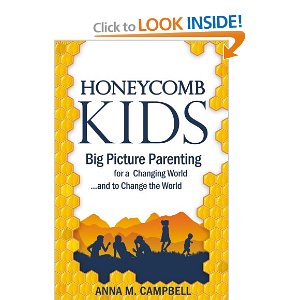
Review: Honeycomb Kids – Big Picture Parenting

5 Star, America (Founders, Current Situation), Atlases & State of the World, Complexity & Resilience, Consciousness & Social IQ, Culture, Research, Education (General), Intelligence (Public), Nature, Diet, Memetics, Design, Peace, Poverty, & Middle Class, Philosophy, Priorities, Public Administration, Strategy, Survival & Sustainment, True Cost & Toxicity, Truth & Reconciliation, Values, Ethics, Sustainable Evolution, Voices Lost (Indigenous, Gender, Poor, Marginalized), Water, Energy, Oil, Scarcity
0Shares
Amazon Page

Anna M. Campbell

5.0 out of 5 stars Intelligent, Endearing, Inspiring, Useful, Rooted in Reality, June 3, 2012

The author asked me if I would review this book, and sent me a PDF version. I've just gone through it and it earns a solid five. If you have any doubts, use Amazon's great Look Inside the Book feature, and read the specifics in the Table of Contents.

It was the table of contents that first impressed me. I've been an intelligence professional most of my life, and in the process of getting to 60 years of age, have developed four strategic analytic models that remains best in class today. I also read a lot — across 98 non-fiction categories, with the last 1,800+ books reviewed here at Amazon (and accessible by category at Phi Beta Iota the Public Intelligence Blog).

I say all of that by way of saying that the author's selection and articulation of the core issues facing humanity — immediately followed by the author's even more inspired outlining of key values, key behaviors, key perspectives — all with citations interspersed and talking points for parents or mentors or teachers and children — impressed me enormously.

Over 30 books are offered as recommended reading, all of them relevant, one in particular catching my eye: The Sacred Balance: Rediscovering Our Place in Nature.

Continue reading “Review: Honeycomb Kids – Big Picture Parenting”

Mini-Me: Obama Moves To Crush Poland After Global Genetic Disaster Revealed

01 Agriculture, 03 Economy, 06 Family, 07 Health, 07 Other Atrocities, 11 Society, Civil Society, Collective Intelligence, Commerce, Corruption, Earth Intelligence, Government, Key Players
0Shares

Huh?

Obama Moves To Crush Poland After Global Genetic Disaster Revealed

By: Sorcha Faal

A Ministry of Foreign Affairs report circulating in the Kremlin today states that United States President Obama has undertaken a campaign to “crush” the nation of Poland after its government this past week officially banned the planting of Monsanto’s MON810, a genetically-modified (GM) variety of maize (corn) that produces its own built-in Bt insecticide in every kernel and is held to be responsible for the global collapse of bee populations and the catastrophic killing of all bat species in North America.

To understand Obama’s anger against Poland and his ties to the most dangerous food ever known to man we can read as reported by Ronnie Cummins, Founder and Director of the Organic Consumers Association:

President Obama knows that agribusiness cannot be trusted with the policy and regulatory powers of government. On the campaign trail in 2007, he promised:

“We'll tell ConAgra that it's not the Department of Agribusiness. It's the Department of Agriculture. We're going to put the people's interests ahead of the special interests.”

But, starting with his choice for USDA Secretary, the pro-biotech former governor of Iowa, Tom Vilsack (who in a stunning reversal greenlighted Monsanto’s genetically modified alfalfa without testing), Obama has let Monsanto, DuPont and the other pesticide and genetic engineering companies know they'll have plenty of friends and supporters within his administration.

President Obama has taken his team of food and farming leaders directly from the biotech companies and their lobbying, research, and philanthropic arms.

Continue reading “Mini-Me: Obama Moves To Crush Poland After Global Genetic Disaster Revealed”