Reference: WikiLeaks Interview in Forbes–Promoting Business Ethics

03 Economy, 07 Other Atrocities, 11 Society, About the Idea, Commerce, Commercial Intelligence, Corporations, Cultural Intelligence, Ethics, Historic Contributions, InfoOps (IO), Journalism/Free-Press/Censorship, Money, Banks & Concentrated Wealth, Officers Call, Power Behind-the-Scenes/Special Interests, Privacy, Reform
Andy Greenberg

Nov. 29 2010

Fascinating article, including leaks in the pipeline (banks), whistleblowers, censorship, his story, trying to stop leaks, spying, untrustful competitors, secrecy, war, field of intelligence, etc.  … “our primary defense isn’t law, but technology…courage is contagious” (p.8) —  JAS

Forbes Cover Story . . . Forbes Transcript

Following is an excerpt from page 5 regarding moving in the direction of ethical business — JAS
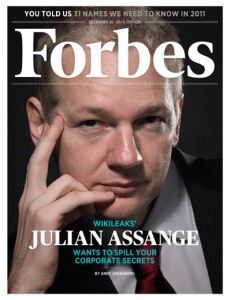
Forbes Cover Story

What do you think WikiLeaks mean for business? How do businesses need to adjust to a world where WikiLeaks exists?

WikiLeaks means it’s easier to run a good business and harder to run a bad business, and all CEOs should be encouraged by this. I think about the case in China where milk powder companies started cutting the protein in milk powder with plastics. That happened at a number of separate manufacturers.

Let’s say you want to run a good company. It’s nice to have an ethical workplace. Your employees are much less likely to screw you over if they’re not screwing other people over.

Then one company starts cutting their milk powder with melamine, and becomes more profitable. You can follow suit, or slowly go bankrupt and the one that’s cutting its milk powder will take you over. That’s the worst of all possible outcomes.

The other possibility is that the first one to cut its milk powder is exposed. Then you don’t have to cut your milk powder. There’s a threat of regulation that produces self-regulation.

It just means that it’s easier for honest CEOs to run an honest business, if the dishonest businesses are more effected negatively by leaks than honest businesses. That’s the whole idea. In the struggle between open and honest companies and dishonest and closed companies, we’re creating a tremendous reputational tax on the unethical companies.

No one wants to have their own things leaked. It pains us when we have internal leaks. But across any given industry, it is both good for the whole industry to have those leaks and it’s especially good for the good players.

But aside from the market as a whole, how should companies change their behavior understanding that leaks will increase?

Do things to encourage leaks from dishonest competitors. Be as open and honest as possible. Treat your employees well.

I think it’s extremely positive. You end up with a situation where honest companies producing quality products are more competitive than dishonest companies producing bad products. And companies that treat their employees well do better than those that treat them badly.

Would you call yourself a free market proponent?

Absolutely. I have mixed attitudes towards capitalism, but I love markets. Having lived and worked in many countries, I can see the tremendous vibrancy in, say, the Malaysian telecom sector compared to U.S. sector. In the U.S. everything is vertically integrated and sewn up, so you don’t have a free market. In Malaysia, you have a broad spectrum of players, and you can see the benefits for all as a result.

How do your leaks fit into that?

To put it simply, in order for there to be a market, there has to be information. A perfect market requires perfect information.

There’s the famous lemon example in the used car market. It’s hard for buyers to tell lemons from good cars, and sellers can’t get a good price, even when they have a good car.

By making it easier to see where the problems are inside of companies, we identify the lemons. That means there’s a better market for good companies. For a market to be free, people have to know who they’re dealing with.
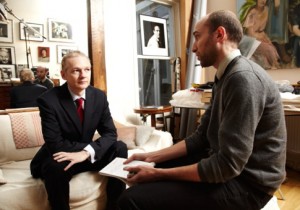
The InterviewYou’ve developed a reputation as anti-establishment and anti-institution.

Not at all. Creating a well-run establishment is a difficult thing to do, and I’ve been in countries where institutions are in a state of collapse, so I understand the difficulty of running a company. Institutions don’t come from nowhere.

It’s not correct to put me in any one philosophical or economic camp, because I’ve learned from many. But one is American libertarianism, market libertarianism. So as far as markets are concerned I’m a libertarian, but I have enough expertise in politics and history to understand that a free market ends up as monopoly unless you force them to be free.

WikiLeaks is designed to make capitalism more free and ethical.

But in the meantime, there could be a lot of pain from these scandals, obviously.

Pain for the guilty.

Do you derive pleasure from these scandals that you expose and the companies you shame?

It’s tremendously satisfying work to see reforms being engaged in and stimulating those reforms. To see opportunists and abusers brought to account.

———————————

Thanks to: Dan Drasin via John Steiner.
Reference: WikiLeaks and Al Qaeda as Open Source Insurgencies

10 Security, 11 Society, Blog Wisdom, Civil Society, Counter-Oppression/Counter-Dictatorship Practices, Cultural Intelligence, Ethics, Money, Banks & Concentrated Wealth, Officers Call, Peace Intelligence, Power Behind-the-Scenes/Special Interests, Reform, Strategy, Threats

Journal: The Security and Secrecy “Tax” – Global Guerrillas

By John Robb at Global Guerrillas (Networked tribes, systems disruption, and the emerging bazaar of violence. Resilient Communities, decentralized platforms, and self-organizing futures)

Wikileaks and Al Qaeda's Open Source Jihad are both open source insurgencies. While there are obvious differences between the two, what's more interesting is how they are similar. Namely: as open source insurgencies both groups use systems disruption (the ability…

Tip of the Hat to Mario Profaca at Facebook.

Phi Beta Iota: The deeper interpretation of the similarity of Al Qaeda and WikiLeaks is that they are both finding huge audiences for what they are offering, and they are both playing off of a massive public distaste for Open Veins of Latin America, Killing HopeRule by Secrecy, Sorrows of Empire, Web of Deceit, The Fifty Year Wound, etc.  The USA has created its enemies because of its hubris and the corruption inherent in how it has supported dictators and predatory immoral capitalism, imposing virtual colonialism and unilateral militarism, all without regard to either the rights of the indigenous parties treated as “collateral damage” or the interests of the American citizen-voter-taxpayer whose blood, treasure, and spirit have been consumed by an elite class that comprises an “Other Atrocity” on a global scale.  It troubles us that there is no one in the Administration with the intellectual breadth of mind and the intestinal fortitude to point out to President Barack Obama that he has a game-changing choice in front of him.  We (the 800 contributors, 80 active, 8 frequent) of Phi Beta Iota have always been open, honest, and loyal–these insurgencies are occurring because the US Government failed to heed the early warnings that began in the 1970's and reached a crecsendo in the 1990's.  There is still time for Barack Obama to Change the Game!

See Also:

Legitimate Grievances Part I (Domestic versus US Government)

Legitimate Grievances Part II (Global versus US Government)

Reference: No Labels “Non-Party” = “Four More Years” for Wall Street

Reference: Crash Course on Reality

Journal: Taliban Laughing–the Clowns Dance On…

Journal: Debt, Defense, and the Diem Moment in AF

Worth a Look: Book Reviews on Elite Rule

Worth a Look: Book Reviews on Empire as Cancer Including Betrayal & Deceit

Journal: WikiLeaks Next Round BANKS

03 Economy, 07 Other Atrocities, 09 Justice, 10 Transnational Crime, Commerce, Commercial Intelligence, Corporations, Corruption, IO Multinational, IO Secrets, Money, Banks & Concentrated Wealth
DefDog Recommends...

WikiLeaks plans to release thousands of internal documents from a major
U.S. bank in early 2011, Forbes magazine reported on Monday.

“You could call it the ecosystem of corruption,” Assange told Forbes
during an interview in London, but refused to provide details about the
bank.

MORE @
http://www.thehindu.com/news/international/article923432.ece?homepage=true

Phi Beta Iota: Our hope for the round after banks would be massive leakage from the Republican National Committee and the Democratic National Committee.  This “open everything” meme is way cool.  Think of it as tough love.

Facebook Question and Answer

Jonathan Kan So, do WikiLeaks make your Open Source Intelligence dream comes true?

The short answer is no–WikiLeaks is the lowest form of open source raw sewage–BUT WikiLeaks is serving an enormous purpose in demonstrating without equivocation that “rule by secrecy” is unethical, inept, and not in the public interest.  It is a catalyst for change, not change itself.  For change the game, see Tom Atlee on politics (search Tom Atlee Change the Game) and for substance see my M4IS2 Briefing to South America, at www.tinyurl.com/SteeleCHILE.  Pass it on.  The revolution has started without a single politician being involved.

Reference: The Modern Big Picture–Two Minds

Analysis, Articles & Chapters, Collective Intelligence, Collective Intelligence, Communities of Practice, Counter-Oppression/Counter-Dictatorship Practices, Earth Intelligence, Ethics, Geospatial, History, InfoOps (IO), IO Sense-Making, Key Players, Methods & Process, Officers Call, Open Government, Peace Intelligence, Policies, Politics of Science & Science of Politics, Real Time, Reform, Secrecy & Politics of Secrecy, Strategy, Technologies, Threats, Tools, Waste (materials, food, etc)

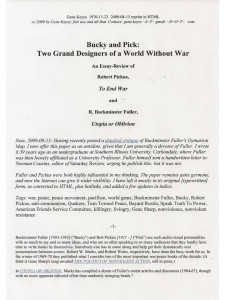
Extract from Conclusion in the Above:  I have observed the World Game as a student-participant, and wish it well. I have also observed Bob Pickus's work, as a student-participant in Turn Toward Peace, and wish him well. There are still other alternatives, but whichever road leads us faster into a world without war, what I gain most from Pickus and Fuller is their sense of the Big Picture. No one else can match their indefatigable and comprehensive efforts to see the problem whole, and to steer the world's energy into a grand design of peace.

See Also:

Who's Who in Collective Intelligence

Who's Who in Peace Intelligence

BigPictureSmallWorld

BigPicture Consulting

Design Science Lab

Global Education Lab

EarthGame

Journal: US Secret Intelligence Tasking US Diplomats

02 Diplomacy, Corruption, Cultural Intelligence, Government, InfoOps (IO), Intelligence (government), IO Secrets, Methods & Process, Officers Call
Marcus Aurelius Recommends

Insofar as I know, the DoD military Services remain under broad and explicit proscription from accessing the Wikileaks site or the Wikileaks releases in any form.  Some of the Service directives are very intimidating, threatening court martials for military members, loss of security clearances, etc., etc.  From the broadcast media, it appears that major lockdowns of information will shortly follow.  And SPC Bradley Manning, currently confined at Quantico, will probably walk as, I suspect, will Hasan at Fort Hood.  MA

Phi Beta Iota: This demonstrates that the National Clandestine Service (NCS) is completely ignorant of what can be known through open sources, and that the Secretary of State is not doing her job of assuring that diplomacy is not micro-tasked into what are clearly clandestine and covert operations support functions absolutely not appropriate to diplomatic status.  These people should not have message release authority.  The US Government needs a total make-over.  First, however, CIA needs a director that is fully capable on day one.

U.S. Expands Role of Diplomats in Spying

By MARK MAZZETTI

November 28, 2010

WASHINGTON — The United States has expanded the role of American diplomats in collecting intelligence overseas and at the United Nations, ordering State Department personnel to gather the credit card and frequent-flier numbers, work schedules and other personal information of foreign dignitaries.

Revealed in classified State Department cables, the directives, going back to 2008, appear to blur the traditional boundaries between statesmen and spies.

The cables give a laundry list of instructions for how State Department employees can fulfill the demands of a “National Humint Collection Directive” in specific countries. (“Humint” is spy-world jargon for human intelligence collection.) One cable asks officers overseas to gather information about “office and organizational titles; names, position titles and other information on business cards; numbers of telephones, cellphones, pagers and faxes,” as well as “internet and intranet ‘handles’, internet e-mail addresses, web site identification-URLs; credit card account numbers; frequent-flier account numbers; work schedules, and other relevant biographical information.”

Philip J. Crowley, a State Department spokesman, on Sunday disputed that American diplomats had assumed a new role overseas.

Read the rest of this sad story….

Worth a Look: Backpacks Full of Hope–The UN Mission in Haiti

5 Star, Disaster Relief, Humanitarian Assistance, Intelligence (Government/Secret), Intelligence (Public), Peace Intelligence, United Nations & NGOs, Worth A Look
Amazon Page

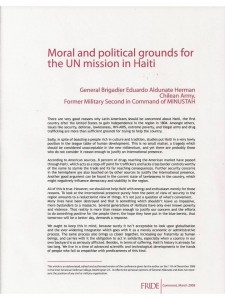
Backpacks Full of Hope: The UN Mission in Haiti describes the experience of a Chilean general as Deputy Force Commander of the United Nations Stabilization Mission in Haiti (MINUSTAH) during the particularly turbulent year September 2005 to September 2006. It details the realities of commanding more than 7,000 men from eleven countries while working to fulfill the mandate of the United Nations in Haiti—to ensure a secure and stable environment, to support the transitional government in a democratic political process, and to promote and protect the human rights of the Haitian people.

Despite the enormous challenges of a complex scenario that included local violence and extreme poverty, the UN command succeeded in its mission, stabilizing the local situation and paving the way for Haiti to hold a presidential election.

Originally published as Mision en Haiti, con la mochila cargada de esperanzas, this work provides a new audience with insight on the peace operation and sheds light on the long-term endeavour of civilians, military, and local and international agencies to support Haiti’s path to prosperity.

Co-published with the Centre for International Governance Innovation.

See Free by the Same Author:

Reference (2): United Nations Intelligence in Haiti

Reference (2): United Nations Intelligence in Haiti

05 Civil War, 07 Other Atrocities, 08 Wild Cards, 10 Security, 10 Transnational Crime, 11 Society, Analysis, Augmented Reality, Ethics, Government, Historic Contributions, InfoOps (IO), Intelligence (government), IO Multinational, IO Sense-Making, Law Enforcement, Methods & Process, Military, Officers Call, Peace Intelligence, Real Time
Peace Operations: Seeing

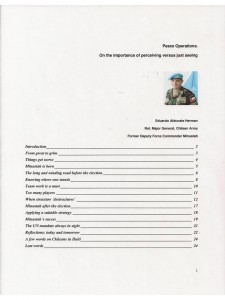
MajGen Eduardo ALDUNATE Herman, Chilean Army (Ret), served as the Deputy Force Commander of the United Nations Force in Haiti (MINUSTAH) in the earliest rounds, and was instrumental in both sponsoring the Joint Military Intelligence Analysis Center (JMAC) concept in its first modern field implementation, but also in evaluating most critically both the lack of useful intelligence from allies relying on secret sources and methods that did not “penetrate” to achieve gangs and neighborhoods; and the astonishing “one size fits all” propensity of the allies to treat every “threat” as one that could be addressed by force.

His contributions are helpful in understanding the more recent failure of allied relief operations in Haiti that again assumed that the use of armed bodies would address the problem, without making provision for real-world ground truth intelligence (CAB 21 Peace Jumpers Plus) or intelligence-driven harmonization of non-governmental assistance (Reverse TIPFID).

See Also:

Reference: Walter Dorn on UN Intelligence in Haiti

Reference: Civil Military Operations Center (CMOC)

2003 PEACEKEEPING INTELLIGENCE: Emerging Concepts for the Future

Books: Intelligence for Peace (PKI Book Two) Finalizing

Reference: Intelligence-Led Peacekeeping

Review: International Peace Observations

Search: UN intelligence peace intelligence