Journal: Human-Centered Computing (Not…)

Analysis, Augmented Reality, Civil Society, Collective Intelligence, Counter-Oppression/Counter-Dictatorship Practices, info-graphics/data-visualization, InfoOps (IO), IO Multinational, Open Government, Reform

Human-centered computing should be–but is not today–about connecting all humans with all information in near-real-time, while providing back office tools that elevate the human brain and more properly plan information and communications technologies in a support role.  See for example our Citizen-Centered Graphics and all of the OSS/EIN Books.  Where the emergent meme is off-target is in focusing on the relationship of the computer to the individual, rather than the whole.  Hacking Humanity is the new meme.

TRADITIONAL

Human-Centered Computing (Wikipedia)
Human-Centered Computing Cluster (HCC)
Human-Centered Computing in Education (Links)
Human-Centered Computing: A Multi-Media Perspective (PDF circa 2005)

WORLD-BRAIN ORIENTATION

Review: The World Is Open–How Web Technology Is Revolutionizing Education
Review: Making Learning Whole–How Seven Principles of Teaching can Transform Education
Review (Guest): Cognitive Surplus–Creativity and Generosity in a Connected Age
2010: Human Intelligence (HUMINT) Trilogy Updated
Review: Holistic Darwinism: Synergy, Cybernetics, and the Bioeconomics of Evolution
Review: Consilience–the Unity of Knowledge
Review: The Unfinished Revolution–Human-Centered Computers and What They Can Do For Us
Review: Philosophy and the Social Problem–The Annotated Edition

See Also:

Worth a Look: Book Reviews on Technology & Web 2.0 to 4.0

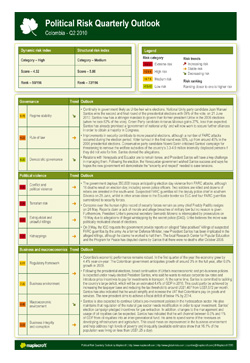
Worth a Look: New Political Risk Quarterly

Commercial Intelligence, Worth A Look
Home Page

RISK AREAS

Governance risks

  • Regime stability
  • Rule of law
  • Democratic governance

Political violence risk

  • Conflict and political violence
  • Terrorism risk
  • Extrajudicial and unlawful killings
  • Kidnappings

Business and macroeconomic risk

  • Regulatory Framework
  • Business environment
  • Macroeconomic environment
  • Business integrity and corruption

Phi Beta Iota: All well and good, but nothing here about whether the government has a holistic strategy, adequate decision support, Whole of Government planning and programming, and so on.  This is a good start that could be made vastly better by embracing the larger contruct of political-legal, socio-economic, ideo-cultural, techno-demographic, and natural-geographic.

NIGHTWATCH Extract: Colombian Constitution vs. US

Analysis, Corruption, Cultural Intelligence, Multinational Plus, Threats, Tribes

Colombia: The Constitutional Court yesterday declared an agreement granting US military access to Colombian bases unconstitutional on procedural grounds. La Patilla reported the vote was 6-3 against the agreement, and Semana reported the court would soon give a press conference to explain the details. The constitutional court ruled the 2009 accord should be redrafted as an international treaty and sent to Colombia's Congress for approval.

The agreement would have allowed US forces to have access to seven Colombian bases that help support operations against drug trafficking and terrorism. This is the draft legislation that other Latin American leaders criticized lat year because it abetted a rise in US regional influence.

The deal agreed by former President Alvaro Uribe in October 2009 gave the US access to the bases for 10 years and would see a maximum of 800 US military personnel and 600 civilian defense contractors based in Colombia.

The court's chief justice Mauricio Gonzalez said the deal was “an arrangement which requires the State to take on new obligations as well as an extension of previous ones.” He said that as such, it should be “handled as an international treaty, that is, subject to congressional approval”. The court did not rule on the legitimacy of the agreement itself and the ruling does not mean the US has to leave the country altogether.

NIGHTWATCH Comment: President Juan Manuel Santos said the court ruling will have little impact on U.S. military help fighting rebels and will not affect the operations of U.S. troops and contractors working with Colombia's military, The Associated Press reported 18 August.  The ruling is primarily procedural not substantive. Nonetheless, it will be an inconvenience.

NIGHTWATCH KGS Home
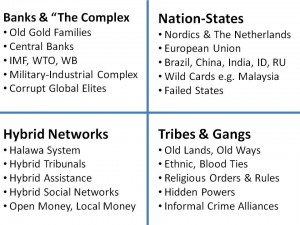
Phi Beta Iota: Here is a rough graphic showing the four spheres of influence that are fighting World War III.  Nations are flexing their Constitutional muscles against US and external incursions, while at the same time, hybrid organizations and “hidden powers” are fighting in the shadows.  Most Nation-States are no longer central because they have lost its legitimacy from a mix of internal corruption and external misadventure.

It is neither possible nor desireable to “fight” the established powers–Non-Zero Strategy requires a focus on the five billion and the creation of infinite wealth with social capitalism and Information Communication Technologies (ICT) as well as energy, food, and other innovations.  Non-violent innovation is the only viable winning strategy.

See Also:

Graphic: Four Threat Classes

Search: world map with 8 conflicts

Search: Africa Graphic and Four Threat Classes

Search: five front war the better way to fight

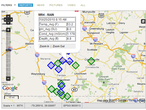
Worth a Look: CrowdMap (Beta)

Advanced Cyber/IO, Analysis, Augmented Reality, Citizen-Centered, Collective Intelligence, Collective Intelligence, Counter-Oppression/Counter-Dictatorship Practices, Earth Intelligence, Geospatial, Historic Contributions, info-graphics/data-visualization, InfoOps (IO), Intelligence (government), International Aid, IO Mapping, Journalism/Free-Press/Censorship, Maps, Methods & Process, microfinancing, Mobile, Officers Call, Open Government, Policy, Reform, Research resources, Technologies, Tools, Worth A Look

Crowdmap (Liquida)

Crowdmap allows you to…

+ Collect information from cell phones, news and the web.
+ Aggregate that information into a single platform.
+ Visualize it on a map and timeline.

Crowdmap is designed and built by the people behind Ushahidi, a platform that was originally built to crowdsource crisis information. As the platform has evolved, so have its uses. Crowdmap allows you to set up your own deployment of Ushahidi without having to install it on your own web server.

See Also:

Graphics: Twitter as an Intelligence Tool

Reference: How to Use Twitter to Build Intelligence

Journal: Tech ‘has changed foreign policy’

Continue reading “Worth a Look: CrowdMap (Beta)”

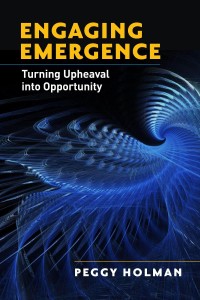
Worth a Look: Engaging Emergence

5 Star, Best Practices in Management, Collaboration Zones, Communities of Practice, Consciousness & Social IQ, Ethics, Key Players, Methods & Process, Policies, Strategy, Threats, Worth A Look

Amazon Page

Phi Beta Iota: Previously recommended in Worth a Look: New Book Engaging Emergence, we reiterate our regard for Peggy Holman, arguably one of a handful of leaders shaping our collective intelligence capacity today–Tom Atlee, Barbara Marx Hubbard, Harrison Owen, Thom Hartman, Jim Rough, Robert Fuller, Mark Tovey, are others, all helping shape community Open Space Open Source Collaborative Information-Sharing and Sense-Making.

See Also:

Review: The Handbook of Large Group Methods–Creating Systemic Change in Organizations and Communities

Review: The Change Handbook–The Definitive Resource on Today’s Best Methods for Engaging Whole Systems

From the Author

At long last, it is available.  I am delighted to say that Engaging Emergence: Turning Upheaval into Opportunity is now for sale from Amazon, Berrett-Koehler, Barnes and Noble, or through local bookstores.

I have a confession. I have an ambitious goal for the book: to meet today's needs in the way The Fifth Discipline did 20 years ago.  And you can help make that happen.

Continue reading “Worth a Look: Engaging Emergence”

Journal: Social Security Being Set Up for a Fall

03 Economy, 09 Justice, 11 Society, Civil Society, Cultural Intelligence, Government
Chuck Spinney Recommends

My good friend Marshall Auerbach has one answer — can you “refudiate” it?

Which Party Poses the Real Risk to Social Security’s Future?

NewDeal2.0.org, Monday, 08/16/2010 – 5:02 pm by Marshall Auerback

Hint: it’s not Republicans.

Social Security remains one of the greatest achievements of the Democratic Party since its creation 75 years ago. Although Republicans have historically fulminated against the program (Ronald Reagan once likened it as something akin to “socialism”), they have actually made little headway in touching this sacred “third rail” in American politics. President Bush pushed for partial privatization of the program in 2005, but the proposal gained no policy traction (even within his own party) because Social Security continues to be hugely popular with American voters. It’s a universal program that benefits all Americans, not a government handout to a few privileged corporations.

Which is why it’s odd that Democrats seem almost embarrassed to continue to champion the legacy of FDR. The party frets about long-term deficits and the corresponding need to “save” Social Security from imminent bankruptcy and, in doing so, opens the gate to radical cuts in entitlements that will do nothing but further destroy incomes and perpetuate our current economic malaise.

FULL STORY ONLINE

Continue reading “Journal: Social Security Being Set Up for a Fall”

Worth a Look: Clay Shirky on Cognitive Surplus & Crisis Mapping

Augmented Reality, Collaboration Zones, Collective Intelligence, Communities of Practice, Counter-Oppression/Counter-Dictatorship Practices, info-graphics/data-visualization, InfoOps (IO), International Aid, IO Sense-Making, Journalism/Free-Press/Censorship, Maps, Methods & Process, Policies, Tools, Worth A Look

About this talk

Clay Shirky looks at “cognitive surplus” — the shared, online work we do with our spare brain cycles. While we're busy editing Wikipedia, posting to Ushahidi (and yes, making LOLcats), we're building a better, more cooperative world.  TED Video of Talk.

About Clay Sharpey

Clay Shirky believes that new technologies enabling loose ­collaboration — and taking advantage of “spare” brainpower — will change the way society works.  Learn more.

Core Point: Over a trillion hours a year in cognitive surplus–Internet and media tools are shifting all of us from consumption to production.  We like to create; we like to share.  Now we can.

More From TED on The Rise of Collaboration

Recommended by Dr. Kent Myers.  His additional commentary:

This talk gets at something that could go into the proposal for Virtual Systemic Inquiry (VSI).  I need to emphasize that the VSI products have civic value.  That motivates participation, but we also need to make it a little more obvious and easy how to participate, in order that generosity can flow more readily from more people.  That's what I was trying to get at by making projects more standardized and quick.  Software can let that flow, as Shirky says.  The process and products should probably be pretty in some way too, like IDEO (also LOL cats).