Reference: Contours of 21st Century Conflict

02 China, 04 Inter-State Conflict, 06 Russia, 10 Security, 11 Society, Advanced Cyber/IO, Cultural Intelligence, DoD, Government, InfoOps (IO), Military, Officers Call, Strategy, White Papers
Berto Jongman Recommends...

Worth a read. Interesting report based on innovative research method.  From the Hague Centre for Strategic Studies.

Report: Contours of Conflict in the 21st Century

EXTRACT from Overview:

In gaining a better understanding of the future nature of conflict, it is therefore of the utmost importance to go beyond the traditional Western (English) language domain experts, and include views from regions across the world. The main purpose of the Future Nature of Conflict project is therefore to map and analyze global perspectives about the future nature of conflict published over the last two decades across four language domains – Arabic, Chinese, English and Slavic.

Click on Image to Enlarge

Phi Beta Iota:  Finally!  For years we have talked about the need to do multi-lingual perspectives and statements (e.g. charting Chinese, Vietnamese, Philippine, and Australian statements on the Spratley Islands going back 200 years).  The protocol developed by this team must be –along with M4IS2–the future of strategic dialog, policy, acquisition, and operations.  Any intelligence community that is unable to do this for any issue, any question, may as well go out of business.

Reading through the report is a real pleasure, with all sources being spelled out in footnotes that are actively linked to the original sources.  This is a marvelous gift to scholars and practitioners at multiple levels.

A few highlights:

Continue reading “Reference: Contours of 21st Century Conflict”
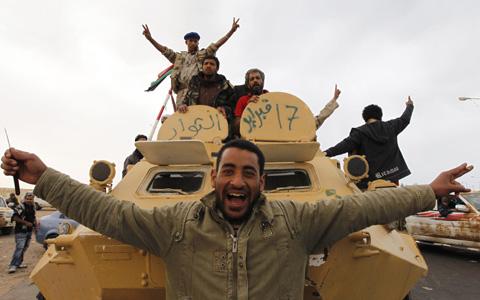
Who Are the Rebels Entering Tripoli?

05 Civil War, 08 Wild Cards, Civil Society, Counter-Oppression/Counter-Dictatorship Practices, Cultural Intelligence

Phi Beta Iota:  This March 30 article continues to be one of the best available.

Who Are the Rebels Fighting Libyan Government Forces?

André de Nesnera

Voice of America, 30 March 2011

EXTRACTS:

But experts are wondering who is this opposition and who are the rebels fighting Ghadafi’s forces?

. . . . . . .

Marc Ginsberg, former U.S. Ambassador to Morocco, says the Libyan opposition is made up of different personalities and groups.

“It’s a sort of ‘Star War' assembly of characters and people who are clearly patriots, very decent people – I’m sure – journalists, opposition military officials who have broken with the regime, former diplomats – and then you’ve got Islamists,” said Ginsberg. “The Benghazi section of Libya was basically an opposition stronghold to Gadhafi and it has a very strong Islamist character to it. So while there are very good people who are part of this opposition coalition, we really can’t say that we know for sure what their capacity is to govern Libya.”

. . . . . .

“The 20-somethings are turning away from Islamists,” she said. “Now you do have an Islamic opposition and you always will have an Islamic extremism in the region. But this is not an Islamic movement. And it is not led by Islamists and it is not demanding the setting up of an Islamic Republic.

Read full article….

John Robb: Failure of Government in One Anecdote

01 Brazil, 01 Poverty, 04 Education, 10 Security, 11 Society, Blog Wisdom, Civil Society, Cultural Intelligence, Government, IO Deeds of Peace, IO Impotency, Methods & Process, Military
John Robb

Status check on Brazil's specialized police units trying to supplant illicit drug governance in the favelas. Per an upcoming law, these units will be in place for 25 years. “Many communities previously relied on the drug gangs for services from water to wireless internet, and critics have pointed out that the state has been slow to replace them.”

Phi Beta Iota:  The program has been successful in applying ruthless pervasive special violence to displace the drug gangs and insert permanent police presence.  The program has FAILED in two respects: it has not been accompanied by the rapid provision of normal services from water to wireless; and it has not provided for the education of the people, something that requires call centers and free cell access to the Internet (they don't have the time to sit in a classroom for N years).

In their own words:

“People in the favela don't believe in themselves. What is really needed in the long term is more education.”

Chuck Spinney: Fukushima Aftermath

03 Economy, 05 Energy, 08 Proliferation, 08 Wild Cards, 11 Society, Corruption, Earth Intelligence, Government, IO Impotency
Chuck Spinney

A sobering Japanese bookend to the stunning Sprey-Cockburn report which documented Fukushima's increased infant death rates in some cities in the United States (distributed on 16 Aug).  Yet another nail in the claim that we can evolve a safe carbon-free economy in the near term.  Given the low power density of green technologies, like wind and solar, going carbon-free or moving away from fire —  i.e., the invention that launched millions of years human cultural evolution — in the next 30-100 years necessarily involves a huge expansion in nuclear power, because is the only high power-density, non-carbon solution available over the foreseeable future).

Chuck Spinney
The Blaster
Nice

Published on Thursday, August 18, 2011 by Al Jazeera

Fukushima Radiation Alarms Doctors

Japanese doctors warn of public health problems caused by Fukushima radiation.

by Dahr Jamail

Scientists and doctors are calling for a new national policy in Japan that mandates the testing of food, soil, water, and the air for radioactivity still being emitted from Fukushima's heavily damaged Daiichi nuclear power plant.

“How much radioactive materials have been released from the plant?” asked Dr Tatsuhiko Kodama, a professor at the Research Centre for Advanced Science and Technology and Director of the University of Tokyo's Radioisotope Centre, in a July 27 speech to the Committee of Health, Labour and Welfare at Japan's House of Representatives.

Read more….

Phi Beta Iota:  We do not agree with Brother Spinney's conclusion.  Infinite free energy is available now, particularly in countries such as Chile where a wide variety of solar, geo-thermal, and oceanic forms can be deployed.  We have lacked both political will and scientific imagination, as well as the essential focus on distributed self-sufficiency.  The “central” generation paradigm is corrupt and will not scale.

Chuck Spinney: NATO and Libya – What Next?

04 Inter-State Conflict, 05 Civil War, 07 Other Atrocities, 08 Wild Cards, 10 Security, Corruption, Counter-Oppression/Counter-Dictatorship Practices, Cultural Intelligence, Government, IO Deeds of War, Military, Peace Intelligence
Chuck Spinney

The interplay of chance with necessity means that no one can predict the future evolutionary pathway in Libya or the US role in Libya, but Ted Galen Carpenter of the libertarian CATO Inst. provides a thoughtful lens for thinking about potential ramifications of NATO's precipitate intervention in Libya.

Key issues discussed:

  • De facto or de jure partition vs a unification that sows the seeds of future conflict?
  • How to replenish empty Libyan treasury and repair infrastructure (including restoring oil production capability)?
  • Will US get sucked into another NATO stabilization, peacekeeping, nation-building mission?

CS

NATO’s New Problem: Post-Qaddafi Libya?

Ted Galen Carpenter, The National Interest, August 18, 2011

After weeks of very little movement either militarily or diplomatically in Libya, there are apparent developments on both fronts in recent days. Rebel forces, aided by NATO’s air support, finally appear to be advancing into western Libya and cutting off supply lines to Tripoli, the long-time stronghold of support for Muammar Qaddafi. And reports are swirling about secret negotiations that might provide a peaceful exit from the country for the aging dictator.

Those developments underscore that U.S. and NATO officials urgently need to consider what strategy they intend to pursue if Qaddafi’s more-than-four-decade hold on power finally comes to an end. That is more crucial for the leaders of the European members of the alliance, since Libya is located on Europe’s Mediterranean flank, but because the Obama administration unwisely chose to involve the United States in Libya’s internecine conflict by launching air strikes, it has become a pertinent issue for Washington as well.

The outlook for a post-Qaddafi Libya is midpoint between sobering and depressing. It is possible that the warring parties will accept a de facto division of the country between the eastern and western tribes, although a formal agreement to that effect is unlikely. Even an informal partition would more accurately reflect the demographics, politics, and history of that territory than an insistence on keeping Libya intact.

Read more….

Phi Beta Iota:  A serious world power would heed the wisdom of Ambassador Mark Palmer, and have Undersecretaries for Peace at both foreign affairs and defense, with two strategies: one for dictators that agree to a five year non-violent exit strategy, and another for those that do not.  What is happening in the Middle East today is a direct representation of the fact that there are no serious world powers in being today.

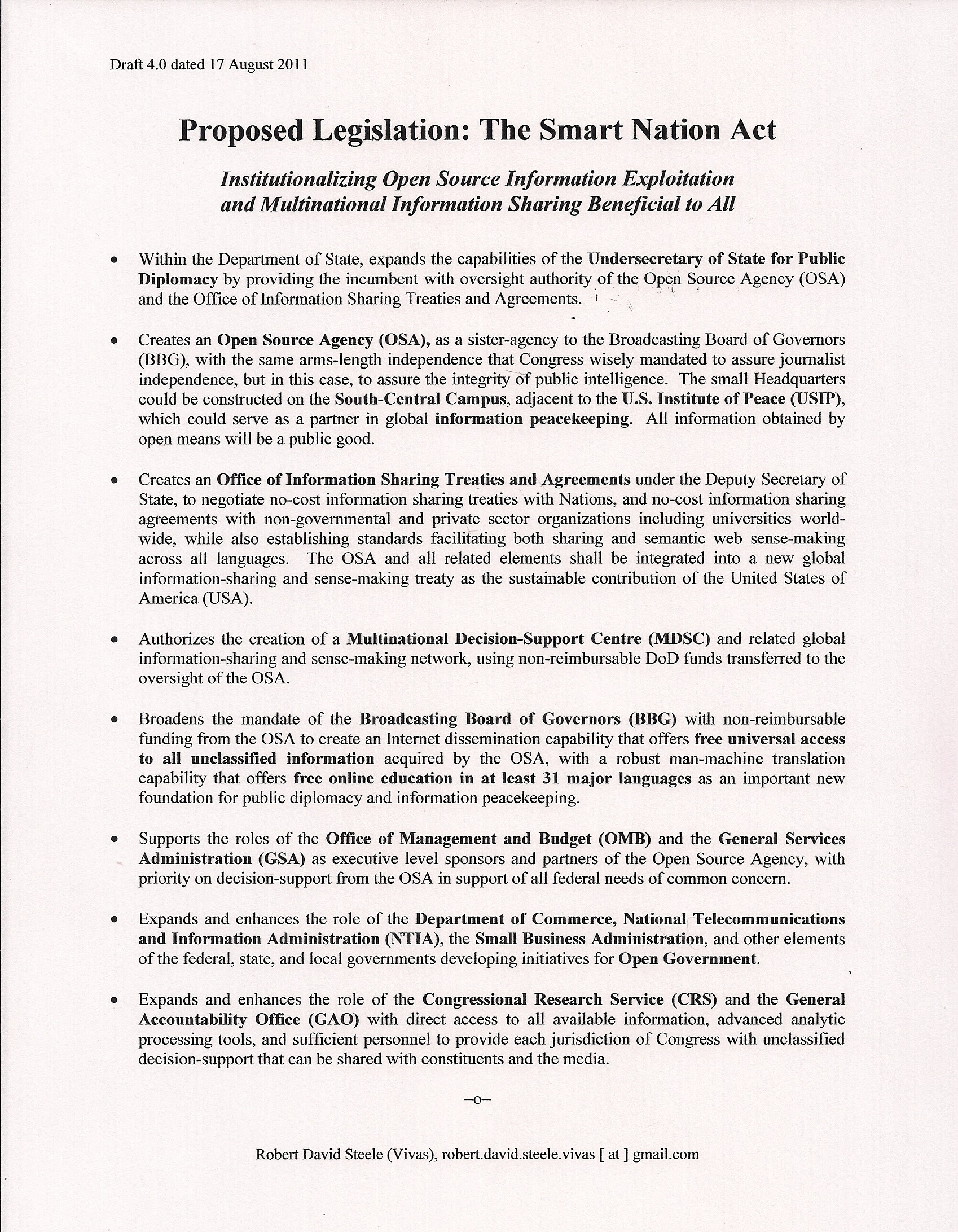
Reference: Smart Nation Act (Simplified) 2011

Advanced Cyber/IO, Analysis, Budgets & Funding, Collaboration Zones, Collective Intelligence, Communities of Practice, Congressional Research Service, Ethics, General Accountability Office, Hill Letters & Testimony, InfoOps (IO), Intelligence (government), Key Players, Legislation, Memoranda, Methods & Process, Mobile, Office of Management and Budget, Officers Call, Open Government, Policies, Policy, Politics of Science & Science of Politics, Real Time, Reform, Research resources, Resilience, Serious Games, Standards, Strategy, Technologies, Threats
Click on Image to Enlarge

Original Online (.doc 1 page)

Chuck Spinney: US versus Iran on Uranium-Lack of Integrity

05 Iran, 08 Proliferation, 10 Security, 11 Society, Corruption, Cultural Intelligence, Government, IO Deeds of War, IO Impotency, Peace Intelligence
Chuck Spinney

Spinning Iran's centrifuges

By Yousaf Butt, Asia Times, Aug 16, 2011

Yousaf Butt is a nuclear physicist and is currently serving as a scientific consultant to the Federation of American Scientists on global security issues. Previously, he was a fellow on the Committee on International Security and Arms Control at the US National Academy of Sciences, and on the Global Security Program at the Union of Concerned Scientists.

Consider yourself warned – “[I]n the next few years Iran will be in position to detonate a nuclear device,” so writes Ray Takeyh, confidently, in a recent Washington Post OpEd [1]. Why? Because the Iranian government willingly informed the International Atomic Energy Agency (IAEA) that it would begin installing additional centrifuges with higher capacity to enrich uranium. [2]

Just like fertilizer can be used to increase crop yields – or make bombs – uranium is a dual use material.

Read full article.

noble gold