5.0 out of 5 stars MUST READ, gift and share — a roadmap for true cost valuation at citizen level, January 12, 2013
I have long been a fan of Herman Daly's ecological economics and E.O. Wilson's concept of consilience, a form of holistic analytics, and of course Buckminster Fuller and Russell Ackoff, among other systems thinkers. This book, just published, is quite extraordinary, and in the absence of a Look Inside the Book offering, one of Amazon's best features, I want to list the chapters here and point to an online resource that provides compelling information supportive of buying this book and then sharing it or gifting it to others.
Chapter 1: The Indispensable Dirt
Chapter 2: Life from Light
Chapter 3: Eco-innovation
Chapter 4: The Pollinators
Chapter 5: Ground Control
Chapter 6: Liquid Assets
Chapter 7: Sunken Billions
Chapter 8: Ocean Planet
Chapter 9: Insurance
Chapter 10: Natural Health Service
Chapter 11: False Economy?
To get right to the web page that does NOT offer the book for free, only provides the supporting references and comments on each reference, search for:
Nature is not a drag on growth – its protection is an unavoidable prerequisite for sustaining economic development
Tony Juniper
The Guardian, 9 January 2013
One of the greatest misconceptions of our time is the idea that there is somehow a choice between economic development and sustaining nature. The narrative developed by the chancellor, George Osborne, since the 2010 general election provides a case in point. He says environmental goals need to be scaled back to promote more growth.
The reality we inhabit is somewhat different, however. One hundred per cent of economic activity is dependent on the services and benefits provided by nature. For some time, and during the last decade in particular, researchers have investigated the dependence of economic systems on ecological ones, and in the process have generated some striking conclusions. I tell the stories behind their findings in my new book, What has nature ever done for us?
While many mainstream economists suffer from the kind of delusions that make it perfectly rational for them to accept to liquidate natural systems in the pursuit of “growth”, different specialist studies reveal the huge economic value being lost as decisions and policies that are geared to promoting economic activity degrade the services provided by nature.
For example, as we struggle to cut emissions from fossil fuels, one study estimates that the value of the carbon capture services which could be gained through halving the deforestation rate by 2030 is around $3.7 trillion. And the wildlife in the same forests has huge value too – about 50% of the United States' $640bn pharmaceutical market is based on the genetic diversity of wild species, many of which were found in forests. And it's not only the genetic diversity in wildlife that brings economic benefits.
Among other things, wildlife also helps to control pests and diseases. The cost of losing India's vultures has been estimated at $34bn, largely because of the public health costs associated with their demise, including increased rabies infections. The annual pest-control value provided by insectivorous birds in a coffee plantation has been estimated as $310 per hectare while the annual per hectare value added from birds controlling pests in timber-producing forests has been put at $1,500. Great tits predating caterpillars in a Dutch orchard were found to improve the apple harvest by 50%.
The services provided by animals, such as bees, doing the pollination work that underpins about one trillion dollars-worth of agricultural sales has been valued at $190 billion per year.
Editor's note: Van Jones, a CNN contributor, is president and founder of Rebuild the Dream, an online platform focusingon policy, economics and media. He was President Obama's green jobs adviser in 2009. He is also founder of Green for All, a national organization working to build a green economy.
(CNN) — We are not living up to the promise of the American Dream.
Even now, our leaders are talking about cutting, instead of creating jobs to grow our way out of the deficit. Congress is ignoring big problems, congratulating itself on avoiding a fiscal cliff of its own creation. The federal budget props up broken parts of our economic system — big banks, big polluters and big defense contractors — instead of investing in areas such as education and infrastructure that would benefit everyone.
Now, a new breed of companies is leveraging the power of networks and sharing — and showing us what a more sustainable, prosperous future can look like.
One of the most well-known examples is Zipcar. Its tagline, “wheels when you want them,” pretty much sums up the company. Zipcar was just bought by rental giant Avis Budget Group for nearly $500 million as part of Avis' push to compete with Hertz's and Enterprise's new car-sharing services. The demographics of car-sharing customers holds promise for future growth as younger, tech-savvy consumers tend to prefer sharing services.
Then there is Mosaic, a new addition to the share economy. Mosaic just launched the first online clean energy investment marketplace.
A talk between John Xenakis and Warren Pollock recorded in August of 2012. This is being re-posted because some of the points we talked about five months ago are first gaining traction in the press, and then they are getting spun incorrectly.
Sunni Shi-ite War in Middle East? Turkey and Kurdish conflict?
A shocking new Federal Security Services (FSB) report on the Obama regimes accelerated plan to disarm his countries citizens, claims that the US President is being supported in his efforts by the Mexican Sinaloa Cartel, both of whose “main target” is the powerful and feared Jewish-American billionaire Steve Feinberg [photo 2nd left], who controls nearly 85% of all private weapons manufacturing in the United States.
This sinister organization is a drug-trafficking and organized crime syndicate based in the city of Culiacán, Sinaloa, with operations in the Mexican states of Baja California, Durango, Sonora and Chihuahua, and with thousands of guns provided to them by the Obama regime, in an operation called “Fast and Furious,” unleashed a war upon rival gangs that, to date, has killed over 60,000.
Even worse, this report continues, under both the Bush and Obama regimes, the Sinaloa Cartel was allowed to transport tonnes of drugs to Chicago for distribution throughout the United States, while at the same time being protected by both the Central Intelligence Agency (CIA) and the Drug Enforcement Administration (DEA).
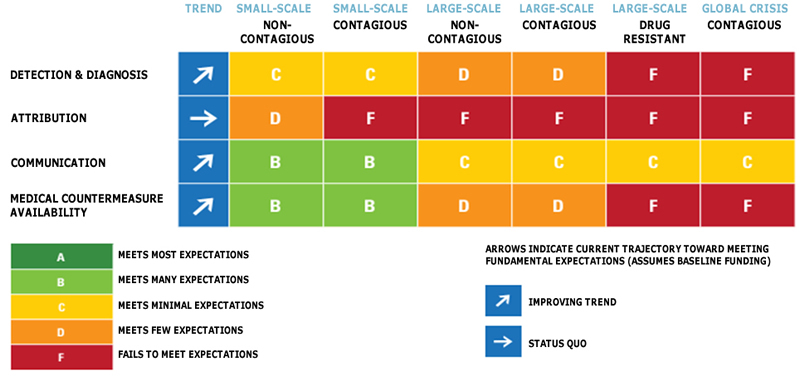
The US Bipartisan Bio-Detection 2011 Report Card Status Evaluation (Source: The US Bipartisan WMD Terrorism Research Center, October 2011 Bio Response Report Card)
Events of the recent decade confirm that the threats of bio-terrorism and infectious disease outbreaks are real. Attacks such as the 2001 Anthrax scare, the 2004 Ricin letters, the 2003 SARS and 2009 H1N1 outbreaks have driven governments to increase their bio-surveillance budgets. Public healthcare and HLS agencies' urgent need to establish an early and reliable bio-surveillance detection infrastructure will drive the market onto a much higher trajectory than ever before. We forecast that the cumulative 2012-2016 market (including: systems sale, consumables, upgrades and service) will reach $22.8 billion.
Click on Image to Enlarge
The recent year that saw the seventh review round of the Biological and Toxic Weapons Convention, demonstrated that demand for biosecurity remains high. As developed countries continue to refine their organizational and technological approach to potential bio-terror and disease outbreak threats, many key emerging markets are also ramping up programs to acquire solutions that provide early outbreak-attack detection. These will require the shortening of bio-attack alarm response time and the proliferation of 3rd generation cost-effective bio-detection technologies and reagent-less detection assays.
In contrast to the US colossal spending of $67 billion on biodefense programs during the 2001-2011 period, the US bipartisan WMD Terror Response Center report card (September 2011) graded the world's leading “US bio-detection and attribution programs” as the Achilles heel of the US BioWatch program. It received a score ranging from “meets minimal expectations” to a catastrophic “fails to meet expectations” (see table above). It stated that “Although naturally occurring disease remains a serious threat, a thinking enemy armed with these same pathogens, or with multi–drug resistant or synthetically engineered pathogens could produce catastrophic consequences“.
Over the next five years, we forecast that, led by the US, Germany, France, China, Japan and India, the global bio-detection market (including systems sale, service, upgrades and consumables) will reach $5.6 billion by 2016.