
Review: The Arab Revolt and the Imperialist Counterattack

4 Star, Atrocities & Genocide, Congress (Failure, Reform), Consciousness & Social IQ, Corruption, Country/Regional, Culture, Research, Diplomacy, Empire, Sorrows, Hubris, Blowback, Executive (Partisan Failure, Reform), History, Impeachment & Treason, Insurgency & Revolution, Intelligence (Government/Secret), Justice (Failure, Reform), Military & Pentagon Power, Misinformation & Propaganda, Peace, Poverty, & Middle Class, Politics, Power (Pathologies & Utilization), Threats (Emerging & Perennial), Voices Lost (Indigenous, Gender, Poor, Marginalized), War & Face of Battle
Amazon Page

James Petras

4.0 out of 5 stars TImely, Deep Historical Insights, Some Gaps & Biases, May 29, 2011

I would normally wait but in the absence of any reviews want to just praise this book as timely, with deep historical insights, and a few gaps and biases as well as no index, the latter almost always causes me to remove a star. The book has been rushed into print and suffers from that rush, but I fully anticipate that a second edition will be fleshed out, add an index, and be a full five star contribution. This is a print on demand book (Amazon's superb CreateSpace offering) and only 78 pages, it is properly priced and that I find especially commendable.

The author is nothing less than a superior analyst with very high integrity, and his historical knowledge, as well as his historical contributions to non-fiction literature, cannot be denied.

Among the core findings that I appreciate are the author's early focus on the complete ignorance of the Central Intelligence Agency (CIA) [and of course also the Departments of State and Defense] with respect to both the opposition leaders (all of them, not just the normal suspects] and the underlying preconditions of revolution across all dimensions.

Continue reading “Review: The Arab Revolt and the Imperialist Counterattack”
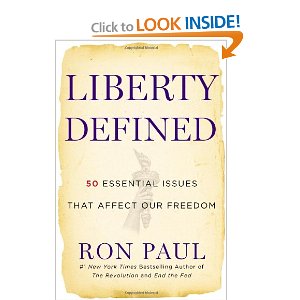
Review: Liberty Defined–50 Essential Issues That Affect Our Freedom

6 Star Top 10%, America (Founders, Current Situation), Biography & Memoirs, Complexity & Resilience, Congress (Failure, Reform), Consciousness & Social IQ, Corruption, Crime (Corporate), Crime (Government), Culture, Research, Democracy, Economics, Education (General), Empire, Sorrows, Hubris, Blowback, Executive (Partisan Failure, Reform), Intelligence (Public), Justice (Failure, Reform), Misinformation & Propaganda, Peace, Poverty, & Middle Class, Philosophy, Politics, Power (Pathologies & Utilization), Priorities, Public Administration, Threats (Emerging & Perennial)
Amazon Page

Ron Paul

5.0 out of 5 stars Six Stars for Ron Paul's Consistent Constitution–50 one liners, May 10, 2011

I have read and reviewed earlier books by Ron Paul, such as The Revolution: A Manifesto and A Foreign Policy of Freedom: Peace, Commerce, and Honest Friendship. This book moves into a higher class (only 10% of the books I read and review get 6 Stars, see all my reviews in 98 categories at Phi Beta Iota the Public Intelligence Blog). I decided in this instance, thinking of Ron Paul as a viable Presidential candidate for the first time, to deconstruct the book down to 50 one liners. I offer these as a short form of the book, not a substitute for the real deal, but intended to help inspire more people to either buy the book, or absorb this free summary as we all try to break free of the corrupt two-party tyranny that fronts for a neo-fascist state.

Bottom line: liberty is a human condition diminished by a leviathan state.

Below: one line summary of each of the 50 chapters. See also the review by A. Maheshwari that I liked so much I cross-posted it to Phi Beta Iota for others to appreciate.

Continue reading “Review: Liberty Defined–50 Essential Issues That Affect Our Freedom”

Review (Guest): Liberty Defined–50 Essential Issues That Affect Our Freedom by Ron Paul

5 Star, America (Founders, Current Situation), Biography & Memoirs, Capitalism (Good & Bad), Civil Society, Complexity & Resilience, Congress (Failure, Reform), Consciousness & Social IQ, Corruption, Crime (Corporate), Crime (Government), Culture, Research, Economics, Education (General), Empire, Sorrows, Hubris, Blowback, Executive (Partisan Failure, Reform), Intelligence (Public), Justice (Failure, Reform), Leadership, Misinformation & Propaganda, Peace, Poverty, & Middle Class, Philosophy, Politics, Power (Pathologies & Utilization), Priorities, Public Administration, Threats (Emerging & Perennial)
Amazon Page

Ron Paul

5.0 out of 5 stars Paul's Greatest, Most Daring Book Yet A. Maheshwari April 19, 2011

Ron Paul continues the noble tradition of founders and thinkers such as Thomas Jefferson, Edmund Burke, James Burnham and Patrick Buchanan in social-political conditions of the 21st Century. The book is written in lucid, vital and free flowing style without any convoluted jargon. I purchased the kindle edition and finished the book in 3 hours with several re-readings of some chapters/paragraphs.

The stage is set in contemporary America, and the intended audiences are likely the young indoctrinated subservient Americans, victims of Washington DC. This book could be the conservative bible for next two decades to effect political renewal of a tired, beaten and declining America. It deals with Paul's unique approach as a practicing Christian, a conservative libertarian and a citizen statesman. The amoral and utopian aspects of left-libertarianism are absent in this book.

Indeed the word libertarian has been mentioned only 6 times in the text. In comparison, the word moral has been mentioned a good 109 times, and “liberty” occurs 191 times. The book emphasizes the true essence of Christianity and Christ as the prince of peace, not a messenger of aggressive/deceitful secular wars.

The writing is universal in its appeal so that a person from China, India, Africa, Islamic World or Europe will naturally relate to its contents. It defines the true meaning of Liberty, Equality and Fraternity, the three principles of humanity. It is applicable to all human societies and aggregates, not just America. It shows the essence of conservatism and social order and extensively deals with liberty's relationship with morality, religion and ethics.

The book is tabulated in 50 chapters and covers 5 principal themes:

Continue reading “Review (Guest): Liberty Defined–50 Essential Issues That Affect Our Freedom by Ron Paul”

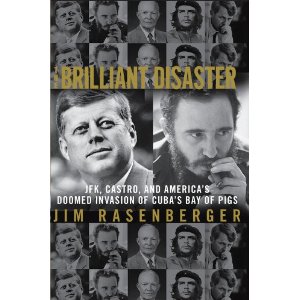
Review (Guest): The Brilliant Disaster–JFK, Castro, and America’s Doomed Invasion of Cuba’s Bay of Pigs

5 Star, Atrocities & Genocide, Congress (Failure, Reform), Empire, Sorrows, Hubris, Blowback, Executive (Partisan Failure, Reform), Impeachment & Treason, Intelligence (Government/Secret), Justice (Failure, Reform), Politics, Power (Pathologies & Utilization), Secrecy & Politics of Secrecy, Truth & Reconciliation
Amazon Page

Jim Rasenberger

5.0 out of 5 stars A Story that Demands to be Told Honestly – A PAGE TURNER – 5 STARS for Jim Rasenberger

April 10, 2011

It is very strange that a story as important as this one has simply not received either the historical attention or public attention that it deserves. Very simply, President Kennedy's people will tell you that prior to entering office, JFK was briefed in a meeting with Eisenhower about plans for CIA trained Cuban exiles (some 1400 in number) to invade Cuba and foment a revolution against Castro. Eisenhower's people deny that this ever happened.
Continue reading “Review (Guest): The Brilliant Disaster–JFK, Castro, and America's Doomed Invasion of Cuba's Bay of Pigs”

Review (Guest): The Threat on the Horizon–An Inside Account of America’s Search for Security after the Cold War

5 Star, Crime (Corporate), Crime (Government), Culture, Research, Empire, Sorrows, Hubris, Blowback, Impeachment & Treason, Intelligence (Government/Secret), Military & Pentagon Power, Misinformation & Propaganda, Politics, Power (Pathologies & Utilization), Priorities, Threats (Emerging & Perennial)
Amazon Page

Loch K. Johnson

5.0 out of 5 stars Missed Opportunities

April 8, 2011

Retired Reader (New Mexico) – See all my reviews (TOP 1000 REVIEWER)

This book The Threat on the Horizon: An Inside Account of America's Search for Security after the Cold War offers a detailed account of the creation and workings of the now nearly forgotten Aspin-Brown Commission on Intelligence Reform (1995-1996). Its author, Loch Johnson, is a recognized authority on intelligence issues and was on the Commission's staff. This book is in part the result of a promise Johnson made to the Commission's original head, Les Aspin before his death.

Some would dismiss this book as concerning a forgotten footnote in the history of the U.S. Intelligence Community (IC), but this would be a mistake. This book actually provides a detailed chronicle of the only real effort to introduce comprehensive reform in the IC prior to the 9/11 tragedy. It also explains in some detail why these reforms proved ineffective. Perhaps unintentionally, the book also provides an excellent picture of the structure and culture of the IC principals (CIA, DIA, NGA, and NSA) as well as the National Reconnaissance Office (NRO) immediately after the end Cold War. The problems of the IC principals in the mid-1990's do much to explain the problems that beset them today and offer a cautionary tale about intelligence reform.

The story of this Commission's efforts to seriously reform the IC demonstrates how by its composition and approach the Commission was more or less bound to fail. Its final recommendations were superficial and would have done nothing to change the moribund cultures and direction of the IC principals even if they had actually been enacted. Indeed as occurred with intelligence reforms recommended by the 9/11 Commission Report which were for the most part enacted, their lack of substance would have made them ineffective.

Johnson attributes much of the problems with the Aspin-Brown Commission to the untimely death of Les Aspin in 1995. He has a point; Aspin was willing to invest a good deal of himself in the search for intelligence reform and clearly took the matter very seriously. This attitude was reflected in the way the Commission's Staff went about the detailed work need for the Commission to be effective and in the way Commission itself went about fact gathering. Aspin's successor Harold Brown was as brilliant as Aspin, but clearly did not take the Commission's work as seriously.

By any standards this book is a very important one for those interested in reform of the U.S. Intelligence System and the reasons why such reform has always failed.

Vote and/or Comment on Review

See Also:

Worth a Look: Book Reviews on Institutionalized Ineptitude

Worth a Look: Book Reviews on Intelligence (Lack Of)

F. William Engdahl: Three Books on Empire

5 Star, America (Founders, Current Situation), Atrocities & Genocide, Budget Process & Politics, Capitalism (Good & Bad), Congress (Failure, Reform), Corruption, Crime (Corporate), Crime (Government), Culture, Research, Democracy, Economics, Empire, Sorrows, Hubris, Blowback, Environment (Problems), Executive (Partisan Failure, Reform), Impeachment & Treason, Justice (Failure, Reform), Misinformation & Propaganda, Nature, Diet, Memetics, Design, Peace, Poverty, & Middle Class, Power (Pathologies & Utilization), Science & Politics of Science, Secrecy & Politics of Secrecy, Threats (Emerging & Perennial), True Cost & Toxicity, Values, Ethics, Sustainable Evolution, Voices Lost (Indigenous, Gender, Poor, Marginalized), Worth A Look
Amazon Page

Available for Pre-Order.Ā  For the faction controlling the Pentagon, the military industry, and the oil industry, the Cold War never ended. They engineered an incredible plan to grab total control of the planet, of land, sea, air, space, outer space and cyberspace. Continuing ‘below the radar,' they created a global network of military bases and conflicts to advance the long-term goal of Full Spectrum Dominance. Methods included control of propaganda, use of NGOs for regime change, Color Revolutions to advance NATO eastwards, and a vast array of psychological and economic warfare techniques. They even used ‘save the gorilla' organizations in Africa to secretly run arms in to create wars for raw materials. It was all part of a Revolution in Military Affairs, as they termed it. The events of September 11, 2001 would allow an American President to declare a worldwide War on Terror, on an enemy who was everywhere, and nowhere. 9/11 justified the Patriot Act, the very act that destroyed Americans' Constitutional freedoms in the name of security. This book gives a disturbing look at the strategy of Full Spectrum Dominance, at what is behind a strategy that could lead us into a horrific nuclear war in the very near future, and at the very least, to a world at continuous war.

Continue reading “F. William Engdahl: Three Books on Empire”

Worth a Look: The Anti-Globalization Breakfast Club: Manifesto for a Peaceful Revolution

5 Star, Capitalism (Good & Bad), Complexity & Catastrophe, Complexity & Resilience, Congress (Failure, Reform), Corruption, Culture, Research, Democracy, Economics, Empire, Sorrows, Hubris, Blowback, Environment (Solutions), Executive (Partisan Failure, Reform), Insurgency & Revolution, Intelligence (Public), Nature, Diet, Memetics, Design, Peace, Poverty, & Middle Class, Survival & Sustainment, Values, Ethics, Sustainable Evolution, Voices Lost (Indigenous, Gender, Poor, Marginalized)
Amazon Page

Alternative models for grass roots economic development such as micro-financing are now being widely adopted in Bangladesh, India, Pakistan and elsewhere. New views on measuring development such as GDH (gross domestic happiness) have been adopted by Bhutan rather than GDP, and China's own hybrid approach combining market and planned policy to achieve economic transformation offer new choices for developing countries. All of these are representative of a new wave of thinking that rejects the increasingly discredited policies of the IMF and World Bank.

It is easy to criticise the views of activists who take to the street every time the World Bank, IMF, WTO or World Economic Forum meet. However they are driven by hard concerns which are not calling for an end to globalization but a reorientation of what this means. They are challenging notions of accepted economic and business parlance, calling for fair trade rather than just free trade; balanced rather than fast growth; and protection of domestic cottage industries and with it ethnic diversification and social identity. In many respects the term is a misnomer. They are calling for fairer re-distribution of the fruits of globalization and a humane reduction of its side-effects through sensitivities to local conditional realities.

Continue reading “Worth a Look: The Anti-Globalization Breakfast Club: Manifesto for a Peaceful Revolution”