5.0 out of 5 stars You need a brain to read this book; if you have one, the book will scare you,February 17, 2012
I have been keeping in touch with “alternative” sources for some time, ever since I realized in about 1988 that neither the US secret intelligence world nor the US media were at all reliable — they are each very good at what they choose to do, but that does not include the public interest.
I am hugely impressed by this author. He does detailed, meticulously documented research and the presentation is excellent. I especially like footnotes I can see while reading the body instead of endnotes.
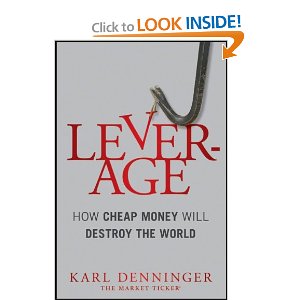
Karl Denninger STRONG FIVE – Original, Award-Winning, Major Contribution, February 5, 2012
On the very last page of the book I learn that the author received the Reed Irvine Accuracy in Media Award for Grassroots Journalism, for his coverage of the 2008 market meltdown. This confirms my own already formed very high estimation of the author and his work. In fact, although I normally do links at the end of the review, let me open with some other books that are world-class and within which I place this work as comparable:
Here is the author's three-line conclusion to the longer chapter that ends the book (my own notes in parenthesis):
01 Federal and state governments KNEW what was going on, and are COMPLICIT. (This introduces me to the reality of “control fraud,” where the government commits impeachable acts that are not sanctioned; I also learn in this book that when Congress passes laws it does not include sanctions for failure by the GOVERNMENT to uphold those laws.)
5.0 out of 5 stars Alternative Perspective, Very Naive on US Reality, January 30, 2012
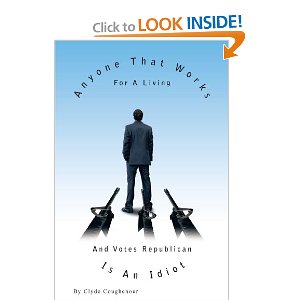
I *like* this book. I've been running for the Reform Party nomination for President (there were three of us, now there are two, and I might drop out soon if I get a federal job and the Hatch Act kicks in). I mention that mostly to emphasize that everything I have learned in the six weeks I've been registered with the Federal Elections Commission (FEC ID C00507756) is relevant to the second half of my review. This book came to my attention via a press clipping service that helps me follow any mention of a third party — this book calls for a new third party Of, By, and For Workers — we used to call that Communism (just kidding), but seriously, the last part of my review is a pitch for what workers should do if they really want to take charge, as workers finally did in Norway and Sweden (it took them 25 years).
I would normally rate this book at four stars, there is a lot missing, but I have to say that in terms of earnest honest patriotic down-to-earth common sense and indisputable pro-labor attitudes, this book is solid, so I am putting it at five stars and linking below to some books that add the missing “weight” to this read. My reviews of all of the books I list are summary in nature, to help those with little time or little money.
The book is scattered, providing snapshots of all of the issues, showing very clearly where neither party, but especially the Republicans, can be trusted to look out for workers. Politics is theater–nothing is decided in the open, the real deals are behind closed doors and the taxpayer ALWAYS loses. I certainly give the book high marks for distilling a very complicated corrupt mess into a simplified structure, and I totally agree with the author that there are no reliable statistics from the government or corporations, but let me give you three that matter:
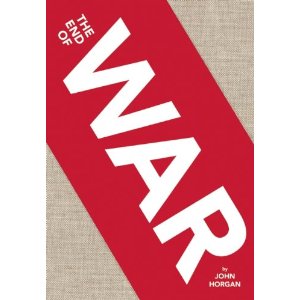
The best book I've read in a very long time is a new one: The End of War by John Horgan. Its conclusions will be vigorously resisted by many and yet, in a certain light, considered perfectly obvious to some others. The central conclusion — that ending the institution of war is entirely up to us to choose — was, arguably, reached by (among many others before and since) John Paul Sartre sitting in a café utilizing exactly no research.
Horgan is a writer for “Scientific American,” and approaches the question of whether war can be ended as a scientist. It's all about research. He concludes that war can be ended, has in various times and places been ended, and is in the process (an entirely reversible process) of being ended on the earth right now.
Amazon Page
The war abolitionists of the 1920s Outlawry movement would have loved this book, would have seen it as a proper extension of the ongoing campaign to rid the world of war. But it is a different book from theirs. It does not preach the immorality of war. That idea, although proved truer than ever by the two world wars, failed to prevent the two world wars. When an idea's time has come and also gone, it becomes necessary to prove to people that the idea wasn't rendered impossible or naïve by “human nature” or grand forces of history or any other specter. Horgan, in exactly the approach required, preaches the scientific observation of the success (albeit incomplete as yet) of preaching the immorality of war.
5.0 out of 5 stars Solid Support for THE Book on USG Assassination of MLK,January 17, 2012<
I am unemployed and cannot afford books the way I once could, so my review is actually applause from the sidelines, and a pointer–something I can still do as the #1 Amazon reviewer for non-fiction, toward THE book:
MLK was assassinated at the direction of J. Edgar Hoover, with the active collaboration of the U.S. Army, and one suspects with at least the tacit knowledge of Lyndon Johnson, himself complicit in the assassination of JFK. I note with reverence that Bobby Kennedy calmed a major crowd with a voice close to that of MLK, only to be himself assassinated later. On JFK see:
5.0 out of 5 stars America Desperately Needs More Illumination Such as This January 16, 2012
I received a review copy of this book [note to publishers: always ask first] and was glad to be offered a chance to read something as important as this. America desperately needs more illumination on the corruption in our government, and the evil done in our name without our permission but very much at our expense.
As a career veteran of the national security community–the Marine Corps and the Central Intelligence Agency–followed by seventeen years teaching 90 governments — 66 directly — how to get a grip on Open Source Intelligence (OSINT) that provides 95% of what we need to know at 2% or less of the cost of what we spend now on secret intelligence–I am well-qualified to read this book from a patriot's point of view.
A strong national defense capability does NOT exist in the USA today. Posturing fools such as Senator Rick Santorum have no idea what they are talking about when they seek to discredit those of us who do. The infantry, four percent of the force, takes eighty percent of the casualties and receives ONE PERCENT of the Pentagon budget. Within the other 99%, half–at least–is fraud, waste, and abuse that makes America weaker, not stronger.
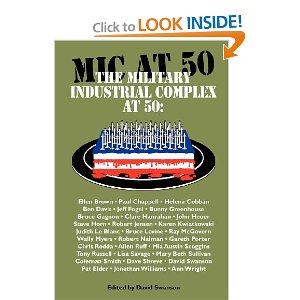
This book, edited by David Swanson, is a very good deal at $25. Its 368 pages include chapters from thirty other authors besides the editor, and include contributions from Ray McGovern and Karen Kwiatkowski, whose work I have admired in the past. If there were one flaw in the book, but not so serious as to lose a star, it would be its isolation from the pioneering work done by Pierre Sprey, Chuck Spinney, and Winslow Wheeler, with a genuflection toward John Boyd, the real pioneer of smart sufficient national security.
What is uniquely valuable about this book, something I have not seen elsewhere, is its provision of a holistic examination not just of the military-industrial process and fraudulent, wasteful, abusive bad design, bad performance, and bad cost, but of the costs that the military-industrial complex imposes on all of us and our economy and our society. This is a world-class book that should be translated into other languages to help others avoid our long-running mistakes.
Here are the blinding flashes of solid insight that stayed with me and merit the broadest possible public understanding:
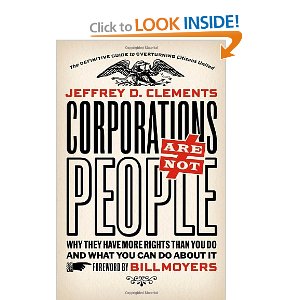
This book should mainstream the campaign to end corporate personhood.
Clements traces the development of the legal doctrine of corporate personhood back long before the Supreme Court's Citizens United decision two years ago this month, in particular to President Richard Nixon's appointment of Lewis Powell to the Supreme Court in 1972. Led by Powell's radical new conception of corporate rights, Clements shows, the court began striking down laws that protected living breathing persons' rights in areas including the environment, tobacco, public health, food, drugs, financial regulation, and elections.
In 1978 the Supreme Court ruled that corporations had speech rights that prevented banning their money from an election, a conclusion that might have been nearly incomprehensible a decade earlier before the U.S. Chamber of Commerce and various corporate foundations began filling our public discourse with phrases like “corporate speech.” In 1980 Congress forbade the Federal Trade Commission from protecting children or students from junk food advertising and sales. In 1982 corporate speech rights in the U.S. Supreme Court overturned a state law that had attempted to block energy companies from promoting greater energy consumption. In the 1990s, the Monsanto corporation, whose genetically engineered drug was banned in many countries, won the right to include it in milk in the United States and the “right not to speak,” thereby overturning a law requiring that milk be labeled to indicate the drug's presence.
Decision after decision has extended corporate rights to a position of priority over actual human rights on everything from food and water and air to education and healthcare and wars. The ground has shifted. In 1971 Lewis Powell argued on behalf of the cigarette companies that they had a corporate person's right to use cartoons and misleading claims to get young people hooked on nicotine, and he was laughed out of court. In 2001, the Supreme Court struck down a state law banning cigarette ads within 1,000 feet of schools and playgrounds. The reason? The sacred right of the corporate person, which carries more weight now than the rights of the people of a community to protect their children … er, excuse me, their “replacement smokers.”
And why do corporate rights carry so much weight? One reason is that, as Clements documents and explains, “transnational corporations now dominate our government” through election spending. This is why a civilized single-payer health coverage system like those found in the rest of the wealthy nations of the world is not “practical.” This is why cutting military spending back to 2007 levels would mean “amageddon” even though in 2007 it didn't. This is why our government hands oil corporations not only wars and highways but also massive amounts of good old money. This is why we cannot protect our mountains or streams but can go to extraordinary lengths to protect our investment bankers.
“Since the Citizens United decision in 2010,” Clements writes, “hundreds of business leaders have condemned the decision and have joined the work for a constitutional amendment to overturn expanded corporate rights.” You might not learn this from the corporate media, but there is a widespread and growing mainstream understanding that abuse by oversized mega-corporations has been disastrous for ordinary businesses as well as communities, families, and individuals. Clements' turns out to be a pro-business, albeit anti-U.S. Chamber of Commerce, book.
And what can be done? We can build an independent, principled, and relentless Occupy movement and include as a central demand the amending of the U.S. Constitution to end corporate personhood. Clements' book offers a draft amendment, a sample resolution, a collection of frequently asked questions (and answers), a list of organizations, websites, resources, books, and campaigns.
This is doable, and it is what we should do this election year so that in future election years we might actually have elections.

 STRONG FIVE – Original, Award-Winning, Major Contribution, February 5, 2012