This year will see the 10th anniversary of the war in Afghanistan and, according to current plans, the beginning of British troop withdrawal. A decade into the military campaign, there is no longer even discussion of winning. The initial objective to release the country from the despotic grip of the Taliban and prevent its use as a safe haven for al-Qaida was achieved within months. Since then, it has only ever become harder to discern what victory might look like.
There is some clarity on what would count as defeat. If Nato withdrawal leads to the total collapse of Hamid Karzai's government and a return to Taliban rule, there would be no disguising the humiliation to western powers, nor the increased security threat from jihadi terrorism. Not that President Karzai is an attractive ruler. His administration is corrupt and repressive.
Please don't underestimate how powerful this sentence is.
When you say this to a colleague, a new hire, a student or a freelancer, you've established a powerful norm, one that they will be hesitant to challenge.
This might be exactly what you were hoping for, but if your goal is to encourage innovation, you blew it.
Phi Beta Iota: In strategic and force structure studies (neither strategic nor studies) the code is “protect the shooters” when they really mean protect shooter command billets, never mind the shooters themselves or the desperate need for a 10% move from shooters to thinkers.
By no stretch should this book be dismissed as a three. While I might normally have gone with a four, I am settling on five for balance and because the author not only covers an extraordinarily important topic in a sensible measured way, but his endnotes are another book all by themselves–I recommend all readers start there.
Where the author falls short is in lacking a strategic analytic construct for measuring the true costs of lying in blood, treasure, and spirit. He tends to ascribe pure motives to leaders (for example, not at all confronting the raw fact that Dick Cheney committed 23 documented impeachable acts (see my review of Vice: Dick Cheney and the Hijacking of the American Presidency for the itemization) and Dick Cheney also led the telling of 935 documented lies best covered by TruthDig but also in Weapons of Mass Deception: The Uses of Propaganda in Bush's War on Iraq.
The book disconnects grand strategy (global engagement) from domestic prosperity in a manner I find disconcerting, and while the author is most able in documenting the costs to a democracy of lies to the public, I do not see nor feel the deeper reality: lies destroy the Commonwealth. Lies allow a two-party tyranny to sell out to the Arabs (not just the Israelis), to Wall Street–lies permit the mortgage clearinghouse fraud, the derivatives fraud, and the Federal Reserve fraud on the one hand, while also fooling the public into a national security policy that is clinically insane, catastrophically costly, and ultimately a self-inflicted wound that could be fatal. Continue reading “Review: Why Leaders Lie–The Truth About Lying in International Politics”
Summary: The author discusses the intellectual but not the ethical underpinings of the failure of US foreign policy and national security since the first Clinton Administration. He touches on alternative policies such as isolationalism, offshore balancing, selective engagement, global dominance, and then settles on offshore balancing as the way to go: pulling back the Army and Marines from overseas, sharply reducing their budgets, and restoring budget to the Air Force and the Navy.
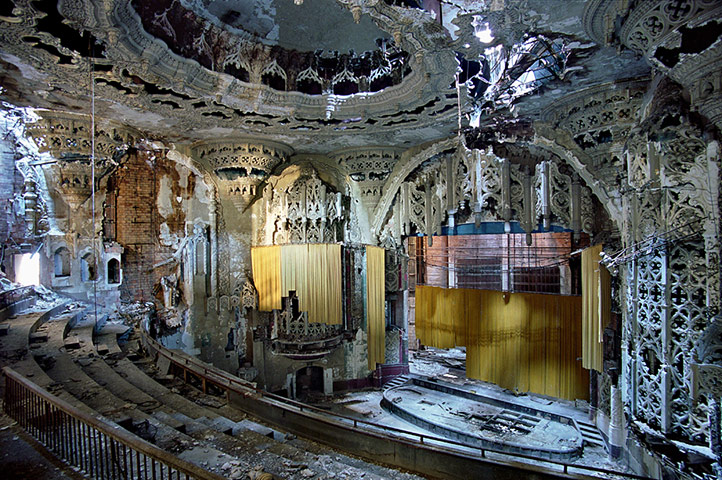
In downtown Detroit, the streets are lined with abandoned hotels and swimming pools, ruined movie houses and schools, all evidence of the motor city's painful decline. The photographs of Yves Marchand and Romain Meffre capture what remains of a once-great city – and hint at the wider story of post-industrial America
. . . . . . .
Click to Enlarge
Cumulatively, the photographs are a powerful and disturbing testament to the glory and the destructive cost of American capitalism: the centre of a once-thriving metropolis in the most powerful nation on earth has become a ghost town of decaying buildings and streets. There is a formal beauty here too, though, reminiscent of Robert Polidori's images of post-hurricane Katrina New Orleans. “It seems like Detroit has just been left to die,” says Marchand, “Many times we would enter huge art deco buildings with once-beautiful chandeliers, ornate columns and extraordinary frescoes, and everything was crumbling and covered in dust, and the sense that you had entered a lost world was almost overwhelming. In a very real way, Detroit is a lost world – or at least a lost city where the magnificence of its past is everywhere evident.”
. . . . . . .
Click to Enlarge
The Ruins of Detroit tells the city's story so far in one starkly beautiful photograph after another, all of which add up to nothing less than an end-of-empire narrative. Or as Sugrue puts it: “The abandoned factories, the eerily vacant schools, the rotting houses, and gutted skyscrapers that Yves Marchand and Romain Meffre chronicle are the artefacts of Detroit's astonishing rise as a global capital of capitalism and its even more extraordinary descent into ruin, a place where the boundaries between the American dream and the American nightmare, between prosperity and poverty, between the permanent and the ephemeral are powerfully and painfully visible. No place epitomises the creative and destructive forces of modernity more than Detroit, past and present.”
I like the book and I like the authors and I do NOT like the fact that neither decision-support nor intelligence (decision-support) nor M4IS2* are in this book. Retired Reader's review–at five stars–is the review I would have written were I to read the book rather than just appreciate it via Look Inside the Book, and he and I have discussed the intellectual and leadership vacuum we all have in cyberspace where most simply have no idea what they are doing.
* Multinational, Multiagency, Multidisciplinary, Multidomain Information-Sharing and Sense-Making (M4IS2)
I must defer to Retired Reader and Bob Gourley on the good of this book, and hence five stars from em as well. However, and with proper regard for the the vastly experienced and well-intentioned authors, it troubles me that they do not include core concepts and context such as were developed by Robert Garigue, who died at the age of 55 before being able to produce his master work. His Preface to my third book, Information Operations: All Information, All Languages, All the Time and a couple of his briefings that I have featured at Phi Beta Iota the Public Intelligence Blog, are all that we have to remember his towering genius. As with all my books, all free online.
Here is Robert Garigue's bottom line: cyber-power–and cyber-security and what some would call today cyber-command (actually an oxymoron) are about TRUTH & TRUST. All this stuff about protecting legacy systems that are 90% rubbish or interdicting and interfering with the 10% of our enemies that have sophisticated system, is out of touch with reality. The Chinese have whipped our butts on both stealth and riding electrical circuits into NSA's computers and they did it because we pretend that spending money on contractor vapor-ware (SAIC's Trailblazer comes to mind) is somehow equivalent to being competent at something useful.
This brings me to the bottom line: cyber-power does not exist in a vacuum. It is, like a weapon, an extention of the humans that it serves or empowers. Right now US cyber-power is–to the extent it is even relevant or effective–being managed by gerbils (Madeline Albright's term, not mine) for utterly unsound and intellectually as well as morally bankrupt ends–and it is not doing a single thing to help infantry squads see over the next hill, survive improvised explosive devices that still cannot be detected (on behalf of the Marine Corps, my #1 requirement for MASINT in 1988 after seeing the wood-encased IED's in El Salvador in 1979-1980) and on and on.



 Cornerstone, Not the Whole Building