Berto Jongman: The Emerging Global Mind

11 Society, Advanced Cyber/IO, Autonomous Internet, Civil Society, Collective Intelligence, Cultural Intelligence, Earth Intelligence, Gift Intelligence, IO Deeds of Peace, Methods & Process, Peace Intelligence, Strategy
Berto Jongman Recommends...

Featured Article

The Emerging Global Mind

Noetic Now, Issue Fourteen, September 2011

by Tiffany Shlain

Fifteen years ago I founded the Webby Awards. I was fascinated by how the Internet was connecting people all over the world in new and unexpected ways. I have also been struck by the many conversations about the problems of our day that view them as separate challenges—whether the environment, women’s rights, poverty, or social justice. It has become increasingly apparent to me that when you perceive everything as connected, it radically shapes your perspective.

The concept of interdependence isn’t new; it’s been around since the dawn of humanity. For two-hundred-thousand years, we’ve been connecting through networks both natural and technological. Interdependence has long been a tenet of Eastern philosophy and indigenous cosmologies. But the recent addition of the Internet has added a new layer, which connects us in a fresh way, giving the world a new type of central nervous system. Something happens in one place, and we can see it, feel it, and do something about it almost instantaneously.

Safety copy below the line (original URL is inconsistent)

Continue reading “Berto Jongman: The Emerging Global Mind”

Seth Godin: Back to (the wrong) school — inspires a plan to retrain 44% of the US workforce in one year

03 Economy, 04 Education, 11 Society, Advanced Cyber/IO, Collaboration Zones, Collective Intelligence, Communities of Practice, Ethics, InfoOps (IO), IO Deeds of Peace, Methods & Process, Open Government, Policy, Politics of Science & Science of Politics, Serious Games, Standards, Strategy, Technologies, Threats
Seth Godin

Back to (the wrong) school

A hundred and fifty years ago, adults were incensed about child labor. Low-wage kids were taking jobs away from hard-working adults.

Sure, there was some moral outrage at seven-year olds losing fingers and being abused at work, but the economic rationale was paramount. Factory owners insisted that losing child workers would be catastrophic to their industries and fought hard to keep the kids at work–they said they couldn't afford to hire adults. It wasn't until 1918 that nationwide compulsory education was in place.

Part of the rationale to sell this major transformation to industrialists was that educated kids would actually become more compliant and productive workers. Our current system of teaching kids to sit in straight rows and obey instructions isn't a coincidence–it was an investment in our economic future. The plan: trade short-term child labor wages for longer-term productivity by giving kids a head start in doing what they're told.

Large-scale education was never about teaching kids or creating scholars. It was invented to churn out adults who worked well within the system.

Of course, it worked. Several generations of productive, fully employed workers followed. But now?

Continue reading “Seth Godin: Back to (the wrong) school — inspires a plan to retrain 44% of the US workforce in one year”

Chuck Spinney: Can USA Move Beyond 9/11 Pathology?

01 Poverty, 03 Economy, 04 Inter-State Conflict, 05 Civil War, 06 Genocide, 07 Other Atrocities, 08 Proliferation, 09 Terrorism, 10 Security, 10 Transnational Crime, Civil Society, Corruption, Cultural Intelligence, DoD, Government, IO Deeds of War, Media, Military, Money, Banks & Concentrated Wealth, Officers Call, Policy, Politics of Science & Science of Politics, Power Behind-the-Scenes/Special Interests, Strategy, Waste (materials, food, etc)
Chuck Spinney

CS Note: Lightly reformatted by text unchanged and nothing added

Can the United States move beyond the narcissism of 9/11?

The unity brought about by the tragedy was intense but fleeting. The war on terror has been disastrous abroad and divisive at home

Gary Younge, guardian.co.uk, Sunday 4 September 2011 18.00

In the immediate aftermath of the September 11 attacks the then national security adviser, Condoleezza Rice, called in her senior staff and asked them to think seriously about “how [to] capitalise on these opportunities”.

The primary opportunity came from a public united in anger, grief and fear which the Bush administration sought to leverage to maximum political effect. “I think September 11 was one of those great earthquakes that clarify and sharpen,” Rice told the New Yorker six months afterwards. “Events are in much sharper relief.”

Ten years later the US response to the terror attacks have clarified three things:

  1. the limits to what its enormous military power can achieve,
  2. its relative geopolitical decline and
  3. the intensity of its polarised political culture.

It proved itself

  • incapable of winning the wars it chose to fight and
  • incapable of paying for them and
  • incapable of coming to any consensus as to why.

The combination of domestic repression at home and military aggression abroad kept no one safe, and endangered the lives of many. The execution of Osama bin Laden provoked such joy in part because almost every other American response to 9/11 is regarded as a partial or total failure.

Read original online–safety copy below the line.

Continue reading “Chuck Spinney: Can USA Move Beyond 9/11 Pathology?”

DefDog: Over-Stating China – Close Down PACOM + RECAP

02 China, Communities of Practice, Corruption, IO Deeds of War, Officers Call, Peace Intelligence, Policies, Strategy, Threats
DefDog

A smaller America could be a stronger America

By Nader Mousavizadeh, 25 Aug 2011

Reuters Compass (author is not Reuters)

Last week, China quietly launched the aircraft carrier Varyag from the port of Dalian. The ship is expected to be deployed to Hainan province in close proximity to the strategic regions of Taiwan and the South China Sea. Amidst an atmosphere of existential gloom triggered by the debt-ceiling debacle and the deeper economic crisis, the reaction in the United States was dominated by the fear of a rising, militarist China challenging America’s global superiority. What few in the United States bothered to mention, however, is that the new Chinese carrier was built from an unfinished Ukrainian hull purchased in 1998 – and is the first and only aircraft carrier China has ever had. The United States, meanwhile, has eleven.

The real problem with the U.S. response was not, however, that it exaggerated the Chinese threat. It is that it greatly overestimates the benefits, to America, of the country’s continuing quest for global supremacy – politically, economically and militarily.

. . . . . .

Six numbers tell the story of empire’s price in stark terms: federal deficits, gross debt, military spending, infrastructure investment, income inequality and now endemic joblessness:

. . . . . .

From Brazil to Indonesia, Turkey to South Africa, the rising pivotal powers are not looking to replace U.S. hegemony with Chinese dependency.  In fact, as they focus on strategies of inclusive growth that sustain accountability and legitimacy, the mobile networked younger generations of these countries will continue to look to America as a model in many respects.  A new partnership with a right-sized America disciplined by limitations and constraints is there to be forged – if only U.S. political leaders are willing to rethink the value of empire.

In an Archipelago World defined by the fragmentation of power, capital and ideas where the winners will be those states able to vertically integrate public and private interests, America’s present global posture is more a curse than a blessing.

Read full article…

Continue reading “DefDog: Over-Stating China – Close Down PACOM + RECAP”

Steven Howard Johnson: Reflections on OSINT

Advanced Cyber/IO, Blog Wisdom, Budgets & Funding, Collective Intelligence, Communities of Practice, Cultural Intelligence, Ethics, Hacking, InfoOps (IO), Intelligence (government), Methods & Process, Open Government, Policies, Resilience, Strategy, Threats
Steven Howard Johnson

Phi Beta Iota:  Mr. Johnson is the author of Integrity at Scale, free online, whose many ideas are being integrated into the vision for a Smart Nation Act and the hub of the Smart Nation, an Open Source Agency and global Multinational, Multiagency, Multidisciplinary, Multidomain Information-Sharing and Sense-Making (M4IS2) network of networks.  He is a party to the on-going push to establish the Open Source Agency and create a more competent and ethical America.

– – – – – – -BEGIN REFLECTIONS- – – – – – –

As I look at the Open Source idea, I find myself experiencing a fair amount of dissonance between a methodological vision of open source intelligence, at one level, and at a very different level, an aspirational vision that sees it as a way of disinfecting a misguided and corrupt set of bureaucracies.

One mission is potentially endorsable by the powers-that-be.  The second mission is not.  Ask people to endorse both and it isn’t likely that either will move forward. If corruption prevention is to be the mission, the open source agency will have to find a home outside of government.  If transparency of intelligence is the mission, then perhaps it can find a home inside government.

My second source of dissonance has to do with design and scale.  Open source intelligence is potentially as vast as all the server farms Google will ever own.  How does a relatively modest site, squeezed in between State and Watergate, ever acquire the heft to handle the challenge?  The scope of the mission and the scope of the agency seem out of sync with the scope of the real estate footprint.

Continue reading “Steven Howard Johnson: Reflections on OSINT”

Reference: Contours of 21st Century Conflict

02 China, 04 Inter-State Conflict, 06 Russia, 10 Security, 11 Society, Advanced Cyber/IO, Cultural Intelligence, DoD, Government, InfoOps (IO), Military, Officers Call, Strategy, White Papers
Berto Jongman Recommends...

Worth a read. Interesting report based on innovative research method.  From the Hague Centre for Strategic Studies.

Report: Contours of Conflict in the 21st Century

EXTRACT from Overview:

In gaining a better understanding of the future nature of conflict, it is therefore of the utmost importance to go beyond the traditional Western (English) language domain experts, and include views from regions across the world. The main purpose of the Future Nature of Conflict project is therefore to map and analyze global perspectives about the future nature of conflict published over the last two decades across four language domains – Arabic, Chinese, English and Slavic.

Click on Image to Enlarge

Phi Beta Iota:  Finally!  For years we have talked about the need to do multi-lingual perspectives and statements (e.g. charting Chinese, Vietnamese, Philippine, and Australian statements on the Spratley Islands going back 200 years).  The protocol developed by this team must be –along with M4IS2–the future of strategic dialog, policy, acquisition, and operations.  Any intelligence community that is unable to do this for any issue, any question, may as well go out of business.

Reading through the report is a real pleasure, with all sources being spelled out in footnotes that are actively linked to the original sources.  This is a marvelous gift to scholars and practitioners at multiple levels.

A few highlights:

Continue reading “Reference: Contours of 21st Century Conflict”

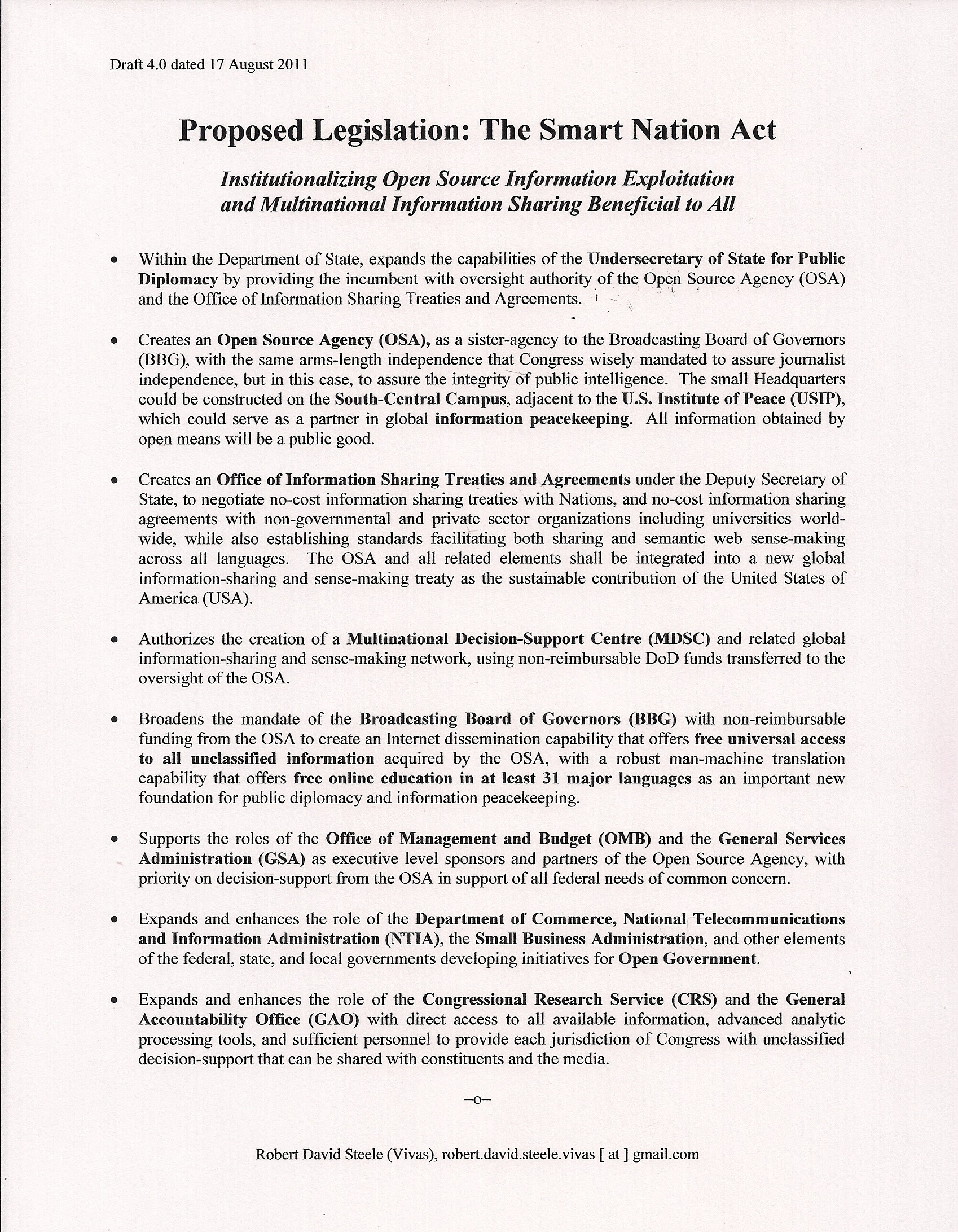
Reference: Smart Nation Act (Simplified) 2011

Advanced Cyber/IO, Analysis, Budgets & Funding, Collaboration Zones, Collective Intelligence, Communities of Practice, Congressional Research Service, Ethics, General Accountability Office, Hill Letters & Testimony, InfoOps (IO), Intelligence (government), Key Players, Legislation, Memoranda, Methods & Process, Mobile, Office of Management and Budget, Officers Call, Open Government, Policies, Policy, Politics of Science & Science of Politics, Real Time, Reform, Research resources, Resilience, Serious Games, Standards, Strategy, Technologies, Threats
Click on Image to Enlarge

Original Online (.doc 1 page)