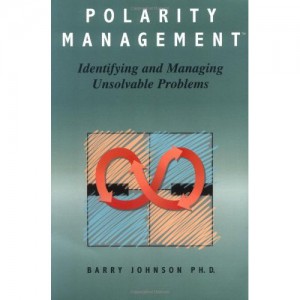
I bought this back in December 2011 when I was scrounging around for books on panarchy (see for instance, Panarchy: Understanding Transformations in Human and Natural Systems. It stayed in my pile as other books moved because my first impression was that it was more complicated than I cared to deal with and might – shudder — even include mathematical formulas. I was wrong.
This is a very straight forward book that I recommend as a read-ahead or work book for any group seeking to radically evolve their internal decision making processes away from the current standard of “I talk, you listen; I decide, you obey.” It has clear charts, the right amount of white space, and I put it down thinking very well of the book.
Panarchy is an evolution of the whole systems approach to anything, with the clarity and integrity of FEEDBACK LOOPS among the elements being the core of any successful system. If everyone does not talk; if everyone does not listen; if everyone does not decide; if everyone does not act in harmonization with all others, system failure is inevitable.
5.0 out of 5 stars Ably Researched and Presented Inspection of One Side of America — the Part Without a Soul,March 20, 201
First off, this is not a “sneering” book, this is a solidly researched and ably presented inspection of Ayn Rand, key people in the Ayn Rand “movement” of Objectivism, and on balance the author is both sympathetic and critical — it takes intelligence and integrity to carry this off, those that lack either or both of these qualities should not buy the book. For the rest of us, it is a small piece of the puzzle, a small but most cogent explanation of why the 1% really do look down on the rest of us, and have neither God nor guilt about greed. HOWEVER, I must emphasize that one of the author's findings is that it is not just the 1% that buy into this whole market laissez faire posture, but a good number of the “little people” who have no idea what a philosophy can or should be.
George Soros nailed it with his essay on “My Philanthropy” subsequently a major portion of the book, The Philanthropy of George Soros: Building Open Societies. Blasting what he calls “the Enlightenment fallacy” he points out that all men are not rational, not necessarily good to one another, and not at all equipped to address the public interest in isolation.
Having seen the negative reviews, I was very pleasantly surprised right off by the author's introduction of his own book. I read a great deal — in 98 categories best understood by accessing all my Amazon reviews via category at Phi Beta Iota the Public Intelligence Blog. I was immediately put at ease — serious author, serious approach to the topic, a good plan, and an undeniable commitment to the public interest.
I have to point out that one reason I was interested in this book was because Ayn Rand is reputed to be a favorite among Tea Partiers who want less or no government, and despite the long standing conflicts between Objectivists (code for anything goes, survival of the fittest, altruism is for wimps) and libertarians (themselves so focused on Liberty they cannot get a grip on the rest of the Preamble to the Constitution of the USA, i.e. little things like general welfare, domestic tranquility, and justice. Which is to day, both the Ayn Rand People and the Libertarians — Ron Paul, I am talking to you and still waiting for a courteous answer to my two letters in January — fail on three out of four Constitutional fundamentals. So does Barack Obama! What I have learned from all of my reading and observation is that the two-party tyranny is godless and amoral, all posturing aside. Ayn Rand fits right in.
The author has done his homework–more than his homework. With due credit to biographers of Ayn Rand (this book is not a biography, it is a tour of Ayn Rand Nation as the title says) he resurrects people who were “buried” or shunned, exiled, reviled, or with great fanfare “ignored” by Ayn Rand.
I learn things I did not know in this book — her opposition to World War II (“let the Germans and the Russians kill each other off”); her favoritism toward Israel (in sharp distinction to the Libertarian ire and refusal to bow to Israeli influence) — her prediction of the 2008-2012 (and soon the 2013-2014) huge financial crash. She nailed it. Government debt in any form that is cumulative and passed off to the future will eventually destroy the nation. The author points out that no one from the Ann Rand Institute realizes she said this, and they have consequently failed to promulgate this one bit of getting it right decades in advance.
Of course Michael Lewis said the same thing in Liar's Poker, and both John Bogle and William Greider have spoken to the issue in their respective books The Battle for the Soul of Capitalism and The Soul of Capitalism: Opening Paths to a Moral Economy, and while it may be that the author goes a bridge too far in laying all of our failures of character and culture at the feet of Ayn Rand, she does seem to fill a very large hole in people's heads and souls — empty spaces without her.
What really jumps out at me as I pass the midway mark is how unethical and ignorant top figures in the upper reaches of US finance are — Henry Paulson, Tim Geithner, Ben Pernanke, John Mack, the Wells Fargo guy, etcetera. They lack intelligence and they lack integrity and they survive on being part of the club, of being reliable to the few at the expense of the many. It makes me sick to contemplate the depravity of the collective US public mind, that it cannot see these people for the charlAtans and postuRers and cheats that they actually are.
It also merits observation that the 1% are so far removed from the Ayn Rand circles as to make her a peasant on a stump, spouting ideas into the ether and completely irrelevant to what some call “deep secrecy” and the manner in which a few banking families (including those in China and Indonesia and India) manage all. This is a side show, not the main event. The named individual in US finance–as greedy and treasonous as they might be, are bit players in a much larger drama.
Throughout the book Barack Obama and his Administration are present as the anti-thesis of Objectivism, and I remind myself over and over again that it is truly a shame that what we have right now in our government is a combination of irresponsible entitlement socialism and irresponsible economic and military fascism. Only in America. Hence, absent a deep understanding of the fact that CORRUPTION is the common ingredient for the two-party system that excludes all other nationally accredited parties from the ballot, and that legalizes crime as a matter of routine (Matt Taibbi is still the best on this, see my summary review of Griftopia: A Story of Bankers, Politicians, and the Most Audacious Power Grab in American History), it is safe to say that both Objectivism and the mix of socialism and fascism now represented by Barack Obama (as the puppet in chief) are identical: amoral, atheist, and absent any coherent strategic analytic model that can actually connect to reality or project future outcomes.
As someone who has spent the past decade reflecting on the urgency of demanding BOTH intelligence AND integrity from all eight tribes at all levels (academia, civil society, commerce, government, law enforcement, media, military, and non-governmental/non-profit) I am charmed by the author's skewering of Alan Greenspan, in a chapter centered on Greenspan, Greenspan's notions of integrity (not), and how much damage Greenspan did to the US with his ignorance and lack of integrity in the holistic sense. I myself fell prey to the Greenspan myth, and while I do not go back and rewrite my reviews, there are several back a few years that I now realize were written from a less than fully informed perspective. I continue to learn, and this book is one I strongly recommend — it is about Ayn Rand Nation, but in passing, it is about what the USA is or is not. For the complete opposite, see my summary of the phenomenal book by Kevin O'Keefe, The Average American: The Extraordinary Search for the Nation's Most Ordinary Citizen.
QUOTE (235): Greenspan could seek to escape reality, but his words and his actions could not be so neatly erased. The fact was that Rand had failed. Her ideas had collided with the real world, a world in which monomaniacal selfishness is not beneficial but harmful, in which businessmen are driven by the scent of money to ast recklessly, and in which capitalism requires government oversight lest capitalist excesses hurt the financial system and society as a whole.”
The author concludes along these lines, but here I believe he misses a very important point. I continue to rate the book five stars because there are too many negative reviews that have no foundation in fact. This is a worthy book for anyone with both intelligence and integrity. It's not about capitalism and it's not about government. It's about education. Since Carnegie and Rockefeller were allowed to standardize what John Gato calls Weapons of Mass Instruction: A Schoolteacher's Journey Through the Dark World of Compulsory Schooling the USA has become an idiot nation, beating the creativity out of kids, still offering today rote instruction that is a hundred years out of date. My youngest is about to “test” out of high school after the 10th grade and spend two years working and traveling–Fairfax County has a good reputation within the nation of inattentive idiots [I certainly include myself in that group], but between its neo-Nazi zero tolerance for youthful indiscretions and its inbred mediocrity of programming, I cannot in good conscience force my son to waste his next two years in the wasteland called “high school.” We lost sight of what it means to be a citizen — a responsible citizen with an obligation to apply their intelligence at all times with integrity, irrespective of which tribe they work for…. my long-term ambition remains to that of integrating education, intelligence, and research, creating a Smart Nation, in which all the bureaucracies are euthenized, and we allow our natural creativity and deeper instincts of community to come forward.
For a complete overview of books by others exploring both the negative and positive of our situation, search for these two lists or find them at Phi Beta Iota the Public Intelligence Blog under books; each review leads back to its Amazon page:
5.0 out of 5 stars Original Solution Not Chosen by Club of Rome, They Blew It,March 4, 2012
This is a seminal work going back in time, integrating reflexive practice, what is now known as third phase science and dialogic design science. A major contribution within this book is A. N. Christakis, “A Retrospective Structural Inquiry of the Predicament of Mankind, Prospectus of the Club of Rome.”
The short story: the Club of Rome chose the Meadows/Randers top-down micro-management solution now famous as the Limits to Growth model. They rejected the reflexive / third order science solution that recognized that all humanity must be engaged, all humanity must comprehend and agree on solutions, or the solutions would never be implementable nor sustainable.
Other vital books that close the circle on where a few of us continue to try to make progress:
My own book that I cannot link to but am allowed to mention, is THE OPEN SOURCE EVERYTHING MANIFESTO: Transparency, Truth & Trust. Find it here on Amazon. I believe Western “democracy” (largely a fraud) and Western capitalism (largely predatory and now gravely wounded by the legalized global financial fraud of Goldman Sachs, Morgan, Citi-Bank, and Bank of America, among others) are both going to implode in the near term (by 2014). Solutions are going to come from bottom up. All of these books are critical design-related texts for bottom-up holistic design, what Buckminster Fuller called “comprehensive architecture.” We need to future-proof our cities, one block at a time. This book is a fine starting point.
5.0 out of 5 stars Gift Book, Gift Idea, Gift Economy, Get a Grip,February 18, 2012
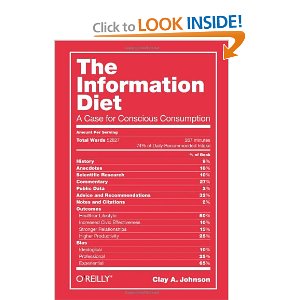
I received a copy of this book as a gift, and gladly so since the top review at this time is unfairly dismissive while also confessing that the reviewer only read the first third of the book (but evidently not the preface (first page) that states plainly (first sentence, actually), “The things we know about food have a lot to teach us about how to have a healthy relationship with information.”
Having just reviewed The Telescreen: An Empirical Study of the Destruction and Despiritualization of Consciousness, and so many other books here at Amazon, I easily connect the point in last night's reading: that food, medicine, education, and the media are all “co-conspirators” in dumbing down a human population whose brains started out as enormous pools of potential creativity, to this book. The information — and the food and the medicine and the tabloid garbage we are ingesting — is killing us.
What the first reviewer completely misses is that this is the first manifesto, beyond The Age of Missing Information, to actually focus on how out of control our relationship is to the world of information. As a lifetime professional in these matters I can state clearly that not only are governments substituting ideology for intelligence and corruption for integrity, but so are all the other communities of information (academia, civil society, commerce, government, law enforcement, media, military, and non-government / non-profit. We live in a totally corrupt world where — right now — banking families (Rothschild et al) own the banks and the banks own the two-party tyrannies (or the outright dictators) that own government, and they own the the corporations, with the 99% being expendable fodder for 1% theft from the commonwealth. This book is a cry from the heart, and an eloquent one at that.
5.0 out of 5 stars You need a brain to read this book; if you have one, the book will scare you,February 17, 2012
I have been keeping in touch with “alternative” sources for some time, ever since I realized in about 1988 that neither the US secret intelligence world nor the US media were at all reliable — they are each very good at what they choose to do, but that does not include the public interest.
I am hugely impressed by this author. He does detailed, meticulously documented research and the presentation is excellent. I especially like footnotes I can see while reading the body instead of endnotes.
5.0 out of 5 stars Alternative Perspective, Very Naive on US Reality, January 30, 2012
I *like* this book. I've been running for the Reform Party nomination for President (there were three of us, now there are two, and I might drop out soon if I get a federal job and the Hatch Act kicks in). I mention that mostly to emphasize that everything I have learned in the six weeks I've been registered with the Federal Elections Commission (FEC ID C00507756) is relevant to the second half of my review. This book came to my attention via a press clipping service that helps me follow any mention of a third party — this book calls for a new third party Of, By, and For Workers — we used to call that Communism (just kidding), but seriously, the last part of my review is a pitch for what workers should do if they really want to take charge, as workers finally did in Norway and Sweden (it took them 25 years).
I would normally rate this book at four stars, there is a lot missing, but I have to say that in terms of earnest honest patriotic down-to-earth common sense and indisputable pro-labor attitudes, this book is solid, so I am putting it at five stars and linking below to some books that add the missing “weight” to this read. My reviews of all of the books I list are summary in nature, to help those with little time or little money.
The book is scattered, providing snapshots of all of the issues, showing very clearly where neither party, but especially the Republicans, can be trusted to look out for workers. Politics is theater–nothing is decided in the open, the real deals are behind closed doors and the taxpayer ALWAYS loses. I certainly give the book high marks for distilling a very complicated corrupt mess into a simplified structure, and I totally agree with the author that there are no reliable statistics from the government or corporations, but let me give you three that matter:
5.0 out of 5 stars Baseline Reading, VERY Dense, A Long Study,January 29, 2012
I read this book in galley form and forgot to post a review after the pre-order period ended. This book was a direct inspiration to my own forthcoming book from the same publisher that I am evidently not allowed to link to here at Amazon, The Open Source Everything Manifesto:Transparency, Truth, and Trust.
From the author:
It [noosphere] is a whole-systems paradigm that melds prophecy and analysis of current world trends. It is a perception that the transformation of the biosphere is inevitably leading to a new geological epoch and evolutionary cycle, and it is due to the impact of human thought on the environment that this new era — the Noosphere — is dawning.
This is a capstone work that integrates all the author's past works, each linked here.