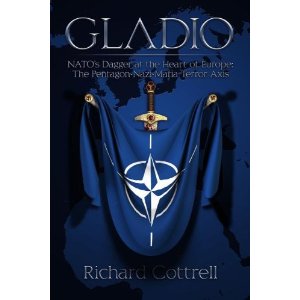
Review: Gladio, NATO’s Dagger at the Heart of Europe – The Pentagon-Nazi-Mafia Terror Axis

4 Star, Asymmetric, Cyber, Hacking, Odd War, Atrocities & Genocide, Crime (Government), Empire, Sorrows, Hubris, Blowback, Force Structure (Military), Impeachment & Treason, Intelligence (Government/Secret), Military & Pentagon Power, Misinformation & Propaganda, Power (Pathologies & Utilization), Secrecy & Politics of Secrecy, Terrorism & Jihad, Threats (Emerging & Perennial)
Amazon Page

Richard Cottrell

5.0 out of 5 stars Startling, Offers a Wealth of New Information, February 19, 2012

EDIT of 6 May 2012 to acknowledge fixed made by publisher for new edition after review, change title, and increase to five stars.

I was given this book as a gift. I do not normally seek-out conspiracy literature, but in the aftermath of 9/11 and all I have learned about that (search for < 9/11 books dvd source=phibetaiota >, I am now shifting from my long held view that given a choice between incompetence and conspiracy, one should go with incompetence every time. This book brings me closer to a 50-50 split, but I am still on the 70-30 side giving incompetence the edge.

The best thing I can say about this book is that while there are others addressing Gladio (the Italian secret unit), this may be the first book that really strings everything together, adds, connects, spreculates, in a more thorough way going beyond Italy to include the rest of Europe and to my surprise, Sweden, than the few prior books. This book is also the most current, to include the Libya take-down and to warn that Turkey is next. The book does not address Syria.

NATO's Secret Armies: Operation GLADIO and Terrorism in Western Europe (Contemporary Security Studies)
Secret Organisation Gladio. Western Union Official Clandestine Killer Organisation (1,2,3,4,5)
Puppetmasters: The Political Use of Terrorism in Italy

Perhaps the most substantive point in favor of the book's value is the detailed and documented manner in which it outlines how Italy spawned the most active secret campaign because it is the one place where the Catholic Church and the Mafia have their homes, and can come together with NATO, big business, the neo-Nazi extreme right, and the intelligence and security services whose budget inevitably benefit from false flag attacks in the absence of real threats.

As much as the book troubles me with detailed documented examples of a long series of false flag attacks including assassination of leaders in Sweden and elsewhere (and at one time targeting Charles DeGaul), I am inclined to think that the author makes an unwarranted assumption that the “legitimate” stay-behind networks created after World War II morphed into a “killer / false flag” network over time everywhere. While this is absolutely proven beyond a doubt for Italy, it is not proven for the rest of Europe.

Because the author relied on second-hand quotes and did not read the original, this book has a poor misrepresentation of the findings of my friend Cees Wiebes' book, Intelligence and the War in Bosnia: 1992-1995 (Studies in Intelligence History). The focus of Cee's book was on the inadequacy of convention intelligence services with respect to peacekeeping intelligence; and that the rest of the mess was a mix of sheer incompetence within the UN, big power politics, and bureaucratic in-fighting in Washington, D.C. That sounds righter to me and is consistent with my own review of the English-language version that I link to here.

I am constantly astonished as I read this book, finding nuggets of documented information that I had no idea were out there. I think frequently while reading this book that it would be truly wonderful to have the ability to ingest this and many other books like it into a professional intelligence evaluation facility, create the maps that connects the dots — people, places, organizations, dates, and such — and get to the bottom of so many crimes against humanity that have been carried out by order of Western powers — certainly co-equal to the crimes against humanity from the “lesser” powers in Rwanda and Burundi.

The assassination of John F. Kennedy is of special interest to me, see my summary reviews of Someone Would Have Talked, JFK and the Unspeakable: Why He Died and Why It Matters, and A Farewell to Justice: Jim Garrison, JFK's Assassination, and the Case That Should Have Changed History. This book and this author opens my eyes to the role of the former Chairman of the Joint Chiefs of Staff, General Lyman Lemnitzer, fired by Kennedy and sent to NATO where he evidently spun a very wide weave.

The author provides details on the Russians using a PSYOP at the end of WWII, creating the myth of the Hitler redoubt, with the specific intent of distracting General Eisenhower and gaining time to take Berlin — their plan worked.

I read with amusement the author's assessment of the National War College as the place where we park right-wing nutcases/neocons, and knowing some of them myself, cannot disagree–that is however a disservice to the 90% of NDU that is solidly in the middle.

The author is provocative as he weaves his documented tale about the degree to which all left of center groups were penetrated in the aftermath of WWII, and I see how easily the intelligence and security services might have found it to manipulate groups into doing violence — or into taking the blame for false flag violence. On the basis of this book as well as others, I speculate that at least half the “threat” against which the USA has devoted considerable time, treasure, and trust, has been FALSE — self-made.

The death of most significant Swedes standing up for Palestine gets my attention.

The “coincidence” of police training exercises in both London and Madrid, each closely associated with the actual train bombing that takes place in and around the exercise area, is profoundly disturbing — we now know that Dick Cheney scheduled the counter-terrorism exercise MONTHS before “the day,” and as I write this, I marvel at the ignorance of the public and the perhaps justified arrogance of those who create false terror to advance their own selfish ends.

I learn that Steve Pieczenik, a former deputy assistant secretary of state, was a Carter trouble-shooter, and I find this fascinating because the same Dr. Pieczenik came on record to call the CIA-JSOG raid to kill Bin Laden a false operation (Bin Laden having died a decade ago, a patsy was killed instead) and to say that there is new evidence against Dick Cheney in relation to 9/11.

I put the book down a bit frustrated — it is hard to make sense of so much detail, it really needs to be visualized with timelines and so on. However, this is a world-class book in terms of documentation, and setting aside the hyperbole, assumptions, and many small mistakes, I certainly recommend it.

We are all beginning to learn that governments lie to their publics as a matter of routine; that banks and corporations lie, cheat, and steal more more than the Mafia; and that the Catholic Church may be the world's primary money-laundering network. It is in the context of a public slowly awakening to reality that I recommend this book as an excellent place to begin exploring and raise it to five stars.

I am limited to ten links. Here are two more, to browse my other 1,700 plus reviews visit Phi Beta Iota the Public Intelligence Blog, where all reviews link back to their book's Amazon page.

The Sorrows of Empire: Militarism, Secrecy, and the End of the Republic (The American Empire Project)
Shooting the Truth: The Rise of American Political Documentaries


Vote and/or Comment on Review

Review (Guest): World in Crisis – The End of the American Century

5 Star, America (Founders, Current Situation), Complexity & Catastrophe, Congress (Failure, Reform), Corruption, Country/Regional, Crime (Government), Culture, Research, Empire, Sorrows, Hubris, Blowback, Executive (Partisan Failure, Reform), Impeachment & Treason, Insurgency & Revolution, Intelligence (Public), Justice (Failure, Reform), Military & Pentagon Power, Misinformation & Propaganda, Politics, Power (Pathologies & Utilization), Threats (Emerging & Perennial), True Cost & Toxicity, Values, Ethics, Sustainable Evolution, Voices Lost (Indigenous, Gender, Poor, Marginalized), War & Face of Battle
Amazon Page

Gabriel Kolko

5.0 out of 5 stars Simplify, Simplify, Simplify,June 22, 2009<

By Tracy McLellan (Chicago) – See all my reviews

One could almost condense the whole of Kolko thought into a single sentence: “Political problems have political and social, not military solution.” He says this at least four or five times in the current volume, as he has even more often previously. A common criticism of Kolko is that he's repetitive. This doesn't speak to the fact that the deafening silence with which his work is greeted is a far harsher, and equally invalid, criticism. Kolko's alleged repetitiveness is more grasp of nuance and comprehensiveness than it is lack of imagination.

World in Crisis: the End of the American Century is an implicit rejoinder to what Kolko himself calls the lunatics in the Bush regime. It is the typically unique type of excellence in political observation I, at any rate, expect of Kolko. The essays in the current volume are a second, yet enduring draft of history reviewing the political turmoil of the last four or five years. They examine the financial crisis, US foreign policy, Israel, the current and historical US alliance system, US intelligence agencies, and other US policies. The essays have appeared previously on ZNet, […], Counterpunch, in anthologies, and elsewhere. All of them are updated for this book, because, as Kolko notes, they become obsolete almost as soon as they are published due to the accelerated trajectory of geopolitical, technological, financial, and sociological events.

Continue reading “Review (Guest): World in Crisis – The End of the American Century”

David Swanson: War and Being and Nothingness

5 Star, Atrocities & Genocide, Complexity & Catastrophe, Congress (Failure, Reform), Corruption, Crime (Corporate), Crime (Government), Culture, Research, Economics, Education (General), Empire, Sorrows, Hubris, Blowback, Executive (Partisan Failure, Reform), Force Structure (Military), Future, Impeachment & Treason, Intelligence (Public), Military & Pentagon Power, Misinformation & Propaganda, Peace, Poverty, & Middle Class, Philosophy, Politics, Power (Pathologies & Utilization), Priorities, Public Administration, Strategy, Survival & Sustainment, Threats (Emerging & Perennial), True Cost & Toxicity, Truth & Reconciliation, Values, Ethics, Sustainable Evolution, Voices Lost (Indigenous, Gender, Poor, Marginalized), War & Face of Battle
David Swanson

War and Being and Nothingness

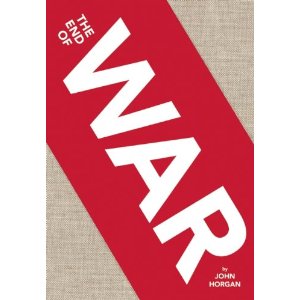
The best book I've read in a very long time is a new one: The End of War by John Horgan. Its conclusions will be vigorously resisted by many and yet, in a certain light, considered perfectly obvious to some others. The central conclusion — that ending the institution of war is entirely up to us to choose — was, arguably, reached by (among many others before and since) John Paul Sartre sitting in a café utilizing exactly no research.

Horgan is a writer for “Scientific American,” and approaches the question of whether war can be ended as a scientist. It's all about research. He concludes that war can be ended, has in various times and places been ended, and is in the process (an entirely reversible process) of being ended on the earth right now.

Amazon Page

The war abolitionists of the 1920s Outlawry movement would have loved this book, would have seen it as a proper extension of the ongoing campaign to rid the world of war. But it is a different book from theirs. It does not preach the immorality of war. That idea, although proved truer than ever by the two world wars, failed to prevent the two world wars. When an idea's time has come and also gone, it becomes necessary to prove to people that the idea wasn't rendered impossible or naïve by “human nature” or grand forces of history or any other specter. Horgan, in exactly the approach required, preaches the scientific observation of the success (albeit incomplete as yet) of preaching the immorality of war.

Continue reading “David Swanson: War and Being and Nothingness”

Review: The Military Industrial Compex at 50

5 Star, America (Founders, Current Situation), Budget Process & Politics, Capitalism (Good & Bad), Congress (Failure, Reform), Corruption, Crime (Corporate), Crime (Government), Culture, Research, Democracy, Economics, Education (General), Empire, Sorrows, Hubris, Blowback, Environment (Problems), Executive (Partisan Failure, Reform), Force Structure (Military), History, Impeachment & Treason, Intelligence (Public), Peace, Poverty, & Middle Class, Politics, Power (Pathologies & Utilization), Priorities, Public Administration, Science & Politics of Science, Secrecy & Politics of Secrecy, Strategy, Survival & Sustainment, Threats (Emerging & Perennial), True Cost & Toxicity, Values, Ethics, Sustainable Evolution, Voices Lost (Indigenous, Gender, Poor, Marginalized), War & Face of Battle, Water, Energy, Oil, Scarcity
Amazon Page

5.0 out of 5 stars America Desperately Needs More Illumination Such as This January 16, 2012

I received a review copy of this book [note to publishers: always ask first] and was glad to be offered a chance to read something as important as this. America desperately needs more illumination on the corruption in our government, and the evil done in our name without our permission but very much at our expense.

As a career veteran of the national security community–the Marine Corps and the Central Intelligence Agency–followed by seventeen years teaching 90 governments — 66 directly — how to get a grip on Open Source Intelligence (OSINT) that provides 95% of what we need to know at 2% or less of the cost of what we spend now on secret intelligence–I am well-qualified to read this book from a patriot's point of view.

A strong national defense capability does NOT exist in the USA today. Posturing fools such as Senator Rick Santorum have no idea what they are talking about when they seek to discredit those of us who do. The infantry, four percent of the force, takes eighty percent of the casualties and receives ONE PERCENT of the Pentagon budget. Within the other 99%, half–at least–is fraud, waste, and abuse that makes America weaker, not stronger.

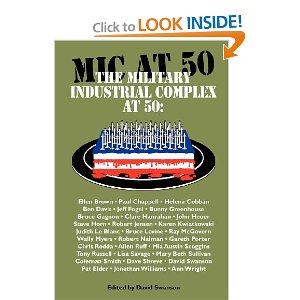
This book, edited by David Swanson, is a very good deal at $25. Its 368 pages include chapters from thirty other authors besides the editor, and include contributions from Ray McGovern and Karen Kwiatkowski, whose work I have admired in the past. If there were one flaw in the book, but not so serious as to lose a star, it would be its isolation from the pioneering work done by Pierre Sprey, Chuck Spinney, and Winslow Wheeler, with a genuflection toward John Boyd, the real pioneer of smart sufficient national security.

What is uniquely valuable about this book, something I have not seen elsewhere, is its provision of a holistic examination not just of the military-industrial process and fraudulent, wasteful, abusive bad design, bad performance, and bad cost, but of the costs that the military-industrial complex imposes on all of us and our economy and our society. This is a world-class book that should be translated into other languages to help others avoid our long-running mistakes.

Here are the blinding flashes of solid insight that stayed with me and merit the broadest possible public understanding:

Continue reading “Review: The Military Industrial Compex at 50”

Paul Craig Roberts: Three Stimulating Books

5 Star, Culture, Research, Democracy, Empire, Sorrows, Hubris, Blowback
Paul Craig Roberts

Three Books to Stimulate Thought

12 January 2012

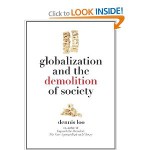
January 11 was the tenth anniversary of amerika’s Guantanamo torture prison. National Public Radio commemorated the anniversary by airing critics and defenders of Washington’s violation of US statutory law, the Geneva Conventions, and the US Constitution. Listening to the former government officials justify their crimes, I realized that I was listening to those who had set the table and served the agenda that transformed the US into a criminal police state. Here was confirmation of Professor Dennis Loo’s theory of democracy in which an elite decides the agenda and the subservient media prepares the electorate’s receptivity.

Amazon Page

In his new book, Globalization and the Demolition of Society (2011) Professor Loo suggests that democracy without an independent and aggressive media becomes a disguised form of dictatorship. People think that by voting they are determining outcomes when in fact they are merely legitimizing agendas decided by the elite.

Amazon Page

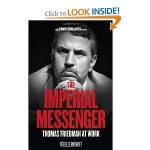
In The Imperial Messenger: Thomas Friedman at Work (Counterblasts) Belen Fernandez reveals New York Times columnist Thomas Friedman as a handmaiden of the elite. In exchange for preparing the electorate to be receptive to elite-determined agendas, such as globalism, the invasion of Iraq and the war on terror, Friedman was given a third Pulitzer prize, reducing this once meaningful award to the current status of the Nobel peace prize, and provided with cushy speaking fees.

Fernandez subjects Friedman to careful scrutiny and assigns him failing grades for logic, consistency, and integrity. After reading Fernandez dissect Friedman column by column, the unavoidable question is: How did Friedman ever pass himself off as a journalist? Why isn’t Belen Fernandez the New York Times’ lead columnist? The answer is clear. Fernandez won’t lie for the establishment.

Amazon Page

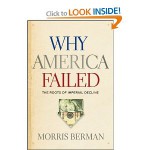
In Why America Failed: The Roots of Imperial Decline (2012), Morris Berman blames America’s failure on the North’s hustler culture. He contrasts the dysfunctional elements of this hustler culture with the culture of the South, which was not focused on material progress and endless acquisition. It was a clash of civilizations. The Southerners enjoyed life itself and were content with being. The North, motivated by progress, saw people as cogs in a plan for empire.

Berman provides a different perspective on the War of Northern Aggression and on ourselves today as products of the triumph of a hustler culture.

These three books are packed with stimulating thoughts. They help us to see how ubiquitous brainwashing can be.

Review: Britain’s Empire – Resistance, Repression and Revolt

5 Star, Asymmetric, Cyber, Hacking, Odd War, Capitalism (Good & Bad), Civil Society, Consciousness & Social IQ, Corruption, Country/Regional, Culture, Research, Empire, Sorrows, Hubris, Blowback, Environment (Problems), History, Insurgency & Revolution, Justice (Failure, Reform), Military & Pentagon Power, Misinformation & Propaganda, Nature, Diet, Memetics, Design, Peace, Poverty, & Middle Class, Politics, Power (Pathologies & Utilization), Religion & Politics of Religion, Secrecy & Politics of Secrecy, Security (Including Immigration), Strategy, Terrorism & Jihad, Threats (Emerging & Perennial), True Cost & Toxicity, Values, Ethics, Sustainable Evolution, Voices Lost (Indigenous, Gender, Poor, Marginalized), War & Face of Battle, Water, Energy, Oil, Scarcity
Amazon Page

Richard Gott

5.0 out of 5 stars Preliminary Review: Understanding the Trade-Offs & True Cost of Empire,December 8, 2011

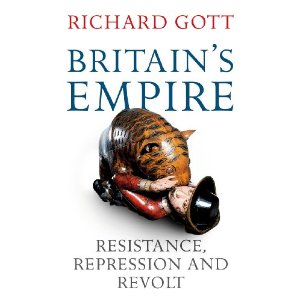
I have ordered this book and am very much looking forward to providing readers (and myself, this is how I keep notes) with one of my more detailed reviews. The publisher is to be scolded for not using Inside the Book, one of Amazon's best features, and for failing to provide the best possible use of the Book Description and Editorial Reviews section. While the existing review is good and I have voted for it, it does not do this book justice. My decision to buy was based on the easily found review in The Guardian (UK) by Richard Drayton, “Britain's Empire: Resistance, Repression, and Revolt by Richard Gott — review,” published 7 December 2011.

Where I am going to go with my review is toward an in-depth articulation of what has never been done before that I know of, an examination of the trade-offs of Empire and the opportunity costs of Epoch A hierarchical “rule by secrecy.” I have reviewed many books on Empire, Class War, Elite Rule, all easily found in master list online, Worth a Look: Book Review Lists (Negative). I also recommend the observe, Worth a Look: Book Review Lists (Positive).

Russell Ackoff would say that Empire represents centuries of doing the wrong thing righter–and at greater expense across the political-legal, socio-economic, ideo-cultural, techno-demographic, and natural-geographic domains. As we approach the Mayan calendar's start date for Epoch B, 12 December 2012, many of us are conscious that we must abandon old ways and rethink how we organize society. Occupy is a sympton of this – organized people against organized money, organized consciousness against organized violence.

Continue reading “Review: Britain's Empire – Resistance, Repression and Revolt”

Review: The Decline of American Power – The US in a Chaotic World

2 Star, America (Founders, Current Situation), Atlases & State of the World, Complexity & Catastrophe, Congress (Failure, Reform), Corruption, Country/Regional, Crime (Corporate), Crime (Government), Culture, Research, Diplomacy, Economics, Empire, Sorrows, Hubris, Blowback, Executive (Partisan Failure, Reform), Insurgency & Revolution, Military & Pentagon Power, Misinformation & Propaganda, Nature, Diet, Memetics, Design, Peace, Poverty, & Middle Class, Politics, Power (Pathologies & Utilization), Priorities, Public Administration, Threats (Emerging & Perennial), True Cost & Toxicity, Values, Ethics, Sustainable Evolution, Voices Lost (Indigenous, Gender, Poor, Marginalized), War & Face of Battle, Water, Energy, Oil, Scarcity
Amazon Page

Immanuel Wallerstein

2.0 out of 5 stars Price for 160 Pages Beneath Contempt,November 16, 2011

I am angry–I really wanted to buy and read this book, but a price of $50 for 160 pages is beneath contempt. The author is being abused by the publisher and I urge the author to consider a new publisher for the paperback, or demanding that the paperback be published immediately. Barnes and Noble has been shut down by Amazon — all other publishers appear in intent on staving off their ultimate demise in the face of on demand publishing by gouging the public.

This book in hardcopy should not be sold for more than $25, and in paperback for $16. Please join me in boycotting this publisher, as someone who cares deeply about the dissemination of important knowledge — which the author clearly offers — I find this pricing an utter outrage.

Here are some reasonably priced books that I offer as a substitute–my “top ten” if you will.
Continue reading “Review: The Decline of American Power – The US in a Chaotic World”