Nathan A. Allen Six Star Pre-History Ignored Until Now, July 17, 2011
This is a BARN-BURNER of a book! This book is a PhD dissertation that is being published quickly to aid the cause of liberty in 2012. The academic detail would normally make it a four-star read, but the relevance, the originality, and the appendices-both within the book as it will be published, and online-carry it to six stars. Depending on one's interest, this can be a quick read to confirm that we need a second American revolution-or a slow read to savor the loneliness, the persistence, the integrity of one man called a lunatic and a traitor for one reason only: he was twenty years ahead of his time. It is on the shoulders of James Otis that the Founding Father stood, and this author, Nathan Allen, has performed brilliantly in identifying a slice of American history here-to-fore overlooked, and in deeply investigating and then publicizing what can only be appreciated as both one man's cross to bear, and one nation's long lead-time in the gestation of liberty.
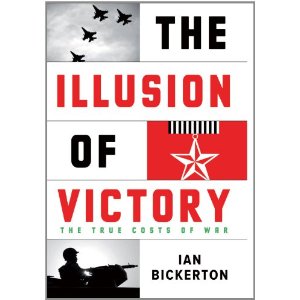
Although I loved Bickerton's excellent book, I did find it a demanding read; chapters one, two and three is not material that a general reader like myself often encounters in the contemporary media: the Russo-Japanese War of 1904–1905 is not a conflict that is considered in accounts of the reasons for contemporary conflicts but the more so that it need be. Far too often the entrails of conflict are not considered and much modern commentary about conflict virtually implies that the event had few if any antecedents implying that it just happened spontaneously. I believe that Illusion of Victory puts that idea away and that seems not to be the author's thesis.
5.0 out of 5 stars The doomslayer falls,April 4, 1998
By A Customer
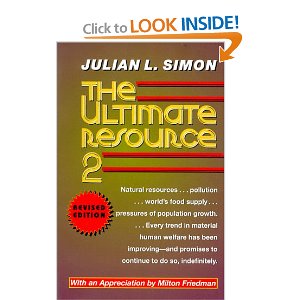
On Sunday, February 8th, psychologist and economist Julian L. Simon succumbed to a heart attack in Maryland. It is difficult to overstate the damage his death will cause the world debate on overpopulation, natural resources, and the environment. Dr. Simon's prolific and energetic mind gave rise to fourteen books and countless papers and lectures, dedicated to overthrowing the dogma that underlies so much of today's environmental discourse.
Simon, still considered a maverick after thirty years of relentless data-gathering, impeccable empirical work, and well-thought out conclusions, questioned the unquestionable. He maintained that the earth is in good shape by every conceivable measure, and that the environmental situation continues to improve each year. Every index of human happiness – food prices, net income, infant mortality, life expectancy, disease rates – has steadily improved. He documented those claims with reams of data, culminating in his 1996 tour de force The State of Humanity. It is absolutely comprehensive, and contains enough obscure data to make the most jaded Trivial Pursuit fan squirm (if you ever want to read about the average lower-class Brazilian's annual starch intake, look no further).
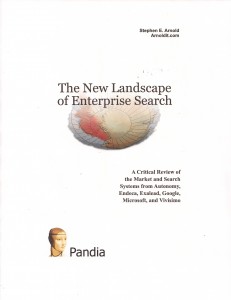
Stephen E. Arnold: The New Landscape of Enterprise Search. A Critical Review of the Market and Search Systems. Published by Pandia, Oslo, Norway, 2011.
ISBN: 978-82-998676-0-3
Phi Beta Iota: For over fifteen years Stephen E. Arnold has been the “virtual CTO” for OSS.Net (ceased operations at end of 2010) and Earth Intelligence Network, of which he is a founding partner. We have reviewed the 154-page document, and as with all publications by Stephen E. Arnold, author of the still-trenchant Google Trilogy, have found it to be deeply helpful including sharp but polite eviseration of both Google and Microsoft (Microsoft comes out ahead of Google, but has its own sucking chest wounds). What is clear to us is that none of the major vendors are serious about the necessary migration to open source software that integrates information sharing, multi-media analytics, cross-disciplinary directories, and deep web applications, for example, integrating c drives and emails across all poverty stakeholders. The big new trend in this book–and in our own research–is the compelling nature of five minute videos as documents of lasting value. We are seeing this in open education and non-government decision-support. Combine that with on demand translation and the way is open for someone to create the M4IS2 system of the future. We doubt it will be Google, and we are certain it will include OpenBTS for the three billion poor, the center of gravity for future knowledge.
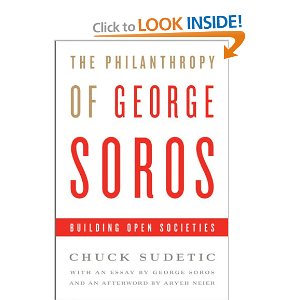
This is a pioneering work, easily a decade ahead of other world-class efforts, my favorite being that of (then) World Bank Vice President for Europe, J. F. Rischard, High Noon 20 Global Problems, 20 Years to Solve Them. It has been largely over-looked, but should gain additional importance, along with the author's additional book, Critical Choices. The United Nations, Networks, and the Future of Global Governance, now that George Soros is sponsoring the Central European University (CEU), and within that university, the author Wolfgang Reinicke has been appointed the inaugural dean of CEU's School of Public Policy and International Affairs. In the context of the essay by George Soros, the first 57 pages of The Philanthropy of George Soros: Building Open Societies, and the now hardened disenchantment with the nation-state system for being ignorant, biased, and non-agile (these and other deficiencies are marvelously articulated by Professor Philip Allot of Cambridge in The Health of Nations: Society and Law beyond the State, one can surmise that Dean Peinicke will seek to focus on integrationist endeavors that demand transparency and accountability for multiple stakeholders in return for stability and mutual gain.
6 Star Special–Soros Out-Grows Broken System, June 24, 2011
On its own merits, without the Foreword from George Soros, this book is a solid five. With the most extraordinary Foreword, a Foreword that draws the lines of battle between a totally dysfunctional global governance and financial system of systems all lacking in integrity–where truth is not to be found–and the need for transparency, truth, and trust, the book goes into my top 10%, 6 stars and beyond.
The essay is a *major* part of the book, the first 57 pages out of just over 335. The essay is available free online and is a “must read” item for any person who wishes to be part of restoring the Republic and laying the foundation for creating a prosperous world at peace. Searching for <George Soros My Philanthropy> will lead directly to both the New York Review of Books and the GeorgeSoros.com offerings–select the latter to get the full article without subscription nonsense from the New York Review of Books.
I confess to having lost faith in George Soros–he fell for the Barack Obama Show and wasted a lot of time and money on what ends up being the Goldman Sachs Show–to the point that Goldman Sachs not only continues to own the Secretary of the Treasury, but now has installed its own man in the role of National Security Advisor. The irony does not amuse me.
This essay is phenomenal, and bears on the book at large, because Soros has finally put his finger of the sucking chest wound that I, John Bogle, William Grieder, and most recently Matt Taibbi have been sounding the alarm on: the lack of intelligence and integrity in the system of systems. Soros is halfway there; he is now outside the system looking in, and that is good news for all of us.
“I am looking for novel solutions in order to make an untidy structure manageable.”
“This book is a product of applying systems thinking to the management and organization of enterprises”. Russel L. Ackoff writes, “therefore, an understanding of the nature of systems and systems thinking is essential for understanding what this book is about. Although most people can identify many different systems, few know precisely what a system is. Without such knowledge, one cannot understand them, and without such an understanding, one cannot be aware of their implications for their management and organization and for treatment of the most important problems that currently face them” (p.5).
Thus, he firstly argues that a system is a whole consisting of two or more parts that satisfies the following five conditions:
(1). The whole has one or more defining properties or functions.
(2). Each part in the set can affect the behavior or properties of the whole.
(3). There is a subset of parts that is sufficient in one or more environments for carrying out the defining function of the whole; each of these parts is necessary but insufficient for carrying out this defining function.
(4). The way that each essential part of a system affects its behavior or properties depends on (the behavior or properties of) at least one other essential part of the system.
(5). The effect of any subset of essential parts on the system as a whole depends on the behavior of at least one other such subset.


 Six Star Pre-History Ignored Until Now, July 17, 2011