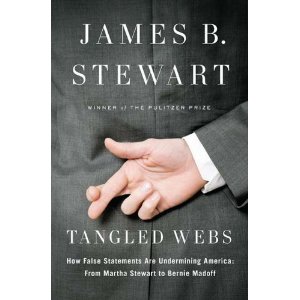
Bestselling author James B. Stewart's newsbreaking investigation of our era's most high-profile perjurers, revealing the alarming extent of this national epidemic.
Our system of justice rests on a simple proposition: that witnesses will raise their hands and tell the truth. In Tangled Webs, James B. Stewart reveals in vivid detail the consequences of the perjury epidemic that has swept our country, undermining the very foundation of our courts.
With many prosecutors, investigators, and participants speaking for the first time, Tangled Webs goes behind the scene of the trials of media and homemaking entrepreneur Martha Stewart; top White House political adviser Lewis “Scooter” Libby; home-run king Barry Bonds; and Wall Street money manager Bernard Madoff.
Guest Review
5.0 out of 5 stars A first-rate story teller takes on the lying addiction of the rich and famous, April 19, 2011 By F. Hayes-Roth (Monterey, CA USA) – See all my reviews (REAL NAME)
Lying seems epidemic in American society. Stewart focuses his superb writing skills on the general problem of perjury and lying under oath by highlighting the cases of four celebrated liars: Martha Stewart (no apparent relation to the author), Scooter Libby, Barry Bonds, and Bernie Madoff. For each of these, he asks the same question: “Why would people with so much to lose put so much at risk by lying under oath?” Ultimately, the answer becomes obvious: “They thought they could get away with it.”
The recent emergence of the first, large-scale Facebook movement among Afghan university students calling for reform can't help but raise the question — will the wave of antigovernment dissent in the Middle East reach Afghanistan?
Since March, some 1,500 university students in Kabul, and another 3,000 elsewhere around the country, have “friended” the Facebook page “Reformists.” There, they meet daily for discussions about how to exert grassroots pressure on the government — pressure that barely exists in Afghanistan today.
In some ways, the movement is very much like similar Facebook groups in the Arab world.
After the success of his initial works (The Spectrum of Consciousness and No Boundary), Ken Wilber gave his “spectrum” model a serious reappraisal and found it woefully lacking. It seemed that he had made a mistake that he goes on to chide others for in his later books- he confused prerational myths with transcendental truths, and confused the spiritual fall with the scientific fall. He makes up for his previous errors with “Up From Eden: A Transpersonal View of Human Evolution”.
“Ken Wilber is one of the most important pioneers in the field of consciousness in this century.”—Deepak Chopra
“The most sensible, comprehensive book on consciousness since William James.”—Dr. James Fadiman, President, Association for Transpersonal Psychology
“No Boundary does for this generation what Alan Watts' writings did for an earlier one. It brings the most difficult subject of all—nature of consciousness—into an easily grasped presentation that is both elegant and simple.”—John White, editor of Kundalini, Evolution, and Enlightenment Continue reading “Review (Guest): No Boundary–Eastern and Western Approaches to Personal Growth”
Humans have an innate need for status and for novelty in their lives. Unfortunately, the modern world has adopted very energy- and resource-intensive ways of meeting those needs. Other ways are going to have to be found as part of the move to a more sustainable world.
Phi Beta Iota: Buckminster Fuller understood the centrality of time/energy, but he did not grasp the psychological roots of collective self-destruction. This is an extraordinary article in every possible way. Strategic Analytics & Smart Nations are a solution.
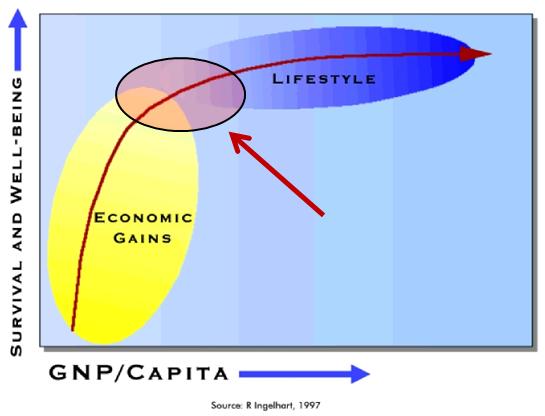
Meeting in the middle? The arrowed circle on this Inglehart Curve represents the highest level of well-being/survival consistent with a low level of resource use. It is therefore a target at which a society should aim. (Source: N. Hagens and R. Inglehart 1997)